Solensia Side Effects in Cats: What’s Normal vs Call the Vet
 The Pets Passion Medical Team
Direct answer: Solensia (frunevetmab) is a Zoetis monthly anti-NGF monoclonal antibody for control of osteoarthritis pain in cats. Per the FDA DailyMed label, the most common field-study adverse reactions included vomiting (13.2%) and injection-site pain (10.9%), with a recognizable skin cluster (dermatitis, alopecia, pruritus, head/neck scabbing). Many listed rates were close to vehicle controls; that does not mean you ignore new sores or sudden collapse. Contact your veterinarian for hypersensitivity signs, severe self-trauma, marked lethargy/anorexia, or any change that worries you—do not change dosing yourself.
YMYL / medical disclaimer: This article from The Pets Passion is educational. It summarizes publicly available FDA DailyMed prescribing information for Solensia (frunevetmab injection), the FOI summary for NADA 141-546, Zoetis owner materials, and veterinary hospital educational pages such as VCA’s frunevetmab monograph. It is not medical advice, a recall notice, or a recommendation to start or stop treatment. Only your veterinarian can weigh osteoarthritis pain control against risks for your cat. Report suspected adverse events to Zoetis (1-888-963-8471) and/or FDA (1-888-FDA-VETS / reportanimalae).
Quick answer — Solensia side effects
| Source | What it tells owners |
|---|---|
| US field study (DailyMed Table 2, 112 days) | Vomiting 13.2%, injection-site pain 10.9%, diarrhea / abnormal behavior / renal insufficiency / anorexia each 6.6%; dermatitis 6.0%; alopecia 5.5%; pruritus 3.8%; head/neck scabbing 3.3% (Solensia n=182 vs control n=93). |
| Label warnings / precautions | Skin scabbing–dermatitis–pruritus association; hypersensitivity possible with mAbs; NSAID combo safety not established; not for breeding/pregnant/lactating; not evaluated under 7 months or under 5.5 lb. |
| How to use this | Watch appetite, litter habits, energy, and face/ears/neck skin after each injection; film odd gait or itch; call the clinic for stop-triggers below. |
Track comfort on treatment months with the Cat Quality of Life tool and facial-pain context via the Cat Grimace Scale guide. Dog owners comparing species: see our Librela side effects article—same anti-NGF idea, different label and AE pattern.
What is Solensia?
Solensia (frunevetmab injection) is a felinized anti–nerve growth factor (NGF) monoclonal antibody given subcutaneously about once a month for control of pain associated with osteoarthritis in cats. FDA approved it under NADA 141-546 (label materials and FOI summary). It is prescription-only. It is not an NSAID and not a steroid. That is why many clinics reach for it when NSAIDs are poorly tolerated in cats or when a monthly clinic injection fits the household better than daily pills.
Label basics owners should hear before the first poke:
- Target minimum dose about 1 mg/kg by weight band (clinic uses 1 or 2 single-use 7 mg/mL vials)
- Weight chart on label: roughly 5.5–15.4 lb → 1 vial; 15.5–30.8 lb → 2 vials
- Steady-state exposure discussed after about two monthly doses in label PK/effectiveness narrative
- Not for breeding, pregnant, or lactating cats
- Safe use with concurrent NSAIDs has not been established in cats
- Not evaluated in cats younger than 7 months or under 5.5 lb
- Long-term effects beyond studied windows (including more than 6 months after use) have not been fully evaluated on the label
- Refrigerated product (clinic storage); single-use vials—no preservative
Do not extrapolate Librela (dog bedinvetmab) dosing or AE lists to Solensia. Same drug class idea; different species, different label.
Is Solensia safe for cats?
“Safe” in regulatory language means the benefit–risk package supported approval for the labeled indication—not “side-effect free.” In the pivotal 112-day masked field study summarized on DailyMed, most tabulated events were mild-to-moderate style findings familiar in senior OA cats (GI upset, injection flinch, skin notes). Control arms often had similar rates for vomiting and diarrhea, which is why clinicians read tables, not social-media certainty.
Zoetis owner materials state Solensia was shown to be well tolerated in a clinical study, with vomiting and injection-site pain as the most common AEs, and note the association with head/neck scabbing, dermatitis, and pruritus. VCA’s educational page lists similar trial-noted effects and flags hypersensitivity (facial swelling, hives, breathing difficulty, collapse) as reasons to stop and call immediately.
Balanced takeaway: many cats receive monthly Solensia without serious problems, osteoarthritis pain is also a welfare issue, and individual monitoring still matters—especially skin self-trauma and any acute allergic-type reaction.
What side effects did Solensia clinical studies report?
The DailyMed label summarizes a masked, controlled 112-day field study: 182 Solensia-treated cats and 93 vehicle-control cats (ages about 1.6–22.4 years; weights about 2.5–11.4 kg), dosed every 28 days for up to three injections. If a cat had the same event more than once, only the first occurrence was counted in the table.
| Adverse reaction | Solensia n=182 | Vehicle control n=93 |
|---|---|---|
| Vomiting | 24 (13.2%) | 10 (10.8%) |
| Injection-site pain | 20 (10.9%) | 13 (14%) |
| Diarrhea | 12 (6.6%) | 5 (5.4%) |
| Abnormal behavior / behavioral disorders | 12 (6.6%) | 5 (5.4%) |
| Renal insufficiency (worsening of existing disease) | 12 (6.6%) | 4 (4.3%) |
| Anorexia | 12 (6.6%) | 4 (4.3%) |
| Lethargy | 11 (6.0%) | 3 (3.2%) |
| Dermatitis | 11 (6.0%) | 1 (1.1%) |
| Alopecia | 10 (5.5%) | 2 (2.2%) |
| Dehydration | 8 (4.4%) | 0 (0.0%) |
| Lameness (new or worsening) | 8 (4.4%) | 2 (2.2%) |
| Pruritus | 7 (3.8%) | 0 (0.0%) |
| Weight loss | 6 (3.3%) | 5 (5.4%) |
| Scabbing on head/neck | 6 (3.3%) | 1 (1.1%) |
| Gingival disorder | 5 (2.7%) | 0 (0.0%) |
| Bacterial skin infection | 4 (2.2%) | 1 (1.1%) |
| Otitis externa | 4 (2.2%) | 0 (0.0%) |
Behavior footnotes on the label for Solensia-treated cats included examples such as inappropriate urination, vocalization, anxiety, hiding, hypersomnia, and increased aggressive behavior (counts are small; not every cat had every sign).
A shorter 56-day exploratory field study also listed digestive and skin disorders as frequent; that study required activity-monitor collars, and the label notes many skin findings there were attributed to collar irritation—another reason not to invent “always drug” stories from every scratch.
Immunogenicity: In controlled field effectiveness work summarized on the label, 4 of 259 Solensia-treated cats developed anti-drug antibodies (ADA). One cat with ADAs had non-detectable drug levels on later visits and failed the effectiveness analysis—clinically relevant for “it stopped working” conversations, not a reason to panic on day one.
Target animal safety (healthy young adult laboratory cats at 1×/3×/5× for six doses) also noted sporadic vomiting/diarrhea across groups and face/ear abrasions, alopecia, or scabs in some treated cats; one prolonged pruritic neck lesion after clipping was deemed possibly drug-related and improved when self-trauma was prevented (e-collar).
What skin changes should I watch for after Solensia?
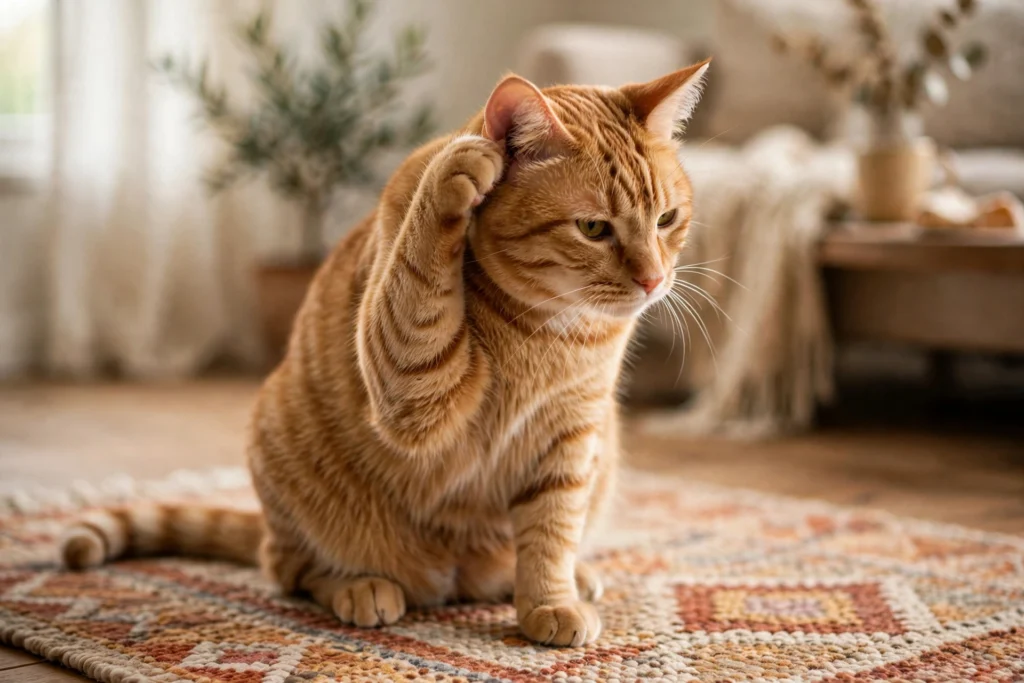
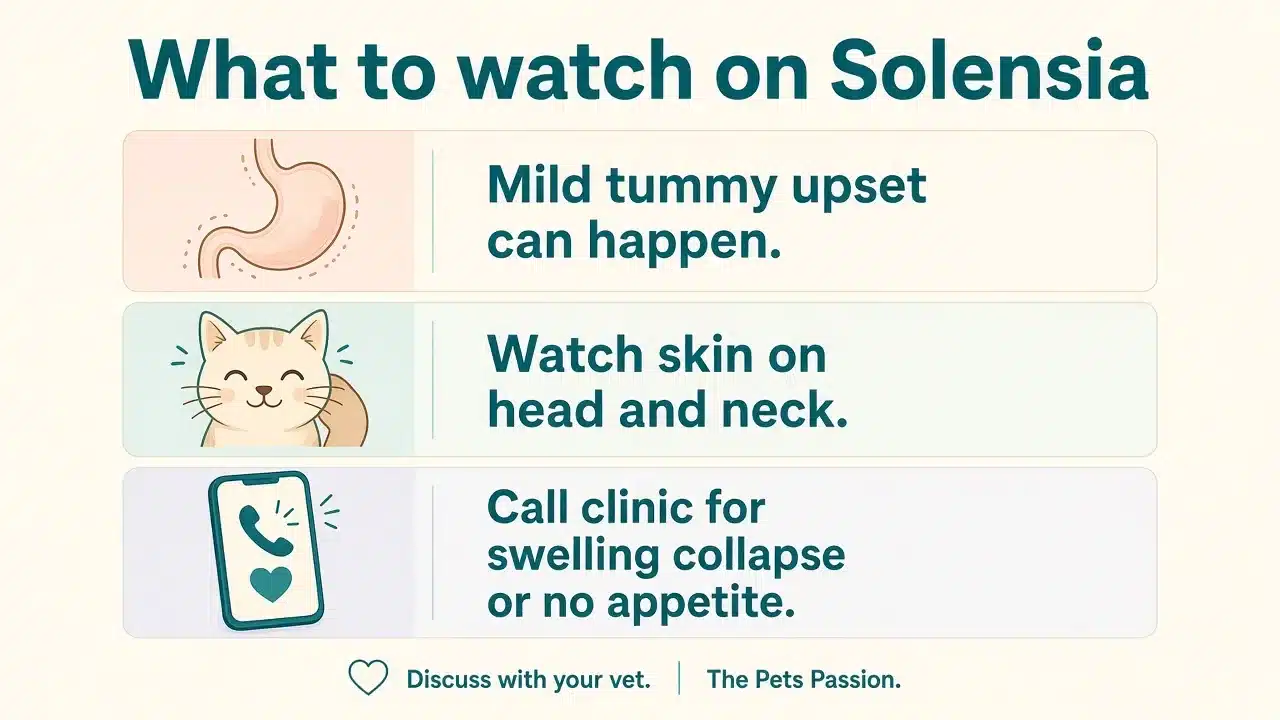
The label explicitly states administration of Solensia may be associated with scabbing on the head and neck, dermatitis, and pruritus, while also noting preapproval data suggest these signs do not automatically require stopping Solensia—your veterinarian still decides based on severity, infection, and quality of life.
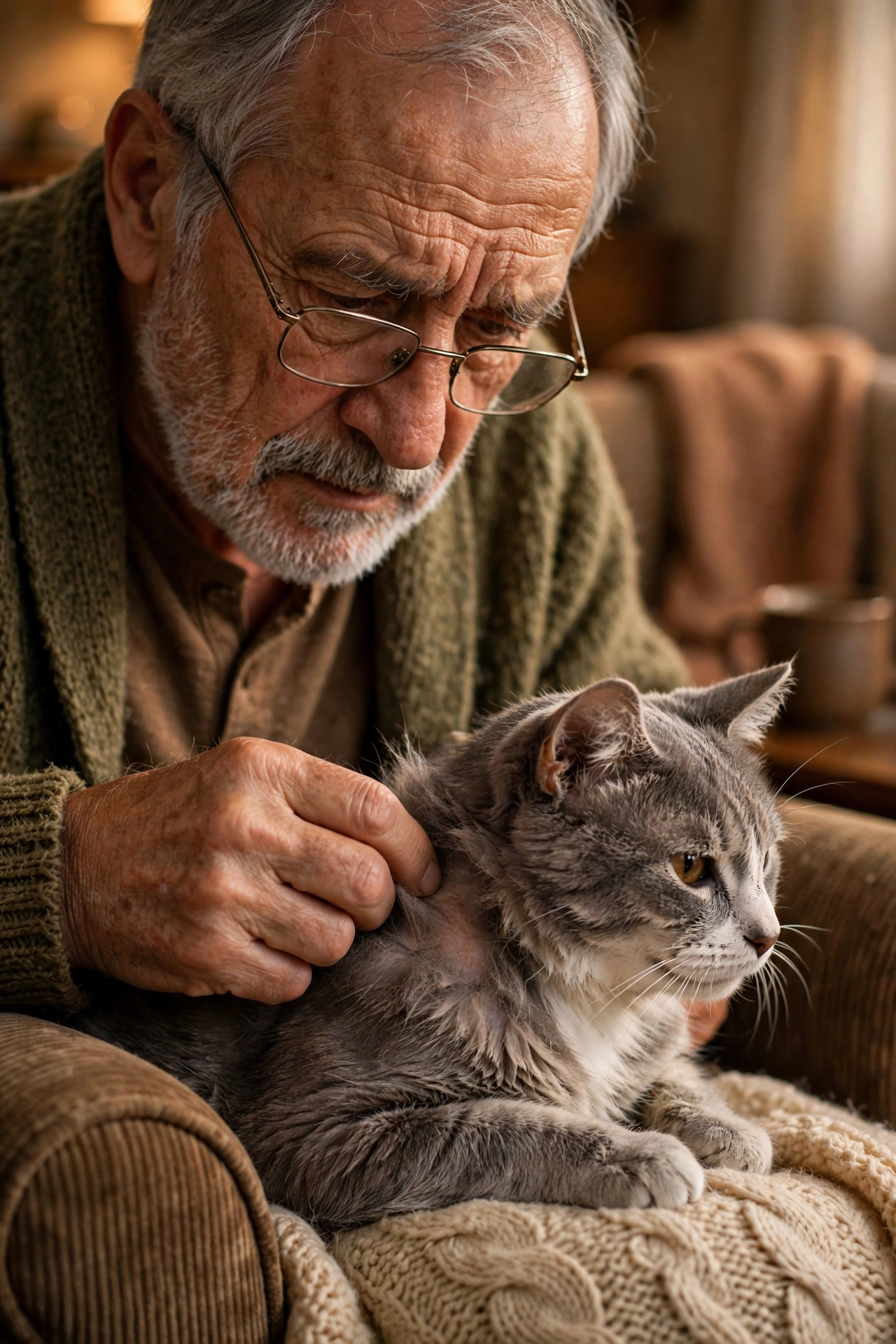
A published JFMS case series (five cats) described moderate-to-severe pruritus and self-trauma to the neck/head days to weeks after injection, sometimes worse on later doses. Case series are not incidence rates; they are a clinic-level reminder that “mild scab” and “ulcerated self-trauma” are different animals.
After every Solensia injection, monitor the head, neck, and injection site for scratching, scabs, redness, or hair loss, and note any vomiting or appetite change. In a published five-cat case series, skin reactions began 3–18 days after the most recent injection — that small series does not define an incidence rate or a mandatory watch calendar, so keep observing and report anything new to your veterinarian.
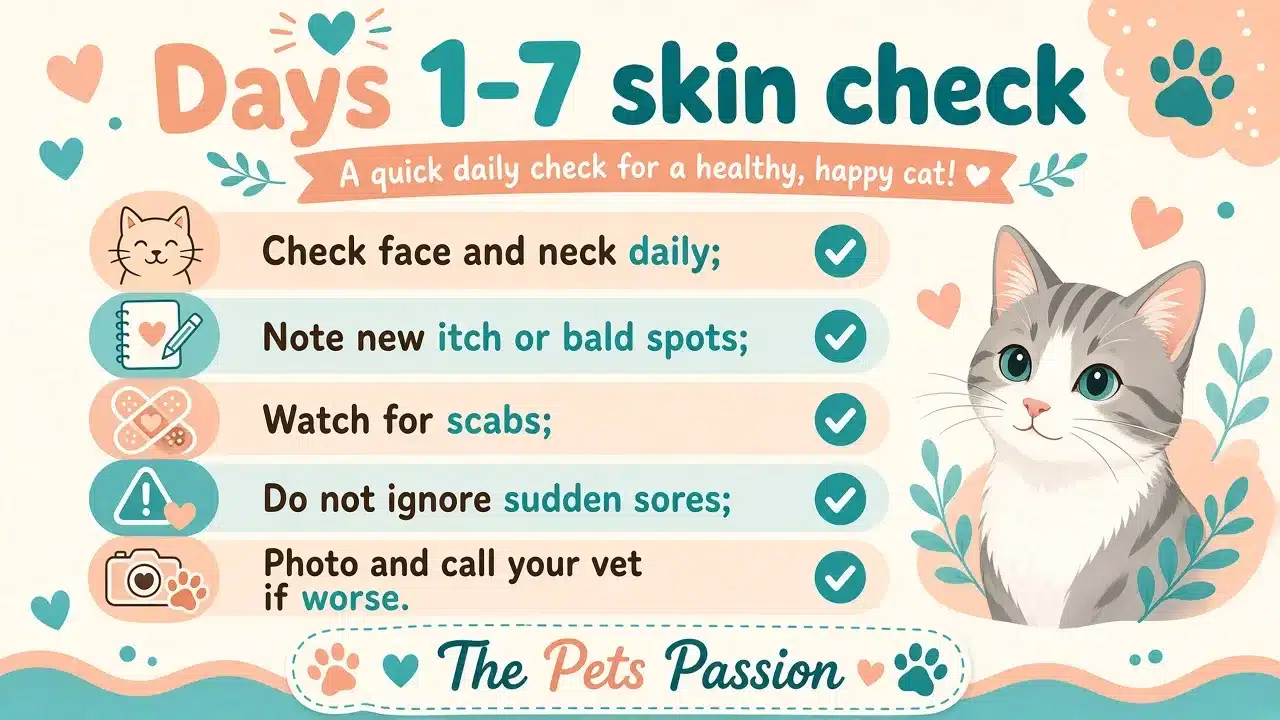
Call sooner if sores enlarge, ulcerate, smell infected, or the cat cannot sleep from scratching. An e-collar is a temporary bandage strategy—not a substitute for a veterinary exam.
When should I call the vet about Solensia?
You do not write the stop order—your veterinarian does. You supply the observations.
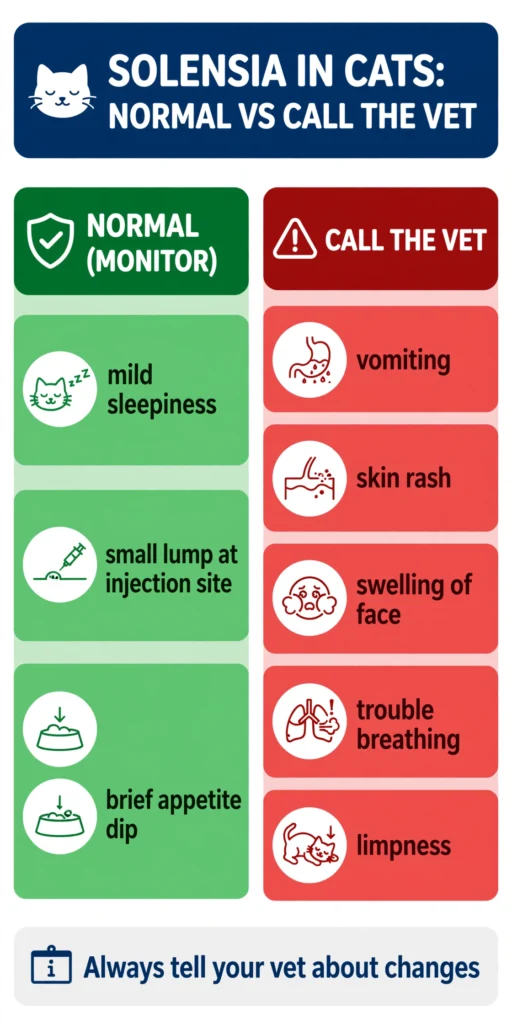
Contact the clinic promptly (same day / urgent care) if you see:
- Facial swelling, hives, trouble breathing, or collapse (hypersensitivity / anaphylaxis-type picture)
- Rapidly enlarging ulcers or severe self-trauma on the head/neck
- Marked lethargy, refusal to eat, or dehydration signs after injection
- Sudden dramatic decline that is out of character for your senior cat
Call your veterinarian promptly for vomiting or GI upset that lasts more than a day or two, or for any skin reaction at the head/neck. Do not wait for the next scheduled appointment for new signs after an injection.
- Small scabs or a tiny bald patch that is stable
- Pain control fading earlier each month
- New ear infection signs or mild itch that comes and goes
- Gradual weight change or litter-box habit shifts
If Solensia is paused or stopped, the label describes monthly dosing. Do not use the ~11-day half-life to calculate a pain-return date at home — pain can return on its own schedule, and retreatment timing is a veterinary decision. Plan a pain bridge with the vet; do not leave a painful cat untreated out of fear alone. Use the Cat QoL tool and Cat Grimace Scale notes so “better” and “worse” are more than vibes.
Who is a poor candidate for Solensia?
Label contraindications and precautions highlight several groups for clinician judgment:
| Group | Why the label flags it |
|---|---|
| Known hypersensitivity to frunevetmab | Contraindicated |
| Breeding / pregnant / lactating queens | May cross placenta / enter milk; developmental toxicity signals with anti-NGF mAbs in lab species |
| Cats under 7 months or under 5.5 lb | Not evaluated |
| Cats that need ongoing NSAIDs | Combo safety not established; human anti-NGF + long-term NSAID programs raised RPOA signals (RPOA not characterized/reported in cats) |
| Cats on other monoclonal antibodies | Concurrent mAb safety not evaluated |
| Young growing cats (broader NGF biology) | NGF involved in normal sensory/sympathetic development |
| Advanced / unstable systemic disease | VCA notes use in later-stage kidney disease has not been assessed; field study “renal insufficiency” rows often reflect worsening of existing disease—baseline labs matter |
Pregnant women, women trying to conceive, and breastfeeding people should take extreme care to avoid accidental self-injection (user safety warning on the label).
Can Solensia be given with NSAIDs or other drugs?
Per DailyMed: safe use of Solensia with concurrent NSAIDs has not been established in cats. Human anti-NGF trials saw rapidly progressing osteoarthritis (RPOA) more often when long-term NSAIDs were combined; the label states RPOA has not been characterized or reported in cats, yet regulators still want caution rather than casual dual therapy.
VCA notes that during safety work, various concurrent drug classes (including some NSAIDs, vaccines, antibiotics, and others) were used without a clear interaction signal in that setting—but that is not the same as a green light to freestyle meloxicam leftovers between injections. Tell the clinic about every chew, joint supplement, corticosteroid, and CBD product before injection day.
How should I monitor my cat after each injection?
Practical routine owners can keep without turning into a lab notebook:
- Day 0–2: appetite, vomiting/diarrhea, litter habits, walk/jump quality, injection-site check.
- Day 3–7: skin watch (face/ears/neck), itch diary, energy; PK summaries often place peak levels in this window.
- Week 2–4: pain score and activity diary; note any delayed oddities before the next vial.
- Every visit: review the Client Information Sheet, weigh if body condition changed, agree on stop-triggers in writing.
Bring phone videos of gait and itch. Video beats “she seemed off.”
Checklist before the next injection
- Review any weird week since the last dose (GI, skin, behavior, drinking)
- Confirm no new NSAID started at home
- Weigh / body-condition check if the cat looks thinner or fluffier
- Agree what hypersensitivity or severe skin change triggers an emergency call
- Update the Cat QoL score
- Keep Zoetis (1-888-963-8471) and FDA animal AE reporting contacts handy
Myth vs label: Solensia
| Myth | Closer to evidence |
|---|---|
| “Solensia is poison for all cats” | Field-study tables show modest rates of several events; many cats continue with monitoring because OA pain is real |
| “Skin scabs mean you must stop forever” | Label associates skin signs but notes they may not require cessation—severity and vet judgment decide |
| “If control rates look similar, the drug never causes anything” | Controls help interpretation; they do not cancel individual adverse events or hypersensitivity risk |
| “Librela warnings apply 1:1 to Solensia” | Different products, species, and AE emphasis—read the cat label |
| “Pain doesn’t count as risk” | Untreated OA pain harms mobility, muscle, and quality of life |
For gabapentin, another arthritis pain option, see our gabapentin guide — some cats use both. Remember that serious reactions need emergency care; don’t wait. Also watch for appetite loss after the injection and report it.
Veterinary sources:
What is Solensia (frunevetmab)?
Solensia is a prescription feline monoclonal antibody that binds nerve growth factor (NGF) to help control osteoarthritis pain. Zoetis markets it for subcutaneous use in cats about once a month. It is not an NSAID; dosing and monitoring belong with your veterinarian.
Are Solensia side effects common?
In the US field-study table, the most frequent tabulated events were vomiting (13.2%) and injection-site pain (10.9%). Several other events clustered around 3–7%. “Common on social media” is not the same as common in clinics—use the label percentages and your cat’s exam.
Is Solensia safe for cats with kidney disease?
The field study listed “renal insufficiency” (often worsening of existing disease) in 6.6% of Solensia cats vs 4.3% of controls. VCA notes use in later stages of kidney disease has not been assessed. Baseline and follow-up labs are a veterinary decision, not a DIY clearance.
Does Solensia cause neurologic problems like Librela?
The US Solensia DailyMed adverse-reaction table emphasizes GI, injection-site, skin, behavior, and renal rows—not the canine Librela post-approval neurologic Dear Vet cluster. Do not import dog panic math onto cats; still call for any sudden profound weakness, collapse, or neurologic change.
Can I give gabapentin or an NSAID with Solensia?
Maybe—ask the prescribing vet. NSAID + anti-NGF combination safety is specifically not established in cats. Never stack pain drugs from the medicine cabinet.
Should every cat stop Solensia because of skin reports?
No. Mild, stable scabs may be monitored; severe self-trauma or hypersensitivity needs prompt care and a stop/pause decision by the clinician. Stopping without a pain plan can also harm welfare.
How do I report a Solensia side effect?
Call your veterinarian first for care. They (or you) can report to Zoetis at 1-888-963-8471 and FDA at 1-888-FDA-VETS. Good reports include injection dates, vial count if known, onset timing, photos/videos, concurrent drugs, and outcome.
Is Solensia the same as Librela?
No. Librela is bedinvetmab for dogs; Solensia is frunevetmab for cats. Related anti-NGF idea, different molecules and labels. See Librela side effects for the dog counterpart.
Bottom line
Solensia side effects deserve clear eyes: respect DailyMed percentages (vomiting and injection discomfort lead the field-study list; skin itch/scabbing is a real watch item), partner with your vet on when to pause or stop, and remember osteoarthritis pain is also a clinical problem worth treating thoughtfully. Pair monthly decisions with the Cat QoL tool and the Cat Grimace Scale so comfort is measured, not guessed; sudden breathing trouble, collapse, or facial swelling after an injection needs emergency care.
Related cat guides: Track comfort with the Cat Quality of Life tool, describe pain with the Cat Grimace Scale, and keep the pet medication converter for units only. Severe reactions: cat emergency-vet guide. More cat guides.
Primary references: FDA DailyMed — Solensia · FOI Summary NADA 141-546 · Zoetis Solensia · VCA — Frunevetmab · Zoetis adverse event line 1-888-963-8471 · FDA animal AE 1-888-FDA-VETS
Veterinary Review & Editorial Standard
This clinical guide was prepared using peer-reviewed veterinary literature and guidelines from leading veterinary associations. If your pet exhibits acute symptoms or distress, please seek immediate in-person veterinary emergency care.