When to Take a Cat to the Emergency Vet: Red Flags & What to Do
 The Pets Passion Medical Team

Take your cat to an emergency vet now for open-mouth or labored breathing, pale/blue gums, collapse, seizures that won’t stop or cluster, major trauma or bleeding, suspected toxin, or a male cat straining with little or no urine. Those are classic life-threatening cat emergency signs in public clinic guidance from VCA, ASPCA, and veterinary association first-aid materials. Cats hide illness — when something sudden and severe shows up, waiting “until morning” can cost hours you don’t have — including a possible lily exposure (see Are lilies toxic to cats?).
Educational disclaimer: This guide from The Pets Passion summarizes public education from VCA Animal Hospitals, the ASPCA, the American Veterinary Medical Association (AVMA), and the American Animal Hospital Association (AAHA). It is not a diagnosis or treatment plan. If you’re unsure, call your veterinarian or the nearest emergency clinic. While you arrange care, our pet symptom checker and pet toxic foods checker can help you organize observations — they never replace a physical exam.
What cat emergency signs mean go to the ER now?
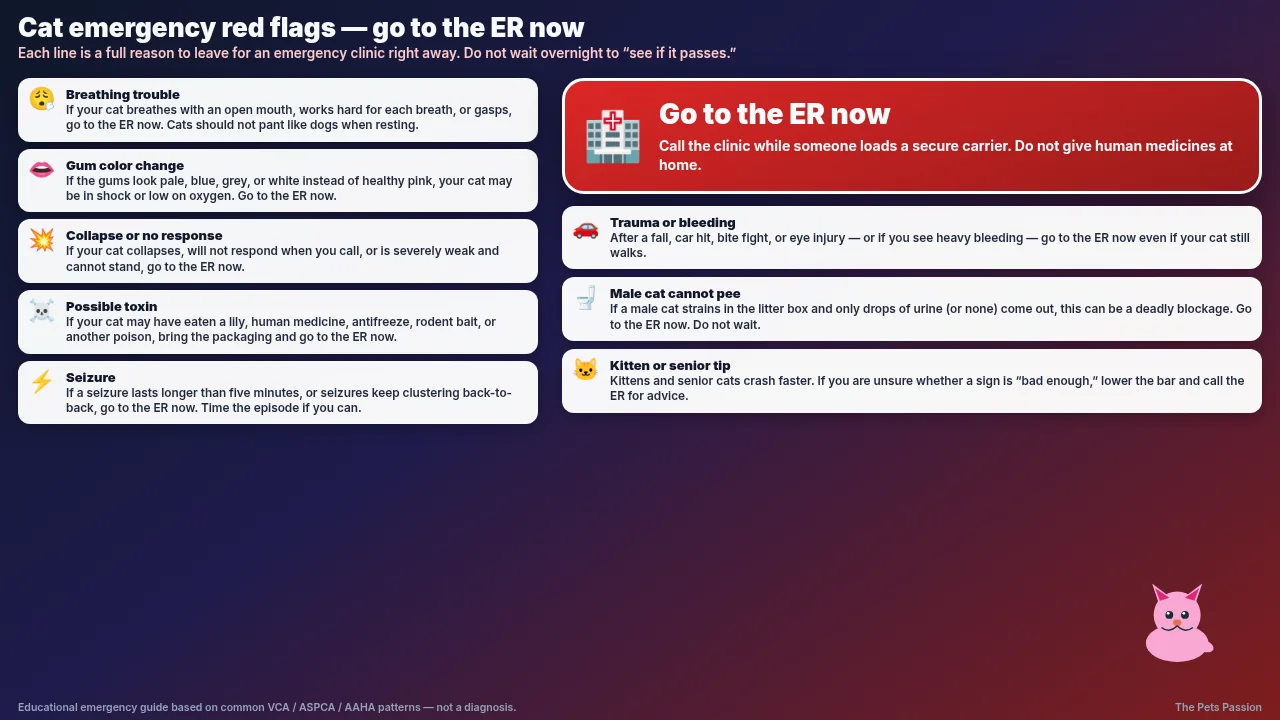
Use this as a go-now filter, not a substitute for clinical judgment. VCA’s cat emergencies handout and ASPCA emergency-care guidance repeatedly flag the same patterns: airway/breathing problems, shock signs, seizures, trauma, toxins, and acute urinary blockage.
Go to emergency care now if your cat has:
- Difficulty breathing — open-mouth breathing, panting, neck extension, noisy breathing, or gasping (VCA; AAHA also lists blue/grey/purple gums with respiratory distress)
- Pale, white, blue, or grey gums or other mucous membranes — a classic shock / oxygen-delivery red flag (ASPCA; VCA shock section)
- Collapse, unresponsiveness, or sudden severe weakness
- Seizure lasting more than about five minutes, or back-to-back seizures (status epilepticus risk — VCA notes permanent damage risk without urgent treatment)
- Suspected poisoning / toxin — plants (including lilies for cats), antifreeze, human meds, rodenticides, household chemicals; call the clinic and ASPCA Animal Poison Control at (888) 426-4435 while you travel (ASPCA)
- Male cat straining in the litter box with little or no urine — urinary blockage can progress to kidney failure and dangerous electrolyte changes (VCA)
- Major trauma — hit by car, high-rise fall, deep bite wounds, penetrating chest/abdomen injury, uncontrolled bleeding, eye injury
- Nonstop vomiting (or vomiting with blood, extreme lethargy, or inability to keep water down), especially with a painful/swollen belly
- Heatstroke signs after heat exposure — excessive panting, distress, weakness/collapse (cool safely while you go; VCA warns against delaying transport)
If pain is part of the picture (squinting, flattened ears, withdrawn face), our cat grimace scale helps you describe facial cues on the phone — it does not replace the ER visit.
How do I check breathing, gums, and collapse at home?
You are looking for obvious life-threatening patterns, not doing a full exam.
Breathing: Count breaths for 15–30 seconds if you can do it calmly. Worry more about effort than a perfect number — open-mouth breathing in cats is abnormal and urgent (VCA). Don’t force a stressed cat into a tight hold that worsens breathing.
Gums / mucous membranes: Gently lift the lip. Healthy gums are usually pink and moist. Pale, white, blue, or muddy grey gums with weakness or rapid breathing are emergency signs ASPCA and VCA both highlight under shock/oxygen problems.
Collapse / mentation: If your cat can’t stand, won’t respond to your voice, or seems “switched off,” treat it as an emergency (ASPCA; AAHA).
Safe handling: Injured cats may bite. ASPCA advises draping a towel/blanket over the head, lifting into an open-topped carrier or box, and supporting the body — especially if spinal injury is possible. VCA says: keep warm (except heatstroke), quiet, and minimize movement; call the hospital so they can prepare.
For mixed symptom sorting before you call, use the pet symptom checker to jot structured notes — then still follow the clinic’s triage advice.
When is male cat urinary straining an emergency?
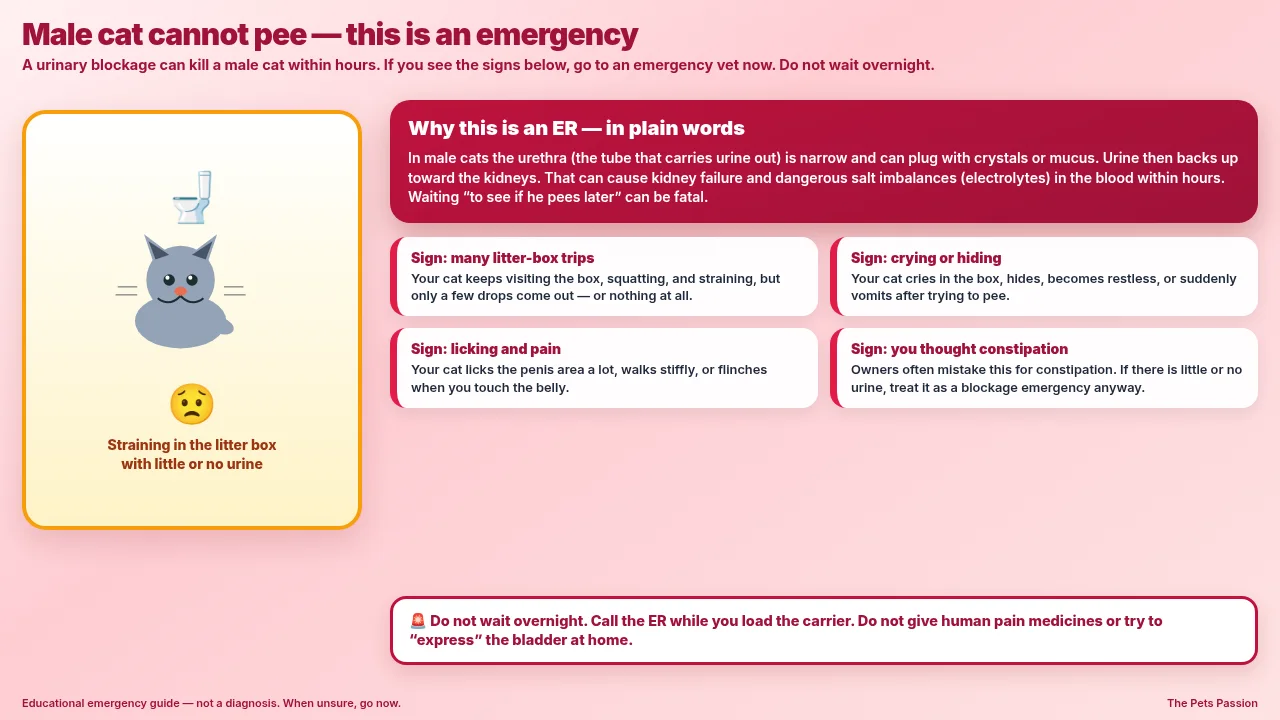
Yes — treat it as an ER now problem, especially in male cats. VCA states that frequent trips to the litter box with no urine or only small drops can mean urethral blockage, which can cause acute kidney failure, extreme suffering, and death if delayed (VCA). Do not wait overnight to “see if it passes.”
Clues owners often misread as “constipation”:
- Repeated litter-box visits with straining and little/no urine
- Crying in the box, licking the penis area, hiding, vomiting, or becoming lethargic
- A firm, painful belly (don’t poke hard)
Female cats can have painful urinary disease too, but complete obstruction is far more common in males because of anatomy — so male “can’t pee” gets the lowest possible wait threshold in every major ER checklist — including the vomiting thresholds in Cat vomiting: when to worry.
We have deeper urinary-blockage education in draft form for later publishing; until that goes live, rely on VCA’s emergencies page and your local ER, and skip hunting for unpublished URLs.
What should I bring to the emergency vet?
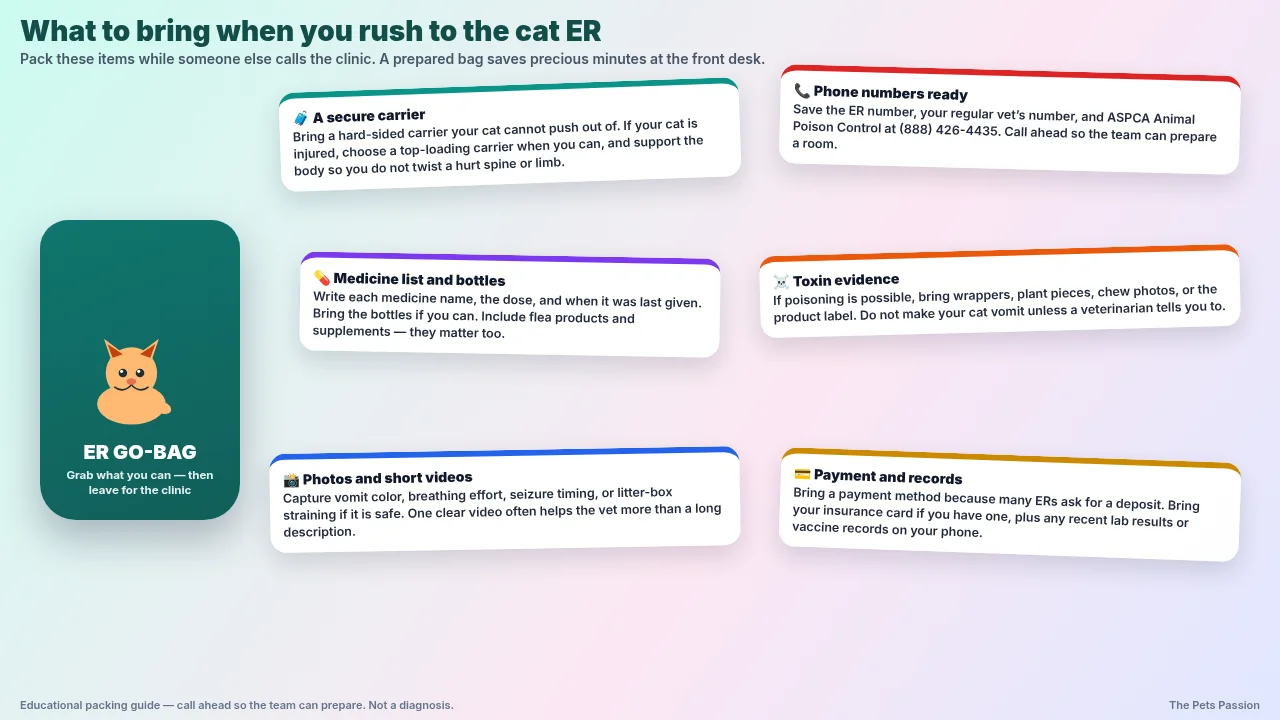
Call ahead if someone can dial while you drive — clinics prepare oxygen, crash carts, and staff when they know you’re coming (ASPCA; AVMA first-aid guidance).
Useful ER go-bag:
- Secure carrier (top-load if injured) + towel/blanket
- Phone numbers — primary vet, ER address, ASPCA Poison Control (888) 426-4435
- Medication list (name, dose, last given) and any current prescriptions in original packaging
- Toxin evidence — plant cuttings, food wrappers, med bottles, photos of what was chewed (ASPCA)
- Symptom log — when it started, breathing changes, litter-box output, vomit photos/videos, seizure timing
- Recent diet / treats / new exposures
- Payment method and any pet-insurance info (ER visits are often prepaid deposits)
Pain and urgency notes from the cat grimace scale or a quick pass through the tools hub are fine to mention — bring facts, not a self-diagnosis.
What should I NOT do at home before the ER?
Good intentions cause a lot of harm here.
- Don’t induce vomiting unless a veterinarian or poison expert specifically tells you to — corrosives, hydrocarbons, sharp objects, and some plants make vomiting dangerous (ASPCA; VCA poisoning section)
- Don’t give human painkillers, antiemetics, or leftover pet meds — many human drugs (including common pain relievers) are toxic to cats (VCA)
- Don’t force food or water if your cat may need sedation, imaging, or surgery, or if they’re actively seizing/vomiting hard
- Don’t put your fingers in a seizing cat’s mouth — they will not “swallow their tongue”; protect them from falling instead (VCA)
- Don’t delay for a “wait and see” nap when breathing, gums, collapse, toxin, trauma, or male non-peeing are on the list
- Don’t stuff an injured cat through a tiny carrier door — use an open top (VCA)
If you suspect a pantry toxin, open the pet toxic foods checker while you head to care or call poison control — tools are for clarity, not delay.
Do kittens and senior cats need a lower threshold?
Yes. Kittens dehydrate and drop blood sugar faster; seniors and chronically ill cats (kidney disease, heart disease, diabetes) have less reserve. Use a lower threshold for both — call sooner rather than later.
Urinary blockage: the classic cat emergency in male cats — don’t wait. For swallowed string or foreign objects, lily poisoning, or when vomiting becomes an emergency, use the specific guides linked below.
FAQ: When to take a cat to the emergency vet
What are the top cat emergency signs in one list?
Breathing trouble (especially open-mouth), pale/blue gums, collapse, prolonged or clustered seizures, major bleeding/trauma, suspected toxin, male cat producing little/no urine, nonstop vomiting with weakness, and heatstroke after heat exposure (VCA, ASPCA, AAHA).
My cat vomited once and seems fine — ER or wait?
A single mild vomit in a bright, eating adult may be monitorable, but escalate for blood, repeats, lethargy, toxin risk, or a kitten/senior. Deeper vomiting triage lives in a separate draft article; until it’s published, use VCA’s vomiting guidance and call if you’re unsure.
How long can a blocked male cat wait?
Don’t plan a wait. VCA treats inability to produce urine (or only drops) as an immediate emergency because toxins and electrolyte changes build quickly.
Should I call poison control or just drive?
For known/possible toxin exposure: both when feasible — call ASPCA Animal Poison Control (888) 426-4435 (fee may apply) and your ER so treatment can start on arrival (ASPCA).
Can the pet symptom checker tell me if it’s an emergency?
It helps you organize signs and urgency language. It cannot examine gums, listen to lungs, or run labs. Life-threatening patterns above → go / call now.
What if it’s after hours and my regular vet is closed?
ASPCA recommends knowing your nearest 24-hour emergency hospital before you need it — save the address and phone in your contacts and on the fridge.
Related cat guides: For specific triage paths, see lily toxicity, male urinary blockage, and cat vomiting; medication questions may also lead to Solensia side effects. More cat guides.
Last researched against VCA Emergencies in Cats, ASPCA Emergency Care / Poison Control public pages, AVMA pet first-aid / emergency resources, and AAHA “Help! Is This a Pet Emergency?” Always follow your veterinarian’s advice for your individual cat.
Veterinary Review & Editorial Standard
This clinical guide was prepared using peer-reviewed veterinary literature and guidelines from leading veterinary associations. If your pet exhibits acute symptoms or distress, please seek immediate in-person veterinary emergency care.