How Many Calories Does My Cat Need? Feeding Guide + Calculator
 The Pets Passion Medical Team
How many calories does my cat need? Most healthy adult cats need a personalized daily calorie target based on body weight, neuter status, activity, and body condition. Most healthy adult cats land somewhere near Resting Energy Requirement (RER) multiplied by a life-stage factor — often about 1.2× RER for a typical neutered indoor cat — then you adjust using body condition and the scale, not the bag cup alone. RER uses the allometric formula 70 × (body weight in kg)^0.75, the same teaching equation used for dogs and cats (Pet Nutrition Alliance). A 10 lb (4.5 kg) neutered indoor adult often starts near ~260 kcal/day with a 1.2× factor — but individuals can sit well outside textbook math.
Educational disclaimer: This guide from The Pets Passion summarizes public WSAVA, AAFP, Pet Nutrition Alliance, and Cornell Feline Health Center framing. It is not a prescription for weight-loss kits, homemade recipes, or disease diets. Kittens, pregnant/lactating queens, seniors with illness, and cats on veterinary therapeutic foods need a veterinarian’s plan. For a structured estimate you can take to the clinic, use our live Cat Calorie Calculator.
What is RER vs MER for cats (plain English)?
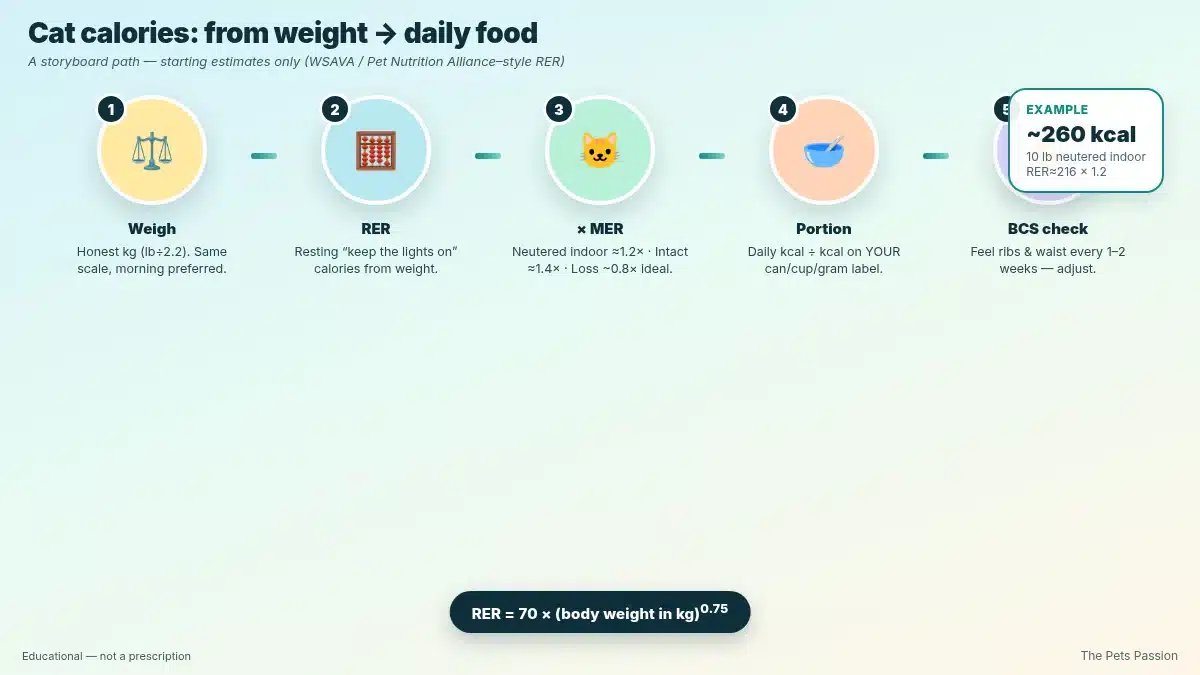
RER (resting energy requirement) estimates the calories needed to keep essential systems running at rest in a comfortable temperature. The Pet Nutrition Alliance and most clinical teaching charts use:
RER (kcal/day) = 70 × (body weight in kg)^0.75
MER (maintenance energy requirement — sometimes called DER) multiplies RER by a factor for neuter status, activity, growth, pregnancy, or lactation. MER is a starting guess. PNA notes individual animals can vary by as much as ~50% from predicted MER, which is why the scale and body condition beat “the bag said half a cup.”
For healthy adults already in ideal condition, WSAVA’s July 2020 cat calorie chart also publishes ready-made ranges from 2006 NRC maintenance math (lean adult ≈ 100 × BWkg0.67; obese-prone ≈ 130 × BWkg0.4). Those bands are guidance — not a promise your indoor tabby lands on the midpoint.
How do I use the cat calorie calculator on this site?
Open the Cat Calorie Calculator. Enter current weight plus the neuter/activity context the tool asks for. Read RER and MER as planning numbers. Then:
- Find kcal per cup, can, pouch, or gram on the food’s calorie statement (or ask the manufacturer).
- Divide MER by kcal per measuring unit for a starting portion.
- Subtract treat calories first if you want extras (Keep treats to no more than about 10% of daily calories (the WSAVA/AAHA screening threshold) — Cornell’s treat framing).
- Recheck weight and body condition on a calendar, not by “she looks fine in winter fur.”
The tool mirrors the WSAVA-style allometric RER approach used on our site. It cannot see hyperthyroidism, steroid therapy, or the tuna “just a spoon.” You still own the honesty layer.
If you’re comparing species math, our sibling dog guide How many calories does my dog need? uses the same RER equation with different MER factors — don’t copy dog multipliers onto cats.
What MER factors do vets commonly teach for cats?
Teaching charts (Pet Nutrition Alliance; AAFP Tear ’N Share materials) often list feline factors like these — orientation, not laws:
| Cat’s situation | Typical factor (× RER) | Notes |
|---|---|---|
| Weight loss / overweight plan | ~0.8–1.0 | Usually based on ideal weight; vet-supervised |
| Inactive / obese-prone adult | ~1.0 | Couch-potato indoor cats that gain easily |
| Neutered adult (typical) | ~1.2 | Most spayed/neutered housecats |
| Intact adult | ~1.4 | Intact cats often need more than neutered peers |
| Kitten / growth | ~2.0–2.5 (tapers with age) | Highest early; decreases toward adulthood |
| Gestation / lactation | Needs rise progressively — late gestation runs roughly 25–50% above maintenance and peak lactation can approach 2.5–3× maintenance energy, varying by litter size and week. | Clinic plan — not DIY crash math |
Neuter status matters: many indoor cats drop energy needs after spay/neuter while appetite stays cheerful. Activity adjectives inflate cups — a “busy” cat that naps 18 hours is not a working barn cat.
Why body condition score beats the measuring cup?
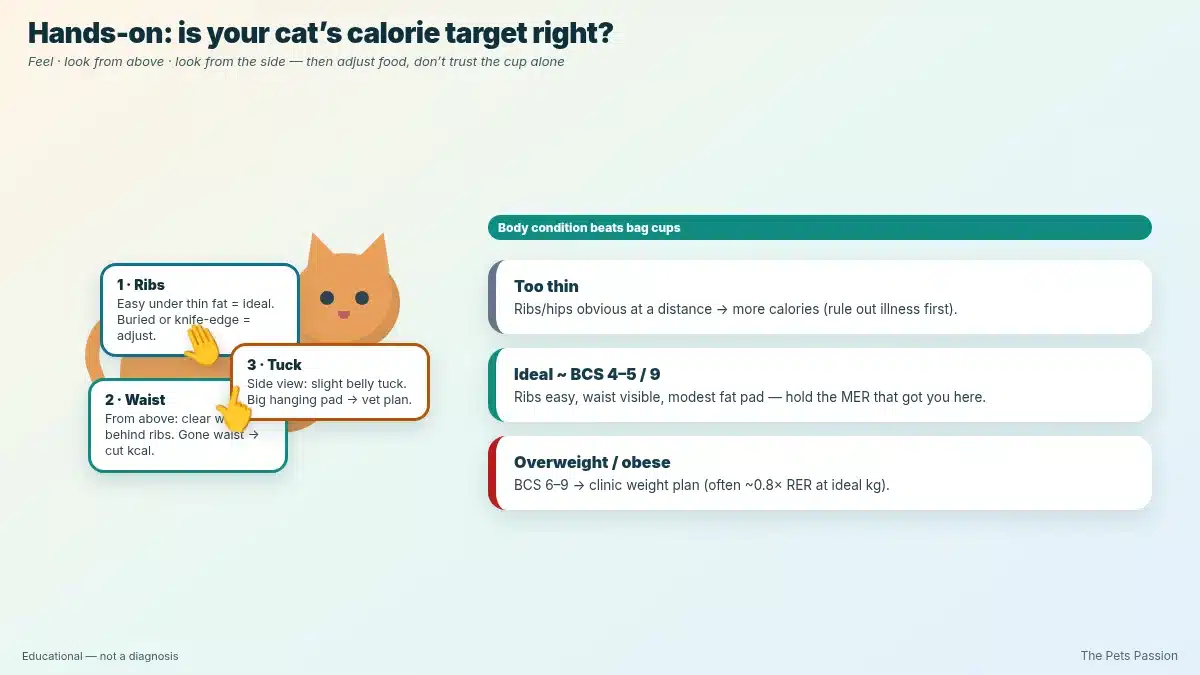
Feel ribs, look from above, look from the side. Cornell’s Feeding Your Cat guide treats body condition as central to weight health; WSAVA nutritional screening flags BCS outside the ideal band as a risk.
On a common 9-point scale, ideal is often 4–5/9:
- Ribs easy to feel under a thin fat cover (not buried, not knife-edge)
- Waist visible from above behind the ribs
- Abdominal tuck from the side; fat pad under the belly stays modest
Too thin (ribs/hips obvious at a distance) and too heavy (waist gone, heavy fat over loin and belly) both need a plan. Muscle condition matters too — seniors can look “fluffy” while losing muscle.
A cat at BCS 7/9 eating “the bag amount” is not proof the bag is wrong; it is proof this cat needs fewer calories or more honest accounting of extras. Conversely, an outdoor hunter may sit above the neutered-indoor factor if work is real.
Brand-comparison and “best food for X condition” shopping is a different intent than calorie math — if you’re choosing formulas rather than portions, see our broader nutrition piece best cat nutrition guide and keep this page focused on how much energy, not which SKU wins a taste test.
How do wet vs dry food change portions (and hydration)?
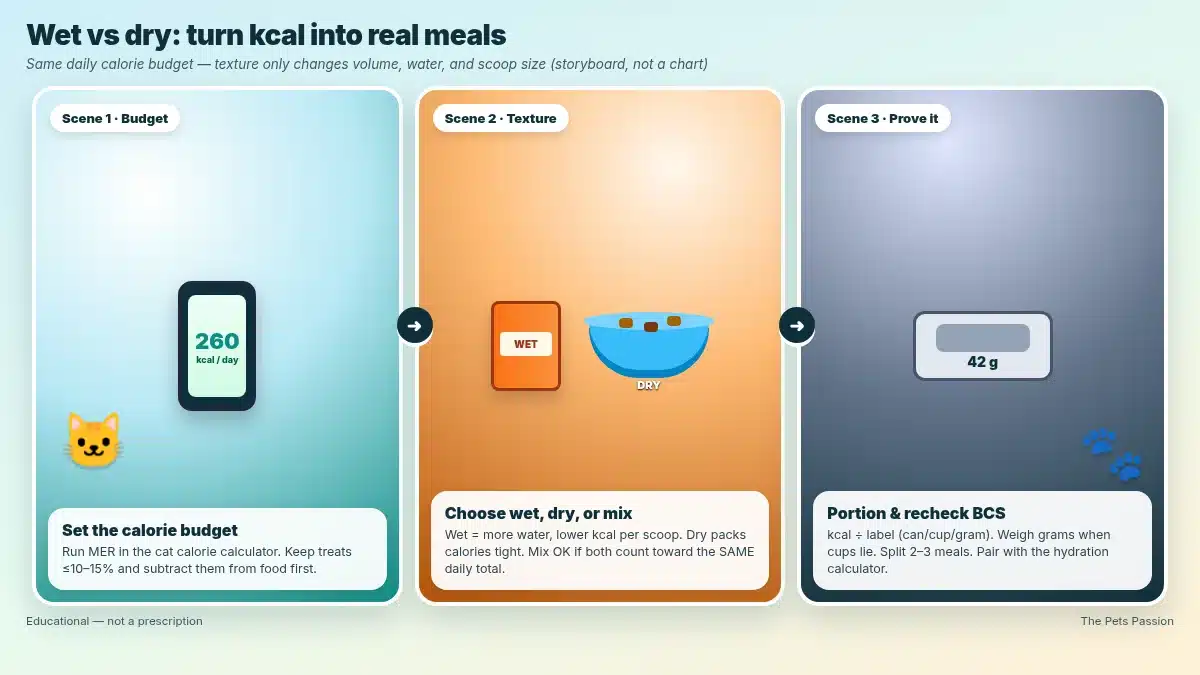
Calories live in the label, not the texture. Wet food is mostly water (Cornell notes canned food is typically ≥ ~75% moisture; dry is often ~6–10%). That means:
- A full wet can can look “generous” while delivering fewer kcal than a heaped dry cup
- Dry food packs more calories into less volume — easy to overfeed with a casual scoop
- Mixing wet + dry is fine if you count both toward the same daily kcal budget
Moisture also matters for fluid intake. Cats have a relatively low thirst drive; wet food contributes water that dry kibble doesn’t. Pair portion math with our Pet Hydration Calculator when you’re checking bowl water plus diet moisture — especially in heat, with CKD risk, or when urine habits change.
How much should I feed my cat? Worked examples
Illustrative math only — run your own numbers in the Cat Calorie Calculator.
Example A — 10 lb (4.5 kg) neutered indoor adult, ideal BCS
- RER ≈ 70 × 4.5^0.75 ≈ 70 × 3.09 ≈ 216 kcal
- MER at 1.2 × RER ≈ 260 kcal/day
- WSAVA chart band for ~4.5 kg healthy adults in ideal condition: roughly 240–270 kcal/day
Example B — 12 lb (5.5 kg) quiet neutered adult that gains easily
- RER ≈ 70 × 5.5^0.75 ≈ 70 × 3.59 ≈ 251 kcal
- Starting MER at 1.0 × RER (obese-prone teaching factor) ≈ 251 kcal
- If BCS is already high, ask the clinic for an ideal-weight plan (often nearer 0.8 × RER at ideal kg) — don’t crash-diet a cat alone
Turning kcal into “how much food”
- Label says 90 kcal per 3 oz wet can → 260 ÷ 90 ≈ 2.9 cans/day (split into meals)
- Label says 340 kcal per cup dry → 260 ÷ 340 ≈ 0.76 cup/day
- Feed by gram on a kitchen scale when cups disagree with reality
Bag feeding charts assume an average cat. Your cat is not average.
What about treats, kittens, seniors, and weight loss?
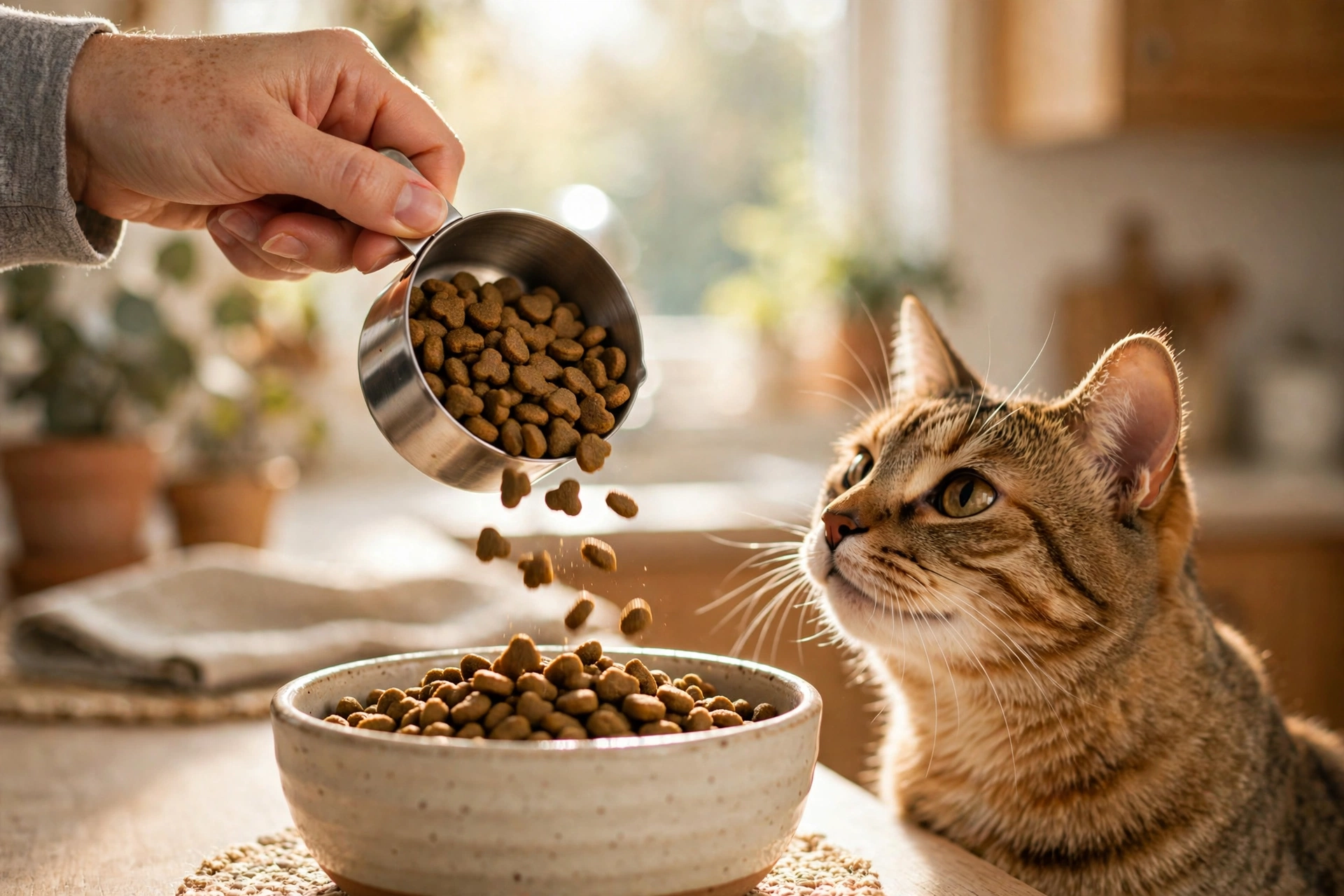
Treats: Cornell’s practical rule is to keep treats to no more than about 10% of daily calories (the WSAVA/AAHA screening threshold). Dental treats, milk, cheese “just a little,” and lickable tubes all count. Training with high treat volume? Use tiny pieces or kibble from the daily ration.
Kittens: Growth factors are high (often ~2–2.5× RER early). Use a complete kitten food (AAFCO/FEDIAF life-stage statement) and weigh frequently. Free-choice dry for a food-motivated kitten is a common route to excess weight.
Seniors: Activity may drop (fewer calories) or muscle may waste (protein-aware support). Disease (CKD, hyperthyroidism, diabetes) can invert naive “feed less” instincts — clinic plan first.
Weight loss: Aim for gradual fat loss while protecting muscle. Hepatic lipidosis risk makes aggressive feline crash diets dangerous. Ask for a target weight, weekly rate of loss, and recheck schedule. PNA’s overweight feline framing often starts near 0.8–1.0 × RER using ideal weight — under veterinary monitoring.
Free-feeding dry food: Convenient, but a common route to excess weight for many neutered indoor cats. Measured meals (or puzzle feeders with a counted portion) beat the forever buffet.
Pair calorie math with water intake and weight tracking — hydration affects the numbers. If your cat won’t eat enough, rule out medical causes first. For the full breakdown of feline nutrition beyond calories, see our nutrition guide, and read up on obesity prevention for easy gainers.
FAQ: How many calories does my cat need?
How many calories does my cat need per day by weight?
There’s no universal table that fits every cat. Start with RER = 70 × kg^0.75, multiply by a life-stage factor (often ~1.2 for neutered adults), then adjust with BCS. WSAVA’s healthy-adult chart gives approximate bands by kg for cats already in ideal condition — use it as a cross-check, not a sentence.
Is RER the same as what I should feed?
No. RER is the resting baseline. MER (RER × factor) is the usual maintenance starting point. Real life still needs BCS and the scale.
Do neutered cats need fewer calories?
Often yes relative to intact cats — many teaching charts use ~1.2× RER for neutered adults vs ~1.4× for intact adults. Appetite doesn’t always drop with metabolism, which is why waistlines expand after surgery if portions stay the same.
How much should I feed my cat if the bag says “1/2 to 3/4 cup”?
Treat bag ranges as a rough factory average. Convert your MER estimate into cups/cans using this food’s kcal statement, then adjust every 1–2 weeks using weight + BCS.
Can wet food help with calories and water?
Wet food’s moisture helps hydration; calorie density per cup is usually lower than dry. You still count kcal. See the hydration calculator when bowl water seems low. If appetite is poor because your cat is vomiting, start with our cat vomiting guide and call your veterinarian when red flags appear.
Are homemade or raw diets automatically lower calorie?
No. Calories depend on the recipe. Cornell does not recommend raw feeding for cats because of infection risk without clear proven benefit. Homemade diets need veterinary nutritionist formulation to be complete.
What if my cat is hungry on the calculated amount?
Confirm treat honesty, food stealing, hyperthyroidism (especially middle-aged/senior cats with weight loss + big appetite), and whether the factor was too aggressive. Higher-fiber or higher-protein therapeutic weight diets are clinic decisions — don’t slash below a vet-approved floor.
Related tools and next clicks
- Cat Calorie Calculator — RER/MER starting estimate
- Pet Hydration Calculator — fluid target alongside wet/dry choices
- Tools hub — more calculators
- Formula shopping / nutrition product intent (different from portion math): best cat nutrition guide
- Dog sibling (same RER equation, different factors): How many calories does my dog need?
Related cat guides: If eating is down because of vomiting, see Cat vomiting: when to worry; use the cat calorie calculator and hydration calculator for starting points. More cat guides.
Last researched against WSAVA Global Nutrition Committee materials, Pet Nutrition Alliance RER/MER guidance, AAFP feline feeding factor sheets, and Cornell Feline Health Center “Feeding Your Cat.” Always follow your veterinarian’s advice for your individual cat.
Veterinary Review & Editorial Standard
This clinical guide was prepared using peer-reviewed veterinary literature and guidelines from leading veterinary associations. If your pet exhibits acute symptoms or distress, please seek immediate in-person veterinary emergency care.