
Should Dogs Take Metronidazole for Diarrhea? What Vets Say
 The Pets Passion Medical Team

Educational disclaimer (not prescribing): This article from The Pets Passion explains how veterinary guidance on metronidazole for dog diarrhea has shifted. It is not a prescription, dose chart, or permission to share leftover tablets. Only a licensed veterinarian can decide if Flagyl belongs in your dog’s plan after an exam.
Should dogs take metronidazole for diarrhea? For most mild and many moderate acute cases, modern evidence-based guidance says no routine antimicrobials—reserve them mainly for severe disease that stays systemically ill despite fluids. Habit is not the same as proof; get testing and a vet plan before starting antibiotics.
Should dogs take metronidazole for diarrhea? For most mild and even many moderate cases of acute diarrhea, bloody or not, modern evidence-based guidance says no routine antimicrobials. The ENOVAT guidelines for antimicrobial use in canine acute diarrhoea (also summarized through WSAVA) issue strong recommendations against antimicrobial treatment in mild and moderate disease, with antimicrobials reserved mainly for severe cases that stay systemically ill despite adequate fluid therapy. Metronidazole has been one of the most commonly handed-out GI drugs historically, habit is not the same as proof.
If the plan is gut support without another antimicrobial course, compare options in do dogs need probiotics and products like FortiFlora vs Proviable.
Quick answer
– Most acute diarrhea: Supportive care (fluids, diet, parasite checks). ENOVAT recommends against antimicrobials for mild and moderate hemorrhagic or non-hemorrhagic acute diarrhea when systemic signs resolve with fluids.
– Severe disease: Antimicrobials may be indicated; ENOVAT suggests parenteral drugs aimed at translocation/sepsis risk. First-line suggestions in non-critical illness include ampicillin / amoxicillin-clavulanate or trimethoprim-sulfonamides, not “start Flagyl by default.”
– Giardia / specific anaerobic infections: Metronidazole is still used off-label in many countries for certain protozoal and anaerobic indications (VCA metronidazole), that is a targeted diagnosis conversation, not a yellow-soft-stool reflex.
– Side effects: Nausea, vomiting, drooling, tiredness; neurologic signs (ataxia, tremors, seizures, eye twitching) need stop-and-call urgency (VCA).Triage tool: Pet Symptom Urgency Checklist. Broader context: Dog Diarrhea: Top Causes….
What is metronidazole (Flagyl) in dogs?
VCA Animal Hospitals describes metronidazole (brand name Flagyl®) as an antibacterial and antiprotozoal agent used against certain anaerobic bacterial and protozoal infections, including those involving Giardia and Trichomonas. In dogs and cats, many of these uses are off-label / extra-label, common in veterinary medicine, but it means you follow your veterinarian’s directions carefully.
Forms include tablets, capsules, liquid, compounded flavored liquids, and injectable hospital products. It tastes intensely bitter, VCA warns not to crush tablets (airborne powder also raises human pregnancy exposure concerns; wear gloves).
Onset: drug begins working within hours, but clinical stool improvement may take days when it is truly indicated.
Why did metronidazole become the default diarrhea pill?
Because diarrhea is common, owners want a tablet, and anaerobic coverage sounds logical for a smelly colon. A UK primary-care pattern cited in the ENOVAT evidence base found antimicrobials prescribed in a large share of acute diarrhea visits, with metronidazole among the most used drugs.
Meanwhile, most dogs with acute diarrhea have mild, self-limiting disease. ENOVAT’s background notes that a large primary-care dataset found roughly 84% mild, 15% moderate, and <1% severe presentations, with most cases resolving within about a week and low fatality rates even among hospitalized subsets.
If the biology is usually self-limiting, reflexive antibiotics mainly buy:
- Microbiome disruption
- Side-effect risk
- Antimicrobial resistance pressure (One Health problem, dogs and humans share this mess)
That is the stewardship case in plain language.
What do ENOVAT and WSAVA actually recommend?
From the ENOVAT guideline PDF hosted by WSAVA:
| Rec. | Clinical picture | Antimicrobial stance | Strength |
|---|---|---|---|
| 1 | Acute non-hemorrhagic, mild | Against antimicrobials | Strong, high-certainty |
| 2 | Acute hemorrhagic, mild | Against antimicrobials | Strong, high-certainty |
| 3 | Acute non-hemorrhagic, moderate (dehydrated but systemic signs fix with fluids) | Against antimicrobials | Strong, high-certainty |
| 4 | Acute hemorrhagic, moderate | Against antimicrobials (exception notes for extreme CBC patterns) | Strong, high-certainty |
| 5 | Severe disease (systemic illness despite adequate fluids) | Suggest systemic antimicrobials | Conditional, very low-certainty |
| 6 | Severe, drug choice | Parenteral agents; non-critical first-line suggestions: ampicillin (or amox-clav) or TMS; broader protocols if critical / resistance likely | Conditional |
| 7 | Duration | Don't continue past clinical resolution; often 3–7 days if used | Conditional |
| 8 | Probiotics | Neither for nor against | Moderate certainty |
WSAVA’s owner-facing summary poster (Canine acute diarrhea short summary) punches the message harder: NO NEED for antimicrobials in the mild/moderate majority; focus on assessing severity and fluids first.
So if your feed algorithm still says “bloody diarrhea = Flagyl tonight,” it is out of date relative to this guideline set.
When might a veterinarian still choose metronidazole?
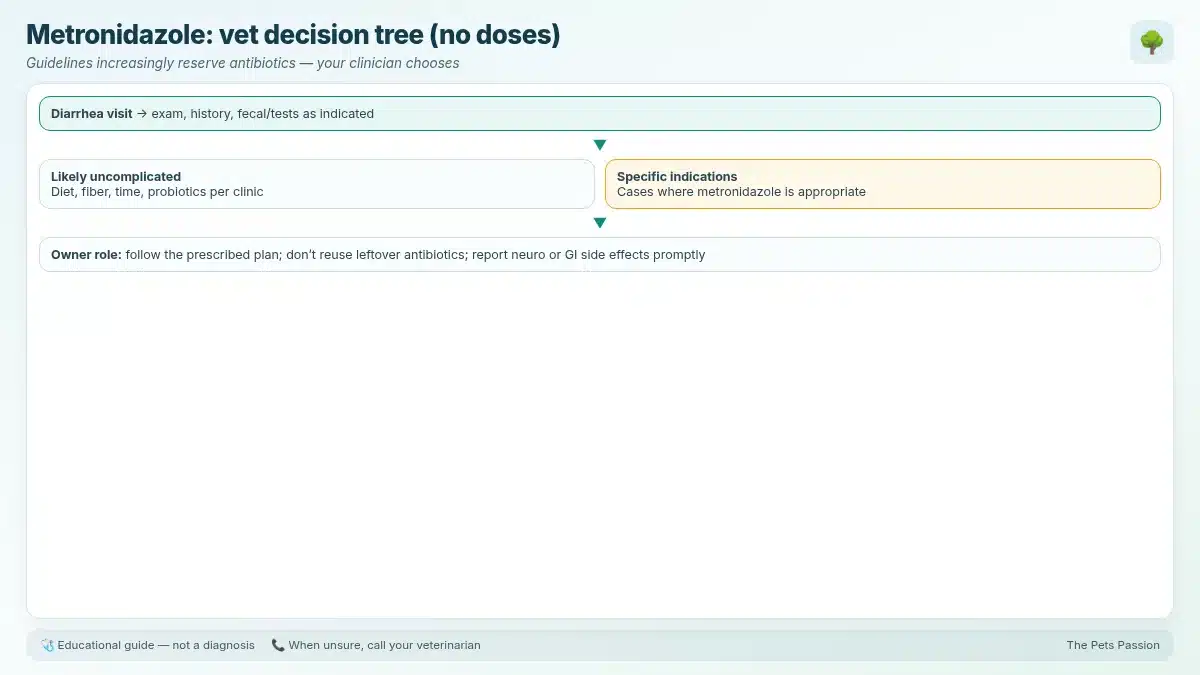
Possible appropriate contexts (clinician judgment, not a DIY list):
- Documented or strongly suspected Giardia (other agents like fenbendazole are also used; protocols vary)
- Specific anaerobic infections where culture/clinical picture supports it
- Some chronic enteropathy protocols historically used metronidazole, many specialists now emphasize diet, fiber, and narrower drug choices; ask a GI-interested vet
- Combination plans in complicated hospital patients (not the same as outpatient soft stool)
If the working diagnosis is “ate the trash Tuesday,” metronidazole is rarely the hero. Supportive care and time are.
For yellow or scored soft stools, start with description and testing paths: why is my dog’s poop yellow, fecal score chart, bland diet supportive feeding.
Metronidazole side effects dogs actually show
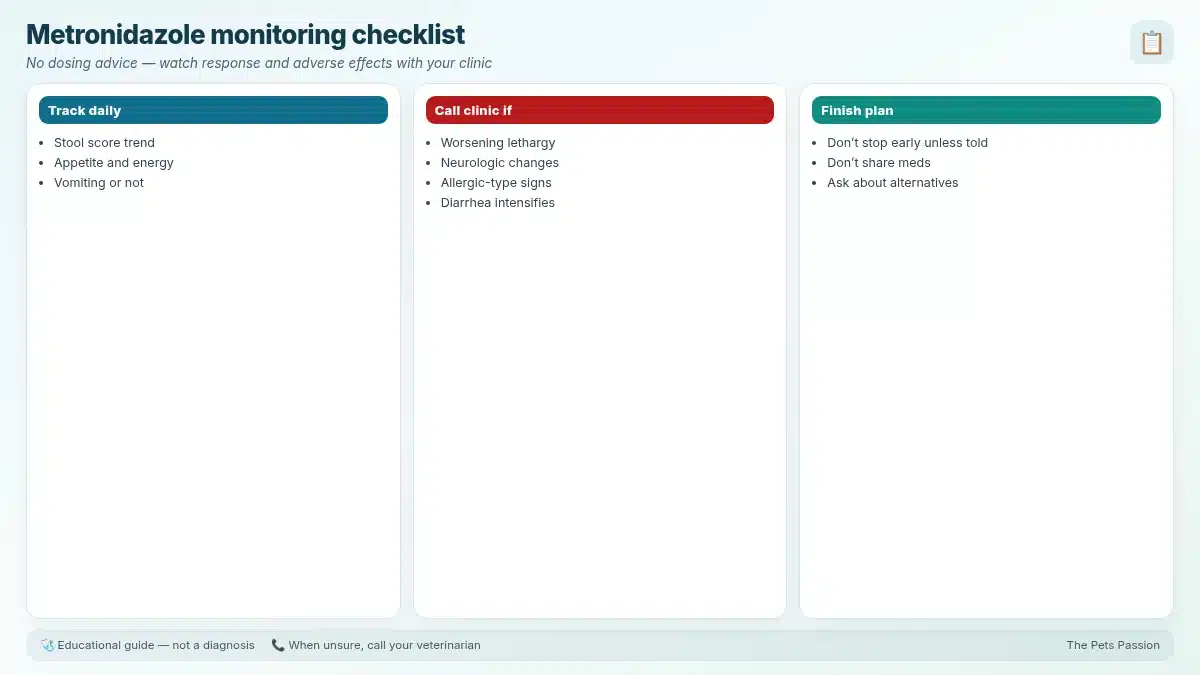
Per VCA, common issues can include:
- Nausea, vomiting, diarrhea
- Regurgitation
- Decreased appetite
- Tiredness
- Drooling (bitterness)
Stop and call your veterinarian immediately if you see:
- Poor coordination / ataxia
- Tremors or seizures
- Weakness
- Eye twitching
- Yellow gums/skin/eyes or sharp appetite collapse (liver toxicity concerns)
- Rare skin vasculitic-type signs (scaling, bruising, bumps)
Neurologic toxicity is the side-effect story every ER clinician wants owners to know, especially with high doses, long courses, or pets with liver disease. VCA lists caution in liver disorders, pets on blood thinners, and young animals; avoid in pregnancy/nursing and known hypersensitivity.
Drug interaction watch-outs VCA flags include certain chemo agents, cimetidine, cyclosporine, and phenobarbital, disclose every med and supplement.
Human safety: pregnant people should avoid accidental exposure; don’t crush pills into powder clouds.
Flagyl dogs: how it is given (process, not your dose)
VCA’s administration points:
- Give with food
- Shake liquids
- Do not double up missed doses
- Complete the course your vet set, if they set one
- Injectable forms stay in-clinic
Doses are weight-, indication-, and patient-specific. Publishing a mg/kg “just use this” table in a consumer SEO article would be reckless. If a website gives you a dose and you never saw a vet, close the tab.
What to try instead for everyday soft stool (vet-guided)
ENOVAT’s severity ladder puts supportive treatment first for mild cases and fluids + supportive care for moderate cases.
Owner-facing building blocks clinicians often discuss:
- Fresh water always; subcutaneous or IV fluids when dehydrated.
- Diet: veterinary GI diets or short bland feeding plans (bland diet guide; Cornell/VCA supportive diet notes).
- Fecal testing for parasites before the third random supplement.
- Probiotics? Optional; ENOVAT is neutral (FortiFlora vs Proviable).
- Skip antidiarrheal human meds unless specifically prescribed, some are unsafe.
Puppies and incomplete vaccines change the timeline, parvo testing may come before any debate about Flagyl (puppy diarrhea when to worry; how dogs get parvo; vaccine schedule tool).
How to talk with your vet if they mention metronidazole
Good client questions:
- “Are we treating a specific organism, or acute nonspecific diarrhea?”
- “Where does my dog sit on the mild / moderate / severe scale ENOVAT uses?”
- “If we skip antibiotics tonight, what monitoring instructions do I follow?”
- “What side effects should make me stop the drug?”
- “Is fenbendazole or another agent better if Giardia is confirmed?”
Bring a 48-hour stool log with fecal scores. Stewardship works best as a team sport, not a fight at the front desk.
If your dog is already mid-course and improving, do not stop abruptly based on a blog, call the prescribing clinic for advice.
Research snapshot: does metronidazole even shorten diarrhea?
Randomized work has challenged the old assumption that metronidazole meaningfully speeds recovery in uncomplicated acute diarrhea. ENOVAT’s evidence tables (and related reviews) find little justification for routine use in mild/moderate CAD; some comparisons suggest other agents or no antimicrobials perform similarly for stool duration. Exact study citations live in the Veterinary Journal ENOVAT paper.
Owner takeaway: “We always used Flagyl and they got better” often means the dog was going to get better anyway.
Q&A
Should dogs take metronidazole for diarrhea every time?
No. ENOVAT/WSAVA guidance recommends against antimicrobials for most mild and moderate acute diarrhea cases. Severe, fluid-refractory systemic illness is a different bucket.
Is Flagyl for dogs the same as human Flagyl?
Same drug molecule family; veterinary directions, concentrations, and legal extra-label use differ. Never self-dose with human leftovers.
What are metronidazole side effects dogs show first?
GI upset and drooling are common. Neurologic signs are the emergency pattern, ataxia, tremors, seizures, eye twitching (VCA).
Can I use metronidazole for yellow diarrhea at home?
No. Color alone doesn’t pick an antibiotic (yellow stool article).
My vet prescribed it, did they do something wrong?
Not automatically. Your dog may have a specific indication, severe disease, regional protocol differences, or a diagnosis not covered by the acute nonspecific diarrhea guideline. Ask them to walk through the reasoning. Guidelines inform care; they don’t examine your dog.
Are probiotics safer than metronidazole?
Different risk profiles. Probiotics are usually lower risk in stable pets but are not proven must-haves (ENOVAT Rec 8). Safety ≠ efficacy.
Red-flag diarrhea that needs a clinic, antibiotic debate aside
- Puppy / unvaccinated dog with acute GI signs
- Repeated vomiting, bloody or black stool
- Collapse, pale gums, severe pain
- Known toxin ingestion (chocolate toxicity)
- Diarrhea past Cornell-style watch windows (Cornell diarrhea)
Use symptom checker after, not instead of, calling when these appear.
Related reads from The Pets Passion
- Dog Diarrhea: Top Causes, Quick Fixes…
- Puppy Diarrhea When to Worry
- Bland Diet for Dogs with Diarrhea
- FortiFlora vs Proviable
- Dog Fecal Score Chart
- Why Is My Dog’s Poop Yellow?
- Pet Symptom Urgency Checklist
Should dogs take metronidazole for diarrhea? Sometimes, for the right diagnosis or severe systemic illness. For the everyday soft-stool majority, current ENOVAT/WSAVA-aligned thinking says skip the automatic Flagyl reflex, fix hydration and cause-hunting, and save antibiotics for the dogs who truly need them.
Mild vs moderate vs severe: owner translation of ENOVAT categories
ENOVAT’s recommendations hinge on severity language. Rough owner translation (your vet’s exam wins):
Mild: Dog is bright, eating/drinking, no meaningful dehydration, maybe annoying diarrhea. Outpatient supportive care. No antimicrobials per strong recommendations.
Moderate: Dog looks duller, some dehydration/hypovolemia signs, but systemic issues are expected to improve once fluids are replaced. Fluids + support. Still against routine antimicrobials (with lab-pattern exceptions noted in the guideline remarks).
Severe: Dog remains systemically ill despite adequate fluid therapy, think ongoing shocky picture, sepsis concern. This is where systemic antimicrobials enter the conversation, often IV in hospital.
Bloody stool alone does not auto-promote a dog from mild to “needs Flagyl.” ENOVAT separates hemorrhagic vs non-hemorrhagic and still says no antimicrobials for mild and moderate tiers.
Stewardship talk without the lecture tone
Antibiotic resistance isn’t an abstract slogan. The same drug classes show up in human medicine. Every unnecessary course in a self-limiting colitis case is a tiny vote for harder-to-treat infections later, in pets and people.
You are not a “bad owner” for asking, “Do we need an antibiotic, or can we support and recheck?” That question is aligned with WSAVA/ENOVAT messaging.
If metronidazole was already started
Don’t flush the remaining tablets into a panic spiral after reading a guideline PDF.
Call the clinic:
- Report current stool scores and energy.
- Ask whether the indication was Giardia, severe disease, or empiric habit.
- Ask whether finishing, shortening, or stopping is appropriate for this patient.
Abrupt internet-based discontinuation can be wrong for some infections and unnecessary for others, only the prescriber knows which bucket you’re in.
Monitoring checklist while on metronidazole
Daily:
- Appetite and vomiting
- Coordination on slippery floors (early ataxia clue)
- Stool score and color
- Hydration (gum moisture, skin tent with vet guidance)
Keep other pets from eating dropped tablets. Store bottles away from kids. Gloves for cleanup if a pregnant person is in the home (VCA exposure caution).
Alternatives your vet might discuss instead of reflexive Flagyl
- Watchful waiting + diet for mild cases
- Fenbendazole or other agents when parasites are documented
- Hospital fluids and injectable antimicrobials for true severe disease (drug choice per ENOVAT Rec 6, not necessarily metronidazole-first)
- Fiber modification or veterinary GI diets for colitis-pattern stools
- Referral to internal medicine for chronic cases rather than month six of rotating antibiotics
Chronic diarrhea workups beat chronic metronidazole loyalty.
Bottom-line owner script
“I’ve read that ENOVAT/WSAVA guidance advises against antibiotics for most mild and moderate acute diarrhea. Can you help me understand where my dog falls on that severity scale and why metronidazole is or isn’t part of today’s plan?”
That script is collaborative. It shows you did homework without accusing anyone. Good clinics welcome it.
Veterinary Review & Editorial Standard
This clinical guide was prepared using peer-reviewed veterinary literature and guidelines from leading veterinary associations. If your pet exhibits acute symptoms or distress, please seek immediate in-person veterinary emergency care.