How Big Will My Puppy Get? A Growth-Curve Estimate
 The Pets Passion Medical Team
YMYL / medical disclaimer: This guide from The Pets Passion is educational. Adult-size predictions from age and current weight are estimates with wide individual scatter—especially in mixed breeds. They are not radiographic bone-age reads, DNA reports, or feeding prescriptions. Rapid growth in large/giant breeds needs veterinary oversight to avoid developmental orthopedic problems. Seek care for failure to thrive, sudden weight loss, or painful lameness.
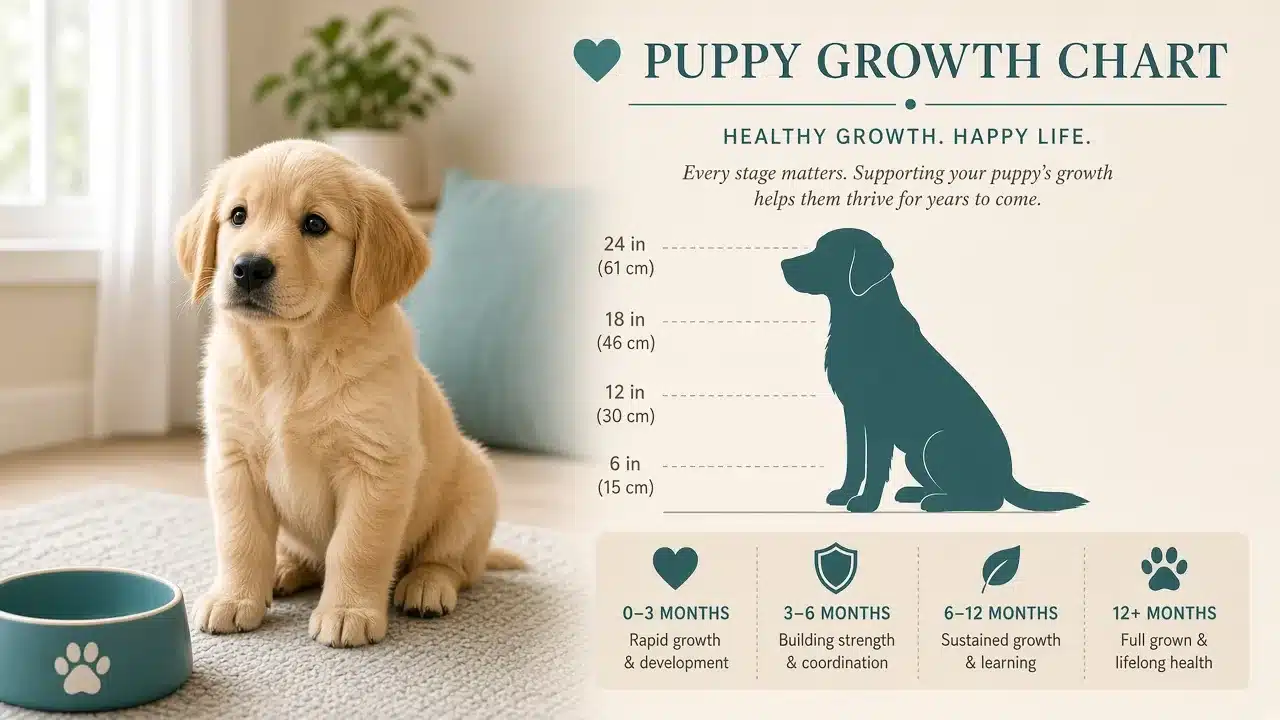
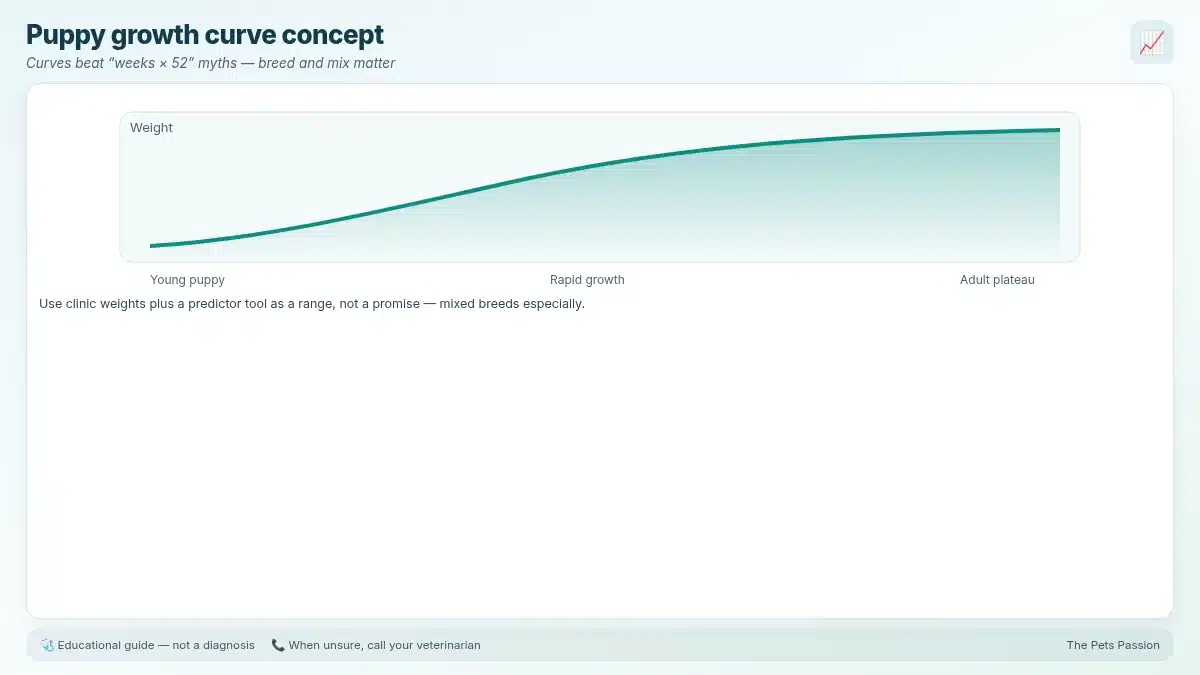
How big will my puppy get? The honest answer: genetics set the destination; age-and-weight curves estimate the mileage markers. Small breeds finish sooner; giant breeds can fill out toward 18–24 months. A better estimate than folklore (“double the four-month weight”) uses what fraction of adult weight a puppy of that size class has typically reached, then scales up. That is what our Puppy Weight Predictor is built to do—breed-size category + current age + current weight in, projected adult weight out.
Quick answer. How big will my puppy get?
| Size class (adult) | Often ~halfway near | Rough skeletal maturity window |
|---|---|---|
| Toy / small | ~4–5 months (often earlier % grown) | ~10–12 months |
| Medium | ~5–6 months | ~12–15 months |
| Large | Later than smalls (still growing hard at 6 mo) | ~15–18 months |
| Giant | Halfway later still | ~18–24+ months |
Why is the weeks × 52 puppy formula misleading?
A popular party trick is: adult weight ≈ current weight ÷ age in weeks × 52. It assumes roughly linear growth to one year. Real dogs are not straight lines. Small breeds finish early (the formula often overshoots). Giant breeds keep adding mass after 12 months (the formula can undershoot or confuse people into early free-feeding).
Growth visits pair naturally with shot timing—keep an age-by-age puppy vaccination schedule beside the weight curve.
Size also drives food, crates, and surgery risk—pressure-test the year using cost of owning a dog.
Bigger forecasts mean different energy math—translate adult size into portions with how many calories does my dog need.
Research on veterinary growth standards—such as Salt et al., PLoS ONE (2017), building centile charts from large primary-care weight datasets—shows different size categories genuinely grow differently. Use size-aware curves; treat any single formula as a sketch.
How does the puppy weight predictor estimate adult size?
Visit the Puppy Weight Predictor. Enter:
- Current weight
- Age in weeks (be accurate—8 vs 12 weeks changes everything)
- Breed size category the tool offers
Read the projected adult weight as a planning range mindset, even when one number displays. Recalculate every 2–4 weeks. A stable prediction across visits beats one dramatic forecast at 9 weeks.
Use the estimate for: crate sizing (dog crate size calculator when relevant), harness budget, and whether that “medium” dog bed is wishful thinking—not for forcing food to hit a number.
How big will my mixed-breed puppy get?
Unknown mixes: score the current size class by the puppy in front of you and by parental phenotypes if available. DNA breed ancestry tests can refine expectations but still produce ranges. Two siblings can land at different percentiles. Keep weighing.
If one parent is 8 kg and the other is 35 kg, expect a wide cone of uncertainty—and buy the adjustable harness.
Growth monitoring vs “he’s fine, he’s fluffy”
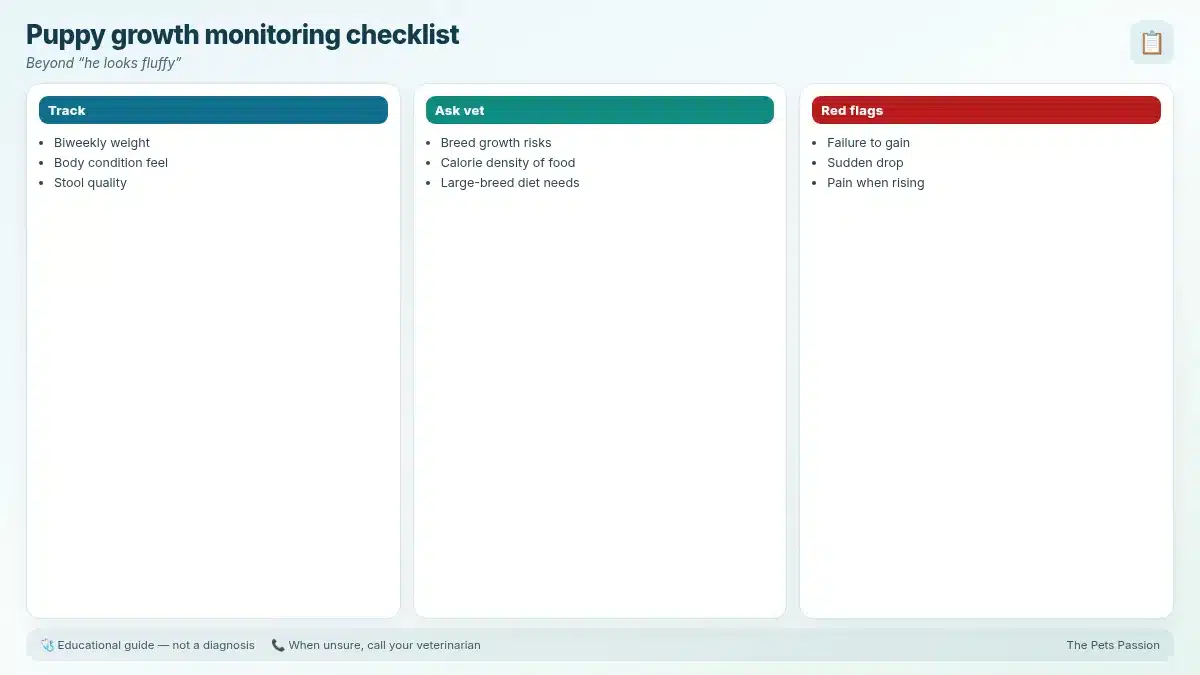
Weigh naked-wet after a bath jokes aside: use the same scale, same time of day, weekly for young puppies, then biweekly. Plot against your clinic’s preferred chart when offered. Crossing centiles rapidly upward in a large-breed puppy is a conversation about calories and orthopedic risk—not a brag.
Body condition still applies to puppies: ribs palpable under a thin cover, waist beginning to show as structure allows. Pair size prediction with the Dog Calorie Calculator once your vet green-lights adult or puppy feeding math—do not slim a growing giant-breed puppy on DIY deficit diets without guidance.
When is a puppy full grown?
Weight and height are not the same clock. Many dogs reach near-adult height before they finish muscling out. Sex hormones, neuter timing, and breed all influence growth plate closure—decisions that belong with your veterinarian, not an internet poll.
Rough owner-facing windows (individual exceptions abound):
- Toy/small: often largely done by ~10–12 months
- Medium: ~12–15 months
- Large: ~15–18 months
- Giant: may continue into year two
“Full grown” for sport conditioning may lag “mostly adult weight.”
Q&A
How big will my puppy get at 4 months?
Many small/medium puppies are somewhere near half of adult weight in the ballpark of 4–5 months; large/giant puppies are often less than halfway. Use the predictor with the correct size class rather than a universal double rule.
How accurate are puppy weight calculators?
Useful for planning bands; weak as guarantees. Accuracy rises after 12 weeks and with correct size class. Genetics and nutrition can move the outcome.
Can I speed up growth with extra food?
Pushing oversized calories into large-breed puppies can harm developing joints. Follow large-breed puppy diet guidance from your vet.
My puppy’s legs look huge. Is that a size clue?
Sometimes—paw and limb “clumsy” phases are common—but conformation optical illusions mislead. Trust serial weights and parental size more than Instagram comments.
Should I wait to buy a crate until adulthood?
Buy for the predicted adult size with a divider, or plan one upsizing. Measure expectations with the predictor first.
Related guides and tools
- Primary tool: Puppy Weight Predictor
- Dog Calorie Calculator
- Dog Crate Size Calculator
- Pet Vaccine Schedule tool
- Pet Budget (food scales with size)
- Kitten Growth for multi-species homes
Vet visit checklist for growth questions
- Birth date (or best estimate) documented
- Weight log (date + kg/lb)
- Parental weights if known
- Current food brand, amount, treats
- Fresh Puppy Weight Predictor screenshot
- Notes on lameness, exercise intolerance, or potbelly worms concern
- Questions on neuter timing and large-breed diet choice
Exercise: grow the joints you actually have
Until growth plates close, skip forced jogging beside bikes, repetitive ball-on-concrete marathons, and weekend “socialization” that is really unregulated wrestling with adult dogs twice the mass. Free play on soft surfaces, multiple short sessions, and training brain games build a dog you can adventure with later.
Predicted adult size should humble your expectations: a future 40 kg dog in a 12-week body is not a parkour athlete yet.
Spay/neuter timing and size (ask, don’t assume)
Research on timing, orthopedic risk, and certain cancers is breed- and sex-specific and still evolving in clinical recommendations. Some large-breed protocols delay elective neutering; others do not. This article will not pick your month. Bring size prediction + breed to a veterinarian who follows current evidence for your dog.
Nutrition labels: “puppy” vs “large breed puppy”
If adult size prediction points clearly into large/giant territory, ask whether a large-breed puppy formula (often with controlled calcium/energy density relative to some all-life-stage foods) is appropriate. The predictor informs the question; the vet answers it.
Track treats inside the daily budget—the adult ≤10% treat rule mindset still keeps pizza crust from becoming a growth plan.
Rescue unknowns: the special case
Shelter age estimates can be off by weeks. Recheck age with dental exam notes from the clinic. Recalculate the predictor when age is corrected—an “8-week 5 kg” puppy who is actually 12 weeks forecasts differently.
Foster carers: log weights every week so adopters inherit a curve, not a shrug.
Gear and budget: size is a line item
Larger adult weight means more food, pricier preventives by dose, sturdier crates, and sometimes higher insurance premiums. Map that with the Pet Budget and Pet Insurance Calculator once you have a predicted range. Buying three “intermediate” beds wastes more money than one correctly sized bolster.
Red flags during growth
- Persistent lameness or “bunny hopping”
- Reluctance to play vs housemates
- Swollen joints, fever
- Ravenous appetite with potbelly and poor coat (parasites/diet issues)
- Weight flatline for multiple weeks in a young puppy
Call the clinic. Size prediction is irrelevant if the puppy is painful or parasitized.
Sample prediction hygiene
- Weigh today.
- Enter data in the Puppy Weight Predictor.
- Save the number with the date.
- Repeat at +2 weeks and +4 weeks.
- If forecasts swing wildly, recheck age/size class or ask the vet to interpret the growth plot.
Myth vs growth reality
| Myth | Reality |
|---|---|
| "Double the 4-month weight always" | Size class changes the fraction grown |
| "Paws never lie" | Paws exaggerate |
| "Mixes always land mid-parent" | Inheritance is not an average button |
| "More food = better bones" | Oversupply can hurt large breeds |
| "One calculator visit is enough" | Serial estimates win |
Height vs weight: shopping for coats and cars
A lanky sighthound-mix may weigh less than a cobby bully-mix at the same shoulder height. Use weight prediction for food and meds; measure height and length for coats, car crates, and airline kennels. Bring both numbers when you shop.
Littermate comparisons
Breeders may show the heaviest sibling as destiny. Percentile spreads inside a litter are normal. Focus on your puppy’s curve and BCS, not sibling rivalry charts on group chats.
From puppy projection to adult maintenance
When the predictor’s month-to-month change shrinks and your vet says growth has matured, shift mental models from “growing” to “maintaining.” That is when adult MER math in the Dog Calorie Calculator and adult BCS targets take the wheel.
Teething, appetite dips, and “stalls” on the curve
Mild weight plateaus during illness recovery or heavy teething weeks happen. Two or more weeks of flat weight in a young puppy—especially with diarrhea, cough, or lethargy—needs a vet, not another calculator refresh. After treatment, expect catch-up gains; recalculate the Puppy Weight Predictor once the puppy is bright and eating steadily again.
Dehydration from GI upset can fake a dramatic overnight “loss.” Use the Pet Hydration Calculator as a general water-planning aid while you follow clinic fluid advice.
Show lines vs pet lines
Within one breed, working/show lines may differ in adult mass by several kilograms. If you know the lineage, prefer parental and grandparental weights over breed-average memes. The predictor’s size category still helps when lines are unknown.
International adopters and unit mix-ups
ag logs in kg while your brain shops in lb (or the reverse) creates phantom growth spurts. Pick one unit for the log; let the tool convert as needed. Write both on the vaccine record card so sitters do not “help.”
Socialization calendars are not size calendars
A future giant still needs gentle socialization on a vaccine-smart schedule. Size prediction should change how carefully you manage play partners, not whether you isolate the puppy for a year. Use your clinic’s guidance and our vaccine tools for timing—never skip vaccines because “he’s going to be big enough to handle parvo” (that is not how immunity works).
Training expectations scale with adult size
A 5 kg adult that jumps on guests is rude; a 40 kg adult that jumps on guests is bowling. Train four-on-the-floor now. Predicted size is a motivation poster for manners, not an excuse to delay training until “he grows into his brain.”
When predictions disagree with the breed standard
Standards list ideals; real dogs miss them. A purebred under the standard weight can still be healthy at a good BCS. Do not free-feed to chase a catalog number. Conversely, do not starve a growing puppy to stay “show fine” without professional guidance.
Photo documentation helps more than memory
Monthly side-view photos against the same doorframe catch height changes that scales miss. Combine photos + weights + predictor outputs in one phone album named “growth.” Your future self—and your vet—will thank you when someone asks how big will my puppy get at the six-month visit and you have receipts.
Supplements marketed for “bigger bones”
Unless your veterinarian diagnoses a deficiency, random calcium boosters on a complete puppy food can unbalance minerals—especially risky for large breeds. Skip the warehouse “mass gainer” culture. Growth quality beats growth quantity.
Heat cycles and intact growth (females)
Intact females may show temporary appetite/water shifts around seasons; weigh on a consistent schedule so hormonal weeks do not panic your curve. Spay timing remains a clinic decision tied to breed risk, not to hitting a predicted kilogram on the Puppy Weight Predictor.
Bottom line
How big will my puppy get? Somewhere inside a genetics-shaped range you can estimate earlier and better with size-aware growth curves than with folk rhymes. Make the Puppy Weight Predictor your primary CTA, reweigh often, feed for healthy growth—not for bragging rights—and let your veterinarian referee orthopedic and neuter timing questions the internet cannot settle.
Veterinary Review & Editorial Standard
This clinical guide was prepared using peer-reviewed veterinary literature and guidelines from leading veterinary associations. If your pet exhibits acute symptoms or distress, please seek immediate in-person veterinary emergency care.