
Apoquel vs Cytopoint: How Vets Choose (Plus Zenrelia)
 The Pets Passion Medical Team

YMYL / medical disclaimer: This comparison from The Pets Passion is educational. Apoquel (oclacitinib), Cytopoint (lokivetmab), and Zenrelia (ilunocitinib) are prescription therapies. Labels, boxed warnings, and clinic protocols change—verify with current product information and your veterinarian. This is not a prescription, dosing chart, or instruction to switch drugs at home.
Apoquel vs Cytopoint is the allergy-season argument that fills waiting rooms: daily tablet versus periodic injection. Both can quiet the IL-31 itch pathway story in different ways. Neither replaces flea control, infection treatment, or diet trials. A newer oral JAK option, Zenrelia (ilunocitinib), now sits beside Apoquel for many dermatology conversations, so a fair 2026 comparison is really a three-tool rack, not a coin flip.
Quick answer. Apoquel vs Cytopoint (with Zenrelia)
Itch drugs are step 4–5 after fleas, mites, yeast/bacteria, and ears are addressed. Triage odd systemic signs with the Pet Symptom Urgency Checklist.
What problem are we even treating?
Canine atopic dermatitis and allergic itch are chronic, waxing conditions. Drugs reduce pruritus and help skin heal. They do not “cure” the allergy. If you skip flea prevention, leave a Malassezia-laden armpit untreated, or never finish an elimination diet when food is a trigger, Apoquel vs Cytopoint debates become expensive theater.
Whatever you choose, score sleep, play, and itch nights on a dog quality of life scale so refills match real life.
OA pain is a different pathway than allergic itch—if your vet mentions an anti-NGF injection, review Librela side effects in the FDA context first.
Before any switch ladder:
- Confirm fleas (even indoor dogs).
- Cytology for bacteria/yeast.
- Ear exam.
- Rule out mites when the pattern fits.
- Decide whether a diet trial is on the table.
Dermatologists repeat this because relapses after a “perfect” Cytopoint month are often infection, not “antibody failure.”
Apoquel in plain language
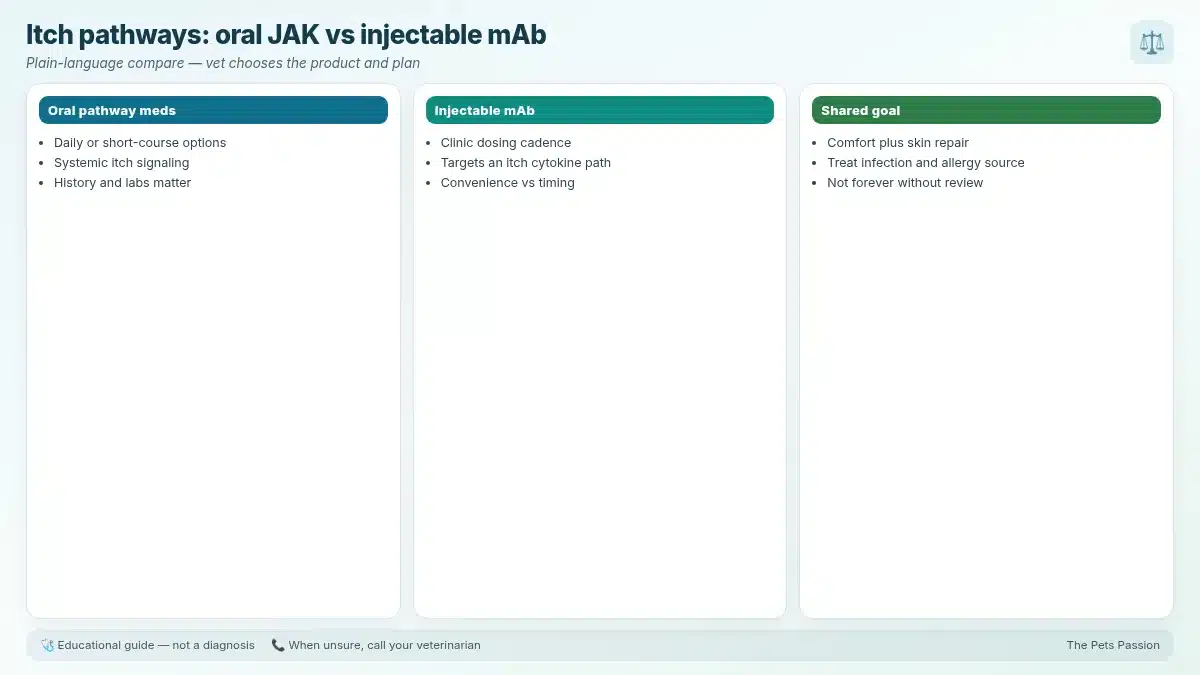
Oclacitinib inhibits Janus kinase pathways involved in itch and inflammation signaling. Clinics like it because many dogs scratch less within hours to a day.
Label-shaped practical points owners hear:
- Common induction: twice daily for 14 days, then once daily
- That step-down is where some households see itch creep back
- Not for dogs under 12 months (labeled age gate)
- Immunomodulatory risks: monitor for infections; discuss history of demodicosis or neoplasia with the vet
- May cause GI upset or other listed adverse effects—read the sheet you were handed
Apoquel shines when you need oral, adjustable, fast control and the dog is an adult with a clinic okay on risk profile.
Cytopoint in plain language
Lokivetmab is a caninized monoclonal antibody that binds IL-31, a cytokine strongly tied to the itch sensation. It is given by injection in the clinic.
Practical points:
- Labeled for allergic and atopic dermatitis clinical signs; usable in young dogs where JAK tablets are off the table
- Onset often within a few days
- Duration commonly discussed in the 4–8 week range, but some dogs shorten to 3 weeks and some stretch longer
- Repeat dosing can improve apparent success rates in some clinical observations (dermatology teaching notes describe rising success across successive monthly injections in case discussions)
- Less ideal as the only tool when ears and paws are severely infected/inflamed—those need local therapy
- During food trials, a long Cytopoint effect can muddy challenge timing—plan with the vet
Cytopoint shines for pill-averse dogs, many puppies with allergic itch, and owners who prefer a scheduled injection over daily tablets.
Zenrelia as the third oral option
Ilunocitinib (Zenrelia, Elanco) is another veterinary JAK inhibitor for allergic pruritus and atopic dermatitis in dogs meeting labeled age criteria. Marketing and clinical materials emphasize once-daily dosing without Apoquel’s day-14 frequency change.
A published head-to-head field study in client-owned dogs (PMC11885073) reported that once-daily ilunocitinib showed strong efficacy outcomes compared with oclacitinib’s standard regimen, including favorable clinical remission metrics at later time points in that trial. Adverse event rates were broadly similar between groups in the study narrative. That is one important trial—not a universal ranking for every dog.
Critical safety difference: Zenrelia carries an FDA boxed warning about inadequate vaccine immune responses. FDA’s Dear Veterinarian letter on Zenrelia and the DailyMed label instruct clinicians on vaccination timing: dogs should be current on vaccines before starting; do not vaccinate while receiving Zenrelia; discontinue for a labeled window before vaccines (materials discuss at least 28 days and up to 3 months before vaccination depending on guidance) and withhold after vaccination per label. This alone can decide Apoquel vs Zenrelia for a puppy finishing a vaccine series or a dog due for rabies.
Elanco materials also note no washout is generally required when switching between these short half-life JAK inhibitors—still a vet-supervised switch, not a kitchen-counter experiment.
Comparison table owners can screenshot
| Question | Lean Apoquel | Lean Cytopoint | Lean Zenrelia |
|---|---|---|---|
| Dog is 8 months old | Usually no (age) | Often yes | Usually no (age) |
| Cannot pill the dog | Poor fit | Strong fit | Poor fit |
| Needs same-day oral control for a trip | Strong fit | Injection timing must align | Strong fit if already on it |
| Itch returns when Apoquel goes SID | Reassess infection; consider Cytopoint or Zenrelia | Good bridge option | Designed as continuous SID JAK |
| Vaccines due soon | Often workable with vet timing | Usually workable | Plan holds carefully per boxed warning |
| History of serious infection / complex immune issues | Case-by-case caution | Sometimes preferred non-JAK path | Case-by-case caution |
| Large dog, cost pressure | Compare monthly tablet cost | Compare injection fee | Some clinics find JAK tablet economics favorable—ask for a written estimate |
Switch ladder (vet-directed)
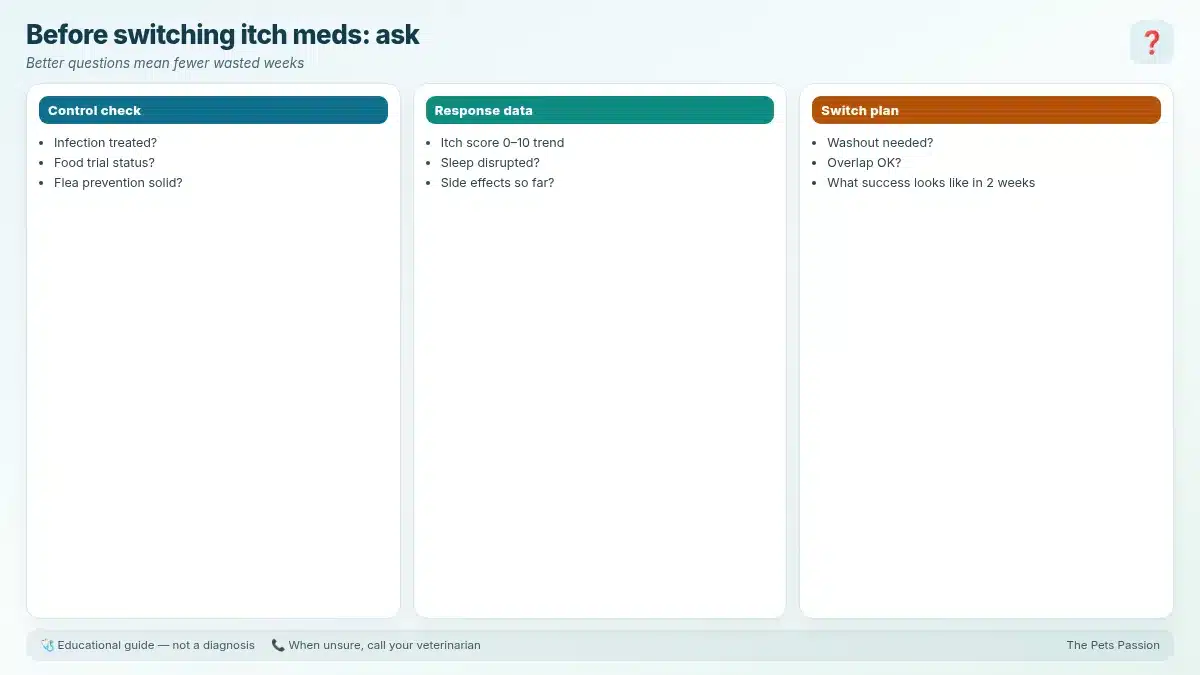
Use this as a conversation script, not a DIY flowchart.
Rung 0 — Fix the basics
Flea prevention on. Cytology done. Ears cleaned/treated. Hot spots addressed. If itch survives that, continue.
Rung 1 — Choose an induction tool
- Adult dog, can take pills, need speed → often Apoquel induction
- Young dog / no pills → Cytopoint
- Adult dog, vaccine schedule clear, want SID JAK from day one → Zenrelia discussion
Rung 2 — Measure response honestly
Score itch 0–10 daily for two weeks. Photograph belly and paws. Note sleep quality.
Rung 3 — If Apoquel fails at the SID step-down
- Recheck infection and fleas.
- Confirm dose still matches weight.
- Discuss returning to a short BID rescue only if the vet directs.
- Offer Cytopoint add-on or switch.
- Offer Zenrelia switch if vaccines allow.
Rung 4 — If Cytopoint “wears off” at week 2–3
- Infection check first (dermatology teaching emphasis).
- Parasite check.
- Dose band review.
- Consider scheduled monthly series rather than one-and-done.
- Add or switch to a JAK if age/risk fit.
Rung 5 — Chronic maintenance
Many dogs rotate seasonally, combine topical care, or move toward allergen-specific immunotherapy for long-game control. Itch pills/injections are tools, not personalities.
Never stop and start three immunomodulators in one week without clinical oversight.
Safety snapshot (not complete labels)
Shared JAK themes (Apoquel & Zenrelia): infection vigilance, bloodwork as recommended, neoplasia discussions, GI effects possible, avoid in unsuitable reproductive status per labels.
Cytopoint themes: injection-clinic product; hypersensitivity possible with biologics; variable duration; anti-drug antibodies can affect some patients over time.
Zenrelia unique: vaccine boxed warning—treat it as non-negotiable planning, not fine print.
For seizure-like events or acute collapse on any drug, emergency care first (symptom checker; seizure first-aid overview on site as relevant).
Q&A
Is Apoquel or Cytopoint better?
Neither wins universally. Match age, pill tolerance, vaccine calendar, infection status, and cost to the dog in front of you.
Can I use Apoquel and Cytopoint together?
Some dermatology plans combine them short-term. That is a specialist/clinic call because stacking immunosuppression/itch control changes risk. Do not freestyle.
What about Atopica (cyclosporine) or steroids?
Still in the toolbox. Steroids work fast but carry classic side effects. Cyclosporine is slower to peak. They appear when JAK/biologic paths fail or do not fit.
Will antihistamines replace these?
Usually not for true atopic-level itch. They may be adjuncts for mild cases.
How do I switch from Apoquel to Zenrelia?
Ask the prescribing vet. Manufacturer materials often state no prolonged washout is required between these short half-life JAKs, but concurrent overlapping without instruction is unwise. Confirm vaccine holds before Zenrelia starts.
Related guides and tools
- Pet Symptom Urgency Checklist
- Canine Quality of Life Scale
- Pet Medication Converter
- Dog Calorie Calculator (weight management helps atopic dogs)
Cost and logistics without the sales pitch
Compare monthly total: tablets + recheck fees vs injection + exam. Large dogs amplify tablet counts. Cytopoint is a clinic visit drug. Zenrelia availability and pricing vary by region and clinic purchasing.
Ask for a 90-day budget sheet. Surprise invoices destroy adherence.
Owner scenarios (anonymized patterns)
- Lab with seasonal itch, great pill taker → Apoquel springs/falls, Cytopoint during vacation months.
- 10-month doodle chewing feet → Cytopoint + topical antimicrobials until old enough for JAK discussion.
- Dog itchy every time Apoquel goes once daily → infection ruled out; switch to Zenrelia after vaccines confirmed current; sleep returns.
- Owner demands “strongest drug” while skipping flea prevention → none of the three look impressive until fleas die.
Checklist before you refill or reinject
- Flea prevention current
- Recent cytology if greasy/smelly skin
- Itch score diary for 7 days
- Vaccine dates reviewed (especially if Zenrelia is on the table)
- Clear plan for what “failure” means at day 14 / week 4
- Written stop/call triggers for GI, fever, lethargy, new lumps
- Follow-up appointment booked
Apoquel vs Cytopoint is a logistics and biology match. Add Zenrelia when a once-daily JAK fits and vaccines are planned honestly. Fix infections and fleas first, measure itch like an adult, and let your veterinarian drive the switches.
Infection masks: why “the shot stopped working”
Dermatology case teaching (including updated allergy therapy discussions used in continuing education) hammers one point: when Cytopoint seems to die at week two, look for yeast, bacteria, fleas, and otitis before declaring antibody failure. The same trap hits Apoquel and Zenrelia. Itch drugs reduce the scratch reflex; they do not sterilize a fold pyoderma.
Before any switch:
- Clip and cytology suspicious skin
- Smell-test ears; treat what you find
- Comb for fleas; update prevention even for “indoor only” dogs
- Recheck weight—underdosing a growing adolescent is common
Some clinicians note rising treatment-success percentages across successive monthly Cytopoint injections in observational teaching summaries. One soft month does not always predict the third.
Food trials and long-acting itch control
Cytopoint’s multi-week effect can hide a food flare during an elimination diet challenge. If a diet trial is planned, ask whether to time injections so you can still see itch return on a challenge. Apoquel and Zenrelia, being daily, are easier to pause briefly under veterinary instruction when a challenge window matters—still not a DIY stop.
Hydrolyzed or novel-protein trials fail when family members sneak treats. Probiotic flavor bases and dental chews break trials too. Write the allowed list on the fridge.
Measuring success without vibes
Use a 0–10 pruritus visual analog style score each evening for two weeks. Photograph axillae, belly, and paws weekly in the same light. Track sleep interruptions. Bring the log to the recheck. “He is still itchy” without numbers wastes months.
Quality-of-life tools (canine QoL scale) catch the dog that stopped hiking even when the belly looks clearer.
When steroids or cyclosporine re-enter
Short anti-inflammatory steroid courses still rescue crisis itch flares while you wait for slower tools. Cyclosporine (Atopica and generics) remains a maintenance option when JAK inhibitors or lokivetmab are unsuitable; expect weeks to peak effect and gingival overgrowth/GI talk-tracks. Allergen-specific immunotherapy is the long game for many atopic dogs once the diagnosis is solid.
Apoquel vs Cytopoint vs Zenrelia is rarely the last allergy sentence your dog will ever need.
Travel, boarding, and seasonal choreography
Plan itch control around real calendars. A dog flying next week may need oral JAK onset more than a delayed injection appointment. A boarded dog that refuses pills may need Cytopoint timed a few days before drop-off. Spring pollen spikes and fall weed seasons deserve pre-emptive rechecks, not panic refills at midnight.
Write the plan on the calendar: injection dates, vaccine holds for Zenrelia, fecal/cytology rechecks, and the itch-score habit. Allergy care fails from logistics as often as from pharmacology.
Veterinary Review & Editorial Standard
This clinical guide was prepared using peer-reviewed veterinary literature and guidelines from leading veterinary associations. If your pet exhibits acute symptoms or distress, please seek immediate in-person veterinary emergency care.