Dog Fecal Score Chart: What Scores 1–7 Mean
 The Pets Passion Medical Team
Medical disclaimer: Educational content from The Pets Passion only. A fecal score helps you describe stool to a veterinarian. It does not diagnose disease, replace fecal testing, or clear a sick puppy.
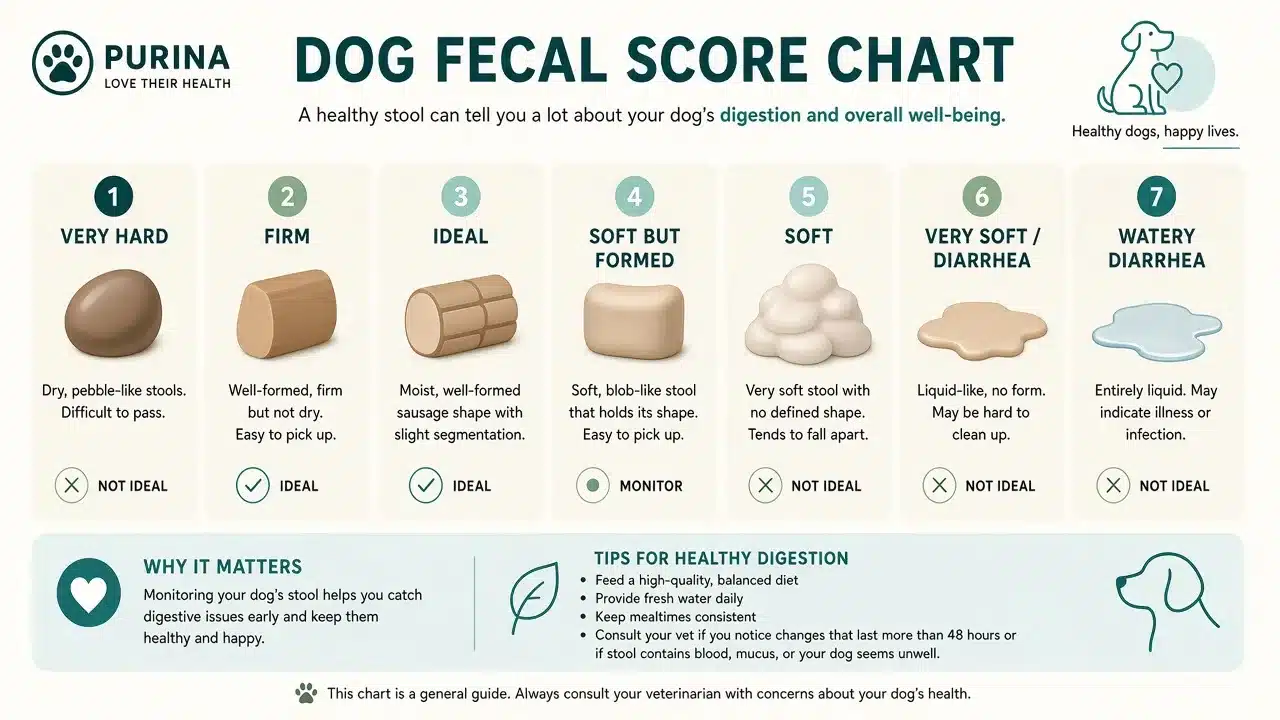
A dog fecal score chart turns “kinda soft?” into a repeatable number so you and your clinic speak the same language. Most teams use a 1–7 scale (often Nestlé Purina’s); score 2 is typically ideal—firm but pliable, segmented, easy to pick up. Scores 6–7 are diarrhea territory and worth logging with photos.
Direct answer: The Purina fecal scoring chart rates dog stool from 1 (very hard pellets) to 7 (watery puddles). Scores of 2–3 are typically ideal—firm, pliable, and easy to pick up. Persistent score 1, 6, or 7, blood, mucus, vomiting, or lethargy warrants veterinary care—not DIY diagnosis of the cause.
A dog fecal score chart turns “kinda soft?” into a repeatable number. Clinics and nutrition teams lean on consistent scales, often Nestlé Purina’s 1–7 system or the Waltham faeces scoring system, so owners and staff speak the same language. AAHA’s 2021 Nutrition and Weight Management Guidelines note that a fecal score can sit inside a nutrition screening exam and that using one system repeatedly improves trend-tracking.
Scores stuck at 5–6 after a bland reset? Ask your vet about evidence before you buy dog probiotics off the shelf.
Ideal stool for many healthy dogs lands around score 2: firm but pliable, segmented, easy to pick up with little residue. Score 1 is rock-hard. Scores 6–7 are diarrhea territory. Score 5 is the “pile that still has a shape but collapses when you scoop” zone, common after diet oopsies and worth tracking.
Quick answer
Use a 1–7 veterinary fecal score (commonly the Purina chart referenced by teaching hospitals and AAHA). Score 2 is typically ideal. Scores 2–3 are often called normal by clinical educators (Animal Medical Center NYC overview). What does fecal score 5 mean dog? Very moist stool that still has a distinct shape, usually in piles rather than neat logs; it leaves residue and loses form when picked up (Purina fecal scoring system PDF via Univ. of Missouri VHC).
The human Bristol stool chart for dogs is a cousin, not a copy, don’t force human type numbers onto canine charts without saying which scale you used.
Soft scores plus red flags (blood, vomiting, lethargy, puppy + incomplete vaccines) beat any chart: call a vet. Tool: Pet Symptom Urgency Checklist.
Dog poop score 1 to 7: the visual chart table
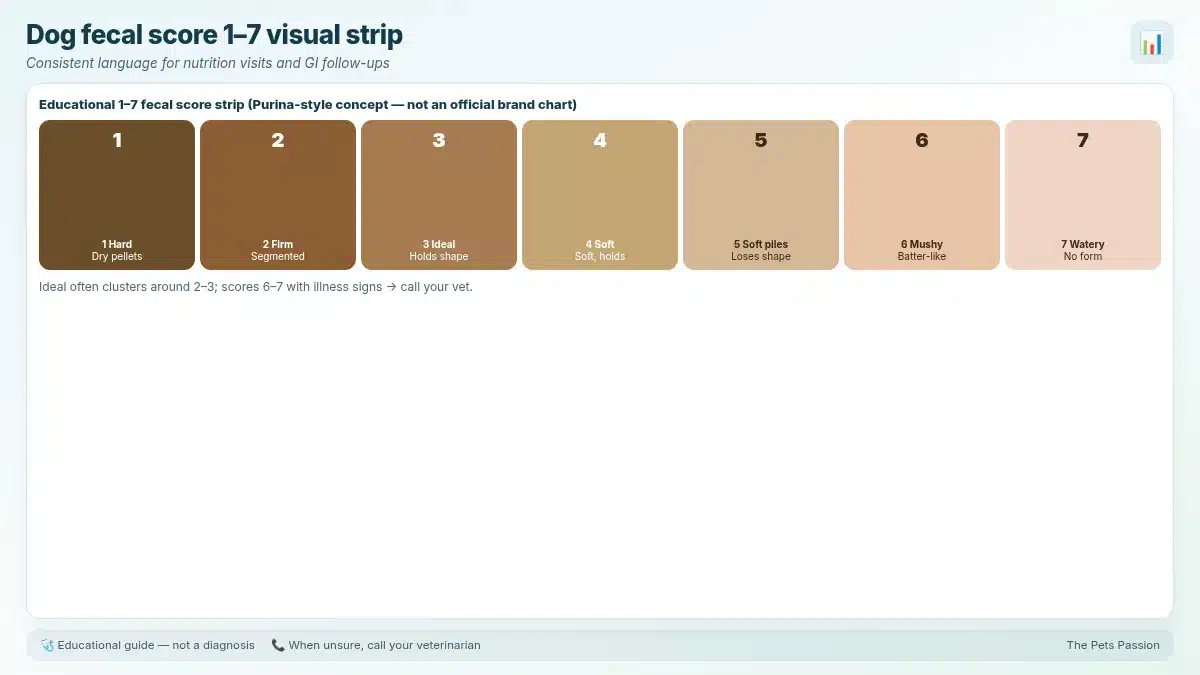
Descriptions below follow the widely used Purina Veterinary Diets fecal scoring language summarized in clinic handouts (Missouri VHC Purina chart; Purina fecal chart PDF).
| Score | Consistency (owner snapshot) | Pickup test | Rough clinical vibe |
|---|---|---|---|
| 1 | Very hard, dry; often individual pellets | No residue; takes effort to pass | Constipation / dehydration / fiber issues on differential |
| 2 | Firm but not hard; pliable; segmented | Little or no residue | Ideal for many dogs |
| 3 | Log-like; little segmentation; moist surface | Holds form; may leave light residue | Acceptable / soft-normal for some diets |
| 4 | Very moist (soggy); still log-shaped | Loses form when picked up; residue | Soft, watch trend |
| 5 | Very moist; distinct shape but in piles, not neat logs | Loses form; residue | Soft diarrhea-adjacent; common "call soon" zone if persistent |
| 6 | Texture but no defined shape; piles or spots | Residue | Diarrhea |
| 7 | Watery; no texture; flat puddles | N/A | Watery diarrhea, hydrate risk |
Print this table or screenshot it. Consistency beats poetry when you message the nurse line at 7 a.m.
Is the Bristol stool chart for dogs the same thing?
Short answer: no, not exactly.
The human Bristol Stool Scale runs types 1–7 from hard lumps to entirely liquid. Veterinary charts (Purina 1–7, Waltham systems cited by AAHA) were built for pet feces and nutrition communication. Numbers can look similar and still disagree on where “ideal” sits.
If you tell a vet “Bristol type 5,” say so. If you use Purina scoring, say “Purina fecal score 5.” Mixing scales without labeling them creates chart chaos.
What does fecal score 5 mean in a dog?
On the Purina-style chart, score 5 means:
- Stool is very moist
- It still has a distinct shape
- It presents in piles rather than tidy logs
- It leaves residue and loses form when picked up
That is softer than ideal. One score-5 after a greasy cheeseburger in a bright adult dog may settle. Daily score-5 stools for several days, score-5 with mucus or blood, or score-5 in a puppy deserve a plan.
Pair the number with volume and frequency:
- Large volume, fewer trips → often small-bowel pattern
- Small blobs, many trips, mucus, straining → often large-bowel pattern
The Purina handout contrasts small-bowel vs large-bowel diarrhea characteristics (frequency, mucus, blood color, tenesmus). Bring those details.
Related: Why is my dog’s poop yellow? if color shifted with the score.
How do I score my dog’s poop without overthinking it?
Step-by-step
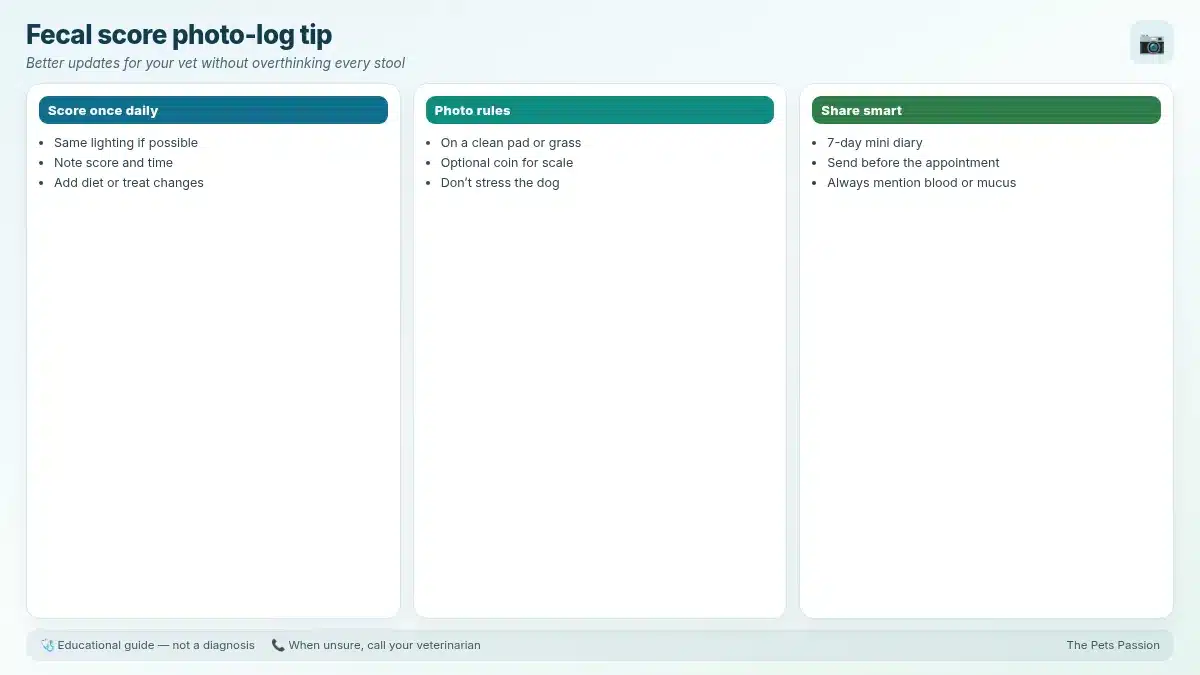
- Look at the freshest stool in good light.
- Ask: hard pellets, ideal pickup, soggy log, pile with shape, or puddle?
- Assign 1–7 from the table.
- Note color, mucus, blood, foreign material.
- Log date, time, diet, treats, and scoops that day.
- Repeat for 2–3 days if the dog is stable enough to monitor.
Uneven tip from clinic life: score the worst stool of the day when you’re deciding whether to call, and mention the range (“mostly 3s, one 6 after the park”).
Phone note template
Dog: Maya, 4y FS Lab mix
Score today: 5 (pile, moist, lost form)
Color: mustard yellow
Mucus: thin coat
Blood: none seen
Times: 4 overnight, 2 this morning
Appetite: ate breakfast
Energy: normal
Recent change: new dental chews Saturday
Vaccines: current
That paragraph saves ten minutes of “uhh it was soft?”
When should a fecal score send me to the vet?
Scores alone never trump systemic signs. Use the symptom checker as a second filter after common sense.
Urgent / ER patterns:
- Score 6–7 with vomiting, lethargy, or puppy + incomplete vaccines
- Any score with black/tarry stool or substantial fresh blood
- Score jump plus painful or bloated belly
- Dehydration signs (sticky gums, skin tenting, extreme thirst then crash)
Soon (same day / next business day depending on severity):
- Persistent scores ≥4–5 beyond ~24–48 hours in puppies or ~48–72 hours in adults who aren’t bouncing back (Cornell diarrhea timing)
- Chronic oscillation between 1 and 6 (diet trial / disease workup territory)
- Score 1 with painful straining (rule out constipation vs obstruction concerns with a vet, don’t force laxatives)
Background causes live in Dog Diarrhea: Top Causes… and puppy diarrhea when to worry.
Small bowel vs large bowel: reading the score with other clues
The Purina fecal scoring handout pairs scores with bowel localization hints:
| Clue | More small-bowel-ish | More large-bowel-ish |
|---|---|---|
| Frequency | Often normal-ish | Increased |
| Volume | Large | Small |
| Typical scores | 6–7 watery/semiformed | 4–5 gelatinous/semiformed |
| Straining (tenesmus) | Uncommon | Common |
| Blood | Darker / melena possible | Fresh red streaks |
| Mucus | Rare | Frequent |
Real dogs blur categories. Localization is a starting conversation, not a Facebook diagnosis.
How clinics use fecal scores in nutrition visits
AAHA frames fecal scoring as part of screening, useful when you change fiber, fat, or a veterinary GI diet and need an objective “before/after.”
Examples:
- Switching to a higher-fiber food for anal-gland issues → watch scores climb toward soft
- Pancreatitis recovery diet → aim back toward 2–3 without greasy score-5 piles
- Post-antibiotic soft stool → track daily until stable
If you’re dialing calories during recovery, the Canine Daily Calorie Calculator helps portion math while your vet sets the diet.
Q&A block
What is a normal dog poop score 1 to 7?
Many sources treat 2 as ideal and 2–3 as a normal band. Individual dogs on certain veterinary diets may live happily at a moist 3. Sudden change matters more than a single “perfect” number.
What does fecal score 5 mean if my dog seems fine?
It means stool quality is suboptimal. Fine energy buys you a short monitoring window, not a free pass to ignore week-long score-5 diaries. Ask about fecal testing for parasites before you stack probiotics.
Can I use a Bristol stool chart for dogs?
You can describe stools with Bristol language if that’s what you know, but tell the clinic which scale you used. Prefer a veterinary dog fecal score chart for diet trials your vet is running.
Does score 7 always mean parvo?
No. Score 7 means watery stool. Parvo is one of many causes, especially in young under-vaccinated dogs with lethargy and vomiting. Test decisions belong to the vet (Merck parvo). See how dogs get parvo.
Should I treat based on score alone with leftover metronidazole?
No. Scores guide description. Drug choice is a veterinary call. Current ENOVAT guidelines summarized via WSAVA recommend against antimicrobials for most mild and moderate acute diarrhea cases. Read metronidazole for dogs diarrhea.
Practical kit for home scoring
Keep a “poop kit” by the door. Sounds silly. Works.
- Phone note pinned with the 1–7 table
- Disposable gloves + bags
- Small sample containers if your clinic wants feces
- Backup photos folder labeled by date
- Link to bland diet guidance only for vet-approved mild cases
During food transitions, score daily for a week. Share the trend line, not one dramatic photo of the worst splat.
Common scoring mistakes
- Scoring only after the dog eats grass and freaks out, skews the log.
- Ignoring color, yellow, black, gray need words beside the number (yellow stool guide).
- Calling every soft stool “score 7”, crying wolf makes triage harder.
- Forgetting treats and dental chews in the diary.
- Waiting out score 6–7 in a 10-week-old because “the chart said monitor.” Puppies dehydrate fast (puppy diarrhea when to worry).
Related tools and reads
- Pet Symptom Urgency Checklist
- Why Is My Dog’s Poop Yellow?
- Dog Diarrhea: Top Causes…
- Bland Diet for Dogs with Diarrhea
- FortiFlora vs Proviable
- Pet Vaccine Schedule tool
A dog fecal score chart won’t cure anything. It will make your next vet call shorter, clearer, and harder to mishear, and that’s half the battle when stools go sideways.
Building a 7-day fecal score diary that vets actually use
A single number is a snapshot. A week of numbers is a trend. Here’s a simple diary format you can paste into Notes:
Day | AM score | PM score | Color | Mucus/Blood | Diet notes | Energy
Mon | 3 | 5 | brown | mucus thin | new chew | normal
Tue | 5 | 5 | mustard | none | bland AM | slightly quiet
.
Share the table at drop-off. Receptionists love you. Interns love you. You get faster plans.
Add body weight twice a week during diarrhea weeks, especially for small dogs. A 1 lb loss on a 10 lb dog is loud.
Diet changes and expected score shifts
| Change | Score often moves… | Watch for |
|---|---|---|
| Abrupt new protein | Toward 4–6 for a few days | Persistence beyond transition window |
| Higher soluble fiber | Firmer or softer depending on dog | Excess flatulence, skipping meals |
| Very high fat treat binge | Toward 5–7, maybe greasy | Abdominal pain → pancreatitis workup |
| Antibiotics | Temporary soft scores | Ask before adding random probiotics |
| Milk/lactose snacks | Soft piles in lactose-sensitive dogs | Easy fix: stop the cheese tax |
During elimination diet trials for itchy dogs, keep scores honest. Cheating with “just one” training treat invalidates weeks of work.
Portion math while recovering: calorie calculator.
Teaching kids and pet sitters to score
Hand them the 1–7 table and three rules:
- Photo if unsure.
- Never punish the dog for diarrhea.
- Text you immediately for blood, puddles (7), or a dog who seems “off.”
Sitters who only say “he was fine!” without scores leave you blind.
Using scores during boarding pickup
Ask the facility what scores they logged. Many chart “normal/abnormal” only. Translate:
- “A little soft” ≈ 4–5
- “Diarrhea” ≈ 6–7
- “Constipated” ≈ 1
If your dog returns at score 6, start the symptom checker and call your vet before the next group playdate. Stress colitis is real; so are kennel-shared parasites.
Fecal score vs fecal test: different jobs
Scoring describes what it looks like.
Fecal testing asks what organisms or blood markers are present.
You can have score 2 with whipworms. You can have score 7 with a negative float (wrong timing, viral disease, diet, etc.). Don’t skip lab work because the score “looked obvious.”
Accessibility tip: scoring without perfect vision
If color and sheen are hard to judge:
- Use phone macro photos with flash off (flash washes color).
- Ask a second person to confirm score.
- Focus on pickup residue and shape words: pellets / log / pile / puddle.
Shape alone gets you close on the Purina-style axis.
Score examples in plain English
Score 1: Goat pellets. Dog strains. You could bounce them (please don’t). Call if painful or unproductive straining continues.
Score 2: The dream log, segmented, picks up clean, maybe one tissue wipe of the grass.
Score 3: Softer log, moist shine, still holds together in the bag.
Score 4: Soggy log that sags when lifted, like soft-serve starting to melt.
Score 5: Cow-pie-ish pile with edges; shape exists until the bag touches it.
Score 6: Blob with texture, no architecture.
Score 7: Puddle. Bring towels and a vet plan.
Tape that translation next to the scientific table if your household hates numbers.
FAQ
What is the Purina fecal scoring chart?
It is a Nestlé Purina 1–7 scale that standardizes how moist and formed a dog’s stool is. Owners and veterinarians use the same numbers so “diarrhea” or “constipation” is clearer than vague descriptions. It assesses appearance, not the specific disease causing a change.
What does each Purina score 1–7 mean?
Score 1: very hard, dry pellets. Score 2: firm, pliable, segmented, little residue. Score 3: log-shaped, moist surface, holds form. Score 4: soggy log that loses form when picked up. Score 5: moist piles that lose shape. Score 6: textured piles/spots, no defined shape. Score 7: watery puddles with no texture.
What is the ideal dog fecal score?
Purina describes score 2 as ideal in healthy dogs—firm but not hard, pliable, segmented, easy to pick up. Veterinary nutrition texts often treat scores 2–3 as normal. Know your dog’s usual baseline; a sudden shift matters more than a single imperfect stool.
When should I see a vet about stool score?
Seek care for persistent score 1 (hard/dry) or scores 6–7 (loose/watery), stool with blood or lots of mucus, or changes lasting beyond a day or two—especially with vomiting, appetite loss, lethargy, or painful straining. Puppies, seniors, and dogs with chronic disease need earlier evaluation.
Can diet alone explain a fecal score change?
Diet, treats, scavenging, stress, parasites, infection, inflammation, and other illnesses can all change stool moisture. A chart helps you describe the problem; it does not replace fecal testing or a veterinary exam.
Is score 4 always a problem?
Not always—some dogs sit at a soft-but-formed 4 on certain diets. Rising from a usual 2–3 toward 5–7, or hard pellets at 1 with straining, deserves a call to your veterinarian.
How do I use the chart with my veterinarian?
Note the score for several days, any diet changes, and other symptoms. Sharing Purina scores (and photos) improves communication. Treatment depends on the cause your vet finds—not on assigning a score at home as a diagnosis.
Veterinary Review & Editorial Standard
This clinical guide was prepared using peer-reviewed veterinary literature and guidelines from leading veterinary associations. If your pet exhibits acute symptoms or distress, please seek immediate in-person veterinary emergency care.