
Chocolate Toxicity in Dogs: My Dog Ate Chocolate — What Now?
 The Pets Passion Medical Team

Medical disclaimer: Educational only. Calculators estimate risk; they don’t replace a licensed veterinarian or poison hotline. If your dog ate chocolate — especially dark, baking chocolate, cocoa powder, or an unknown amount — call your vet, an ER, or a poison hotline now. Don’t wait for symptoms.
Chocolate toxicity in dogs starts with three facts: weight, chocolate type, and amount eaten. Note those numbers, run our free chocolate toxicity calculator, and call a professional immediately. Mild signs can begin near 20 mg/kg of methylxanthines, cardiac effects near 40–50 mg/kg, and seizures at ≥60 mg/kg per the Merck Veterinary Manual — so “they seem fine right now” isn’t a safety plan.
Direct answer: Chocolate toxicity in dogs depends on theobromine dose and chocolate type. ASPCA/Merck-aligned thresholds often cite mild signs near 20 mg/kg, cardiotoxic risk around 40–50 mg/kg, and seizures at ≥60 mg/kg; baking and dark chocolate far exceed milk or white. Use our chocolate toxicity calculator, then call your veterinarian or Pet Poison Helpline—do not wait for symptoms.
How do I use the chocolate toxicity calculator first?
Before you scroll for comfort, run the numbers. Risk hinges on dog weight × chocolate type × amount.
Primary tool: Canine Chocolate Toxicity Risk Assessor
Have ready:
- Your dog’s weight (kg or lb)
- Chocolate type (or cocoa %)
- Estimated ounces or grams eaten
- Time of ingestion
- Fillings on the label (raisins, macadamia nuts, xylitol / sugar-free)
Then call:
- Your veterinarian or nearest emergency clinic
- ASPCA Animal Poison Control Center: (888) 426-4435 (ASPCA guidance)
- Pet Poison Helpline: (855) 764-7661 (Pet Poison Helpline chocolate calculator)
Hotlines often charge a consult fee. That fee buys toxicology expertise that speeds ER decisions.
Related tools: all calculators, pet toxic foods checker, pet symptom checker.
Why is chocolate toxic to dogs?
Understanding chocolate toxicity in dogs starts with theobromine and caffeine — methylxanthines dogs clear slowly.
Chocolate comes from Theobroma cacao. The problem ingredients are methylxanthines — mainly theobromine, plus some caffeine. Both stimulate the nervous system, push heart rate and contractility up, and act as diuretics.
Dogs absorb these compounds readily and clear them slowly. Merck lists a theobromine half-life in dogs around 17.5 hours, and caffeine around 4.5 hours. That’s why a calm first hour doesn’t mean you’re in the clear.
Cornell’s Riney Canine Health Center notes dogs can’t metabolize chocolate like people, and darker products sit at the top of the risk ladder. High-fat chocolates and baked goods can also trigger GI upset or pancreatitis even when the theobromine dose looks modest — white chocolate included.
A 12-lb (5.4 kg) Chihuahua and a 70-lb (32 kg) Labrador don’t share the same “one square” math. Small dogs, puppies, seniors, and dogs with heart disease often fare worse from the same mg/kg exposure.
How much chocolate is toxic for dogs?
There’s no single safe bite. Toxicity is dose-dependent and dog-specific. Merck’s widely cited clinical bands for total methylxanthines in dogs:
| Estimated methylxanthine dose | What may happen |
|---|---|
| About 20 mg/kg | Mild signs: vomiting, diarrhea, increased thirst |
| About 40–50 mg/kg | Cardiotoxic effects (abnormal heart rate/rhythm risk) |
| ≥ 60 mg/kg | Seizures may occur |
| Reported oral LD₅₀ 100–200 mg/kg | Potentially lethal range — severe illness can still hit at lower doses |
Source: Merck — Chocolate Toxicosis in Animals.
Merck also notes that for milk chocolate, roughly 62 g/kg (about 1 oz per lb of body weight) can be potentially lethal. Baking chocolate and cocoa powder reach dangerous doses with far smaller amounts.
Bottom line: Convert the exposure into an estimated mg/kg dose with the calculator, then verify with a veterinarian. Stories about other dogs “being fine” aren’t a safety standard.
Is dark chocolate worse than milk chocolate for dogs?
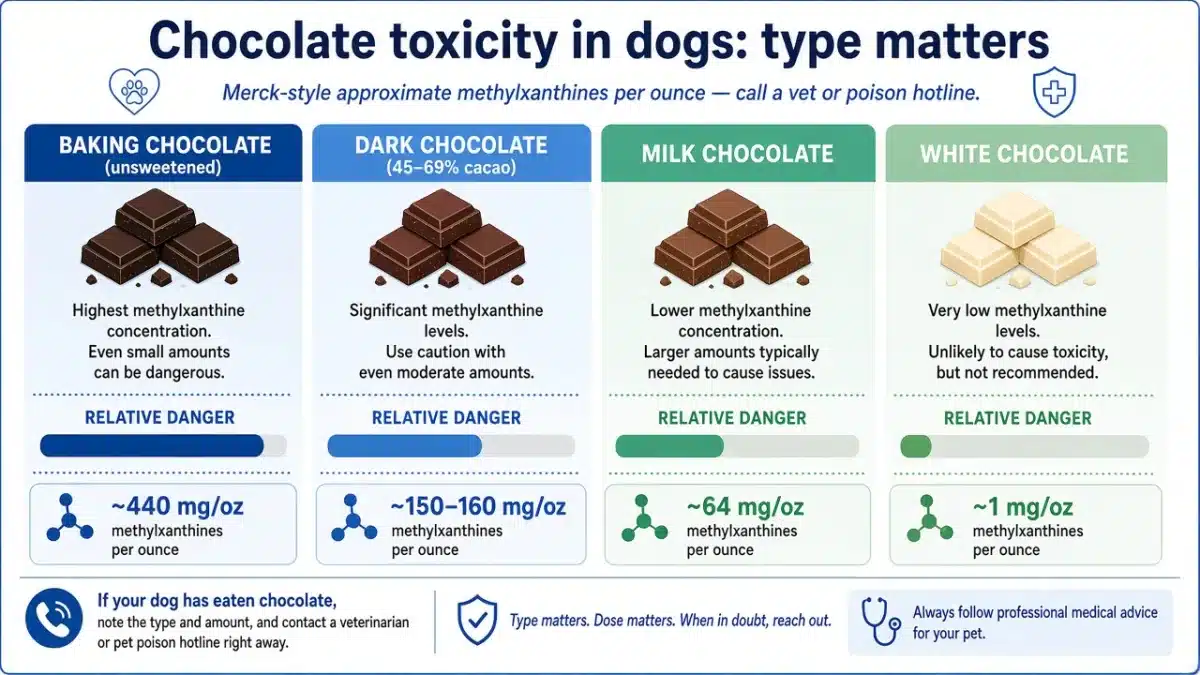
Yes — ounce for ounce. The darker and more concentrated the product, the more methylxanthines you pack into each bite. Merck’s approximate total methylxanthine content:
| Product | Approx. methylxanthines |
|---|---|
| Cocoa powder | 807 mg/oz (28.5 mg/g) |
| Unsweetened (baker’s) chocolate | 440 mg/oz (15.5 mg/g) |
| Semisweet / sweet dark chocolate | 150–160 mg/oz (5.3–5.6 mg/g) |
| Milk chocolate | 64 mg/oz (2.3 mg/g) |
| Cocoa bean hulls (mulch) | 255 mg/oz (9 mg/g) |
| White chocolate | ~1.1 mg/oz (negligible methylxanthines) |
Source: Merck methylxanthine table.
Practical takeaways
- Cocoa powder and baker’s chocolate are emergencies even in small amounts for many dogs.
- Dark / semisweet is substantially riskier ounce-for-ounce than milk (~150–160 vs ~64 mg/oz).
- Milk chocolate still causes toxicity — candy bowls and cookies are frequent sources.
- White chocolate is rarely a theobromine crisis, but fat and sugar can still cause GI illness or pancreatitis.
- A % cocoa label roughly scales with unsweetened content; Merck notes a 65% bar ≈ 286 mg/oz.
If the product also contains raisins, macadamia nuts, or xylitol, treat it as a multi-toxin emergency. Cross-check other hazards with the pet toxic foods checker.
What should I do if my dog ate chocolate?
Action steps for chocolate toxicity in dogs are the same whether you found a wrapper or caught them mid-bite.
Use this as a phone-side checklist, not a replacement for professional advice.
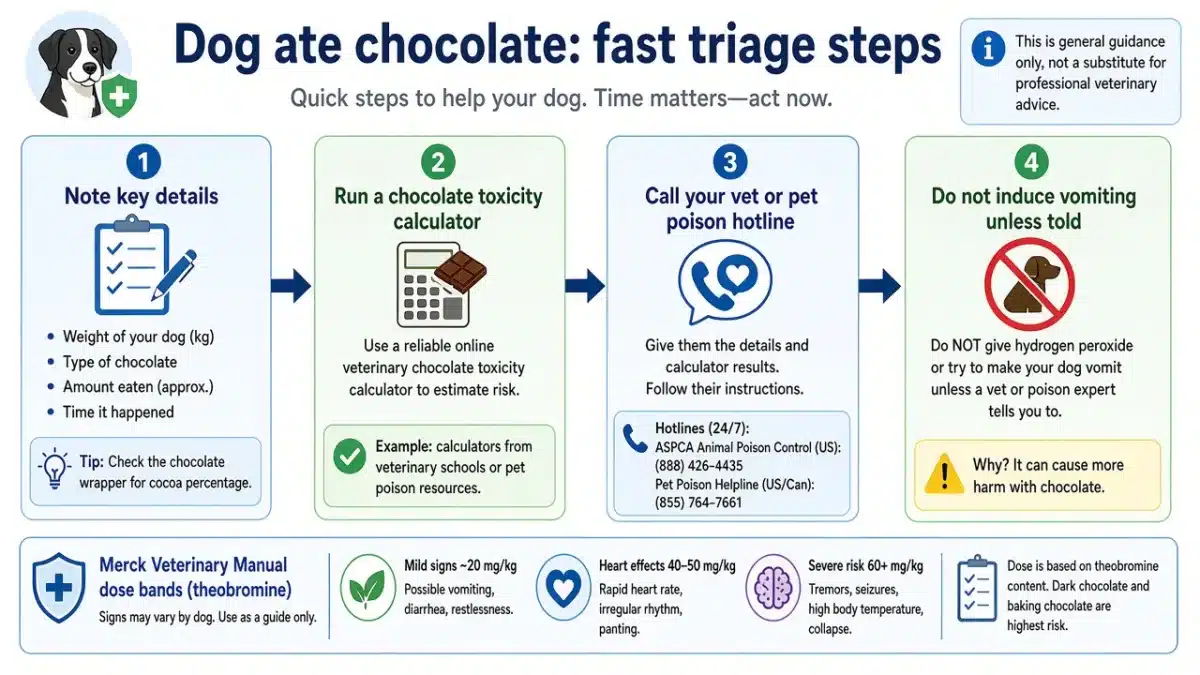
Chocolate triage (owner side): collect facts, run the calculator, call a professional — then branch on signs and risk.
| Step / branch | What to do |
|---|---|
| Start | Dog ate chocolate (or you strongly suspect it). |
| Collect facts | Weight, chocolate type, amount, time, extra ingredients (raisins, xylitol, macadamia, etc.). |
| Estimate risk | Run the chocolate toxicity calculator. |
| Call for guidance | Your vet, an ER, ASPCA Animal Poison Control (888-426-4435), or Pet Poison Helpline (855-764-7661). |
| Signs now? (vomiting, restlessness, tremors, collapse, seizure) | Yes: emergency clinic now. No: follow the clinician’s decontamination / monitoring plan. |
| Unknown amount, baking/cocoa/dark bar, or small dog? | Assume higher risk until a professional says otherwise. |
| After the crisis | Monitor 24–72 hours; watch GI signs and delayed pancreatitis risk. |
Phone script
- “My dog ate chocolate.”
- Weight and age/breed if known.
- Exact product name and type (bring the wrapper).
- Estimated amount eaten and time.
- Current symptoms: vomiting, diarrhea, panting, tremors, seizures, collapse.
- Other ingredients on the label.
If neurologic signs appear, seek emergency care first. For context later, our seizures causes guide and dog seizure what to do walk through first aid — after you’ve already called for help.
What do chocolate poisoning symptoms look like over time?
Recognizing chocolate toxicity in dogs early still means you should have already called — symptoms can lag hours behind ingestion.
Merck reports signs usually begin within 6–12 hours after ingestion. Cornell notes timing can vary. Because theobromine clears slowly, signs may persist up to 72 hours in severe cases (Merck).
Early / milder signs
- Vomiting
- Diarrhea or soft stool (dog diarrhea guide)
- Increased thirst and urination
- Restlessness, pacing, agitation
- Panting
Progressive / serious signs
- Hyperactivity or ataxia (wobbly gait)
- Muscle tremors or rigidity
- Rapid or irregular heartbeat
- Elevated body temperature
- Hypertension or other cardiovascular instability
- Seizures
- Collapse, bluish gums, or coma in life-threatening cases
Death, when it occurs, is generally linked to cardiac arrhythmias, hyperthermia, or respiratory failure (Merck). High-fat products may also spark pancreatitis later.
Never “watch and wait” through progressive neurologic or cardiac signs. Use the pet symptom checker only after you’ve already contacted a veterinarian.
What should I never do at home?
Well-meaning internet advice causes preventable harm:
- Don’t induce vomiting with salt, mustard, ipecac, or random kitchen mixes. Salt can cause dangerous sodium imbalance; home methods often fail or cause aspiration.
- Don’t give hydrogen peroxide unless a veterinarian or poison hotline specifically instructs you on dose, timing, and candidacy. Veterinary emesis belongs to people who know contraindications (already vomiting, seizuring, late timing, brachycephalic risk, and more).
- Don’t self-dose activated charcoal. Timing and dose are clinical decisions; Merck also notes electrolyte concerns with charcoal in chocolate cases.
- Don’t give human heart, seizure, or stimulant medications.
- Don’t assume white chocolate or “just a little” milk chocolate is automatically safe — especially for small dogs or if xylitol is present.
- Don’t delay calling because a calculator said “low.” Estimates miss wrong wrappers, underestimated amounts, and dangerous fillings.
Cornell’s first-aid for poisonous substances guidance: call a veterinarian or poison control first; inducing vomiting is sometimes contraindicated.
How do veterinarians treat chocolate toxicity?
Clinic care for chocolate toxicity in dogs is individualized to dose estimate, timing, and clinical signs.
Treatment is individualized. Clinicians may induce emesis when appropriate, consider activated charcoal selectively, give IV fluids, control vomiting/tremors/seizures, monitor arrhythmias and temperature, and hospitalize when dose or signs warrant it. There’s no simple at-home antidote. Early professional decontamination often reduces severity (Merck).
Ask what to watch for overnight: appetite, stools, heart rate vibe (restlessness, panting), and any tremor. Write down the times. Bring that log to recheck conversations.
How can I prevent the next chocolate grab?
- Store chocolate, baking cocoa, and cocoa powder in closed cabinets — not on counters a Labrador can clear.
- Manage holiday candy bowls. Valentine’s, Easter, Halloween, and Christmas are peak seasons in ASPCA clinical literature.
- Keep cocoa-bean hull mulch away from diggers.
- Remind guests chocolate isn’t a dog treat.
- Use gates during baking days if your dog scavenges.
- Bookmark the chocolate toxicity calculator and toxic foods checker before you need them.
A muffin tin on a coffee table looks harmless until a Beagle empties it. Prevention beats an ER invoice.
What if the amount or type of chocolate is unknown?
Guess carefully toward the higher risk. Assorted holiday boxes, crushed wrappers under the couch, and half-eaten brownies hide more theobromine than a neat recipe card. ASPCA toxicology guidance has long recommended worst-case assumptions when the assortment includes dark pieces.
Tell the hotline:
- Smallest possible dog weight if you’re between scale readings
- Darkest chocolate type that could have been in the mix
- Maximum amount that could be missing from the package
A 6-lb (2.7 kg) Yorkie that may have eaten baker’s chocolate is a different emergency than a 90-lb (41 kg) Mastiff that licked a milk-chocolate smear. Don’t average those stories together.
If raisins, macadamia nuts, or xylitol are on the label, say that in the first sentence of the call. Multi-toxin exposures change triage faster than fine-tuning ounce estimates.
Keep the empty wrapper in a ziplock for the ER. Photos of the nutrition panel help when the front of the package is torn.
How do holidays change chocolate toxicity risk?
Halloween buckets, Advent calendars, Valentine samplers, and Easter nests put chocolate at dog-nose height. Guests who “just wanted to share one kiss candy” create the same math problem as a counter-surfing Labrador.
Before parties:
- Park candy in a latching cabinet, not a low coffee table bowl
- Brief kids and guests in one sentence: chocolate is a dog toxin
- Crate or gate scavengers while packaging is open on the floor
- Save the chocolate toxicity calculator in your phone favorites
After a scare, do a house sweep for foil wrappers behind cushions. One missed square of baker’s chocolate still counts.
FAQ: chocolate toxicity in dogs
What should I do if my dog ate chocolate?
Collect weight, chocolate type, amount, and time. Call your veterinarian or a poison hotline immediately. Use the chocolate toxicity calculator to quantify risk while you arrange care. Don’t wait for vomiting or tremors.
How much chocolate is toxic for dogs?
It depends on methylxanthine dose (mg/kg) = type × amount ÷ body weight. Merck’s bands start near 20 mg/kg (mild), 40–50 mg/kg (cardiac), and ≥60 mg/kg (seizures). Baking chocolate and cocoa powder reach those bands with much less product than milk chocolate.
Is dark chocolate worse than milk chocolate for dogs?
Yes, ounce for ounce. Merck lists semisweet/sweet dark around 150–160 mg/oz versus about 64 mg/oz for milk. Baker’s (~440 mg/oz) and cocoa powder (~807 mg/oz) sit higher still.
Can a dog die from eating chocolate?
Yes. Merck cites a reported oral LD₅₀ of 100–200 mg/kg, notes severe disease can occur at lower doses, and links fatalities to arrhythmias, hyperthermia, or respiratory failure.
How long after eating chocolate will a dog get sick?
Often within 6–12 hours (Merck). Signs may last up to 72 hours in severe cases.
Is white chocolate toxic to dogs?
White chocolate has negligible methylxanthines (~1.1 mg/oz per Merck), so classic theobromine toxicosis is unlikely from typical amounts — but fat/sugar can still cause GI upset or pancreatitis, and sugar-free products may contain xylitol.
Should I make my dog throw up after eating chocolate?
Only if a veterinarian or poison specialist directs you, using their exact method. Don’t invent a home emetic plan.
What if my dog ate chocolate chip cookies or brownies?
Treat it seriously: estimate chocolate content, check for raisins or xylitol, run the calculator, and call a professional. Baked goods add fat that may worsen pancreatitis risk.
Sources
- Hayes C. Chocolate Toxicosis in Animals. Merck Veterinary Manual. https://www.merckvetmanual.com/toxicology/food-hazards/chocolate-toxicosis-in-animals
- Merck chocolate toxicity calculator. https://www.merckvetmanual.com/multimedia/clinical-calculator/chocolate-toxicity-calculator
- Cornell Riney Canine Health Center. Chocolate toxicity. https://www.vet.cornell.edu/departments-centers-and-institutes/riney-canine-health-center/canine-health-topics/chocolate-toxicity-what-should-i-do-if-my-dog-eats-chocolate
- Cornell. First-aid for poisonous substances. https://www.vet.cornell.edu/departments-centers-and-institutes/riney-canine-health-center/canine-health-information/first-aid-poisonous-substances
- ASPCA. What to Do If Your Pet Gets into Chocolate. https://www.aspca.org/news/what-do-if-your-pet-gets-chocolate
- Pet Poison Helpline. Dog Chocolate Toxicity Calculator. https://www.petpoisonhelpline.com/blog/dog-chocolate-toxicity-calculator/
Related on The Pets Passion: chocolate calculator · toxic foods checker · symptom checker · all tools · seizure causes · dog diarrhea guide
FAQ
Why is chocolate toxic to dogs?
Chocolate contains methylxanthines—mainly theobromine, plus caffeine—that dogs metabolize slowly. Effects can include vomiting, diarrhea, restlessness, rapid heart rate, tremors, seizures, and in severe cases death.
What theobromine dose is dangerous?
ASPCA Animal Poison Control experience and Merck Veterinary Manual commonly cite mild signs near 20 mg/kg of methylxanthines, cardiotoxic effects around 40–50 mg/kg, and seizures at doses ≥60 mg/kg. These are clinical guideposts—not DIY go/no-go rules.
Which chocolate is most dangerous?
Toxicity rank is generally baking (unsweetened) > dark/semisweet > milk > white. Merck lists approximate methylxanthine content such as ~440 mg/oz baking chocolate, ~150–160 mg/oz dark, ~64 mg/oz milk, and negligible amounts in white chocolate. Cocoa powder can be extremely concentrated.
Is white chocolate safe for dogs?
White chocolate is a negligible theobromine source but is high in fat and sugar and can still cause gastrointestinal upset or pancreatitis risk. Treat any chocolate ingestion as a reason to check dose and call a professional—especially in small dogs.
How do I estimate risk quickly?
Note your dog’s weight, chocolate type, and how much may have been eaten. Use our chocolate toxicity calculator, then contact your veterinarian, an emergency clinic, ASPCA Animal Poison Control, or Pet Poison Helpline. Calculators support triage; they do not replace care.
What should I do right after my dog eats chocolate?
Do not induce vomiting unless a veterinarian or poison hotline specifically instructs you. Keep packaging for type/amount, prevent further access, and call for guidance even if the dog still acts normal—signs can be delayed.
When is chocolate ingestion an emergency?
Large amounts of baking or dark chocolate, small body weight, known heart disease, or onset of vomiting, agitation, tremors, collapse, or seizures require emergency veterinary care now.
Why is chocolate toxic to dogs?
Chocolate contains methylxanthines—mainly theobromine, plus caffeine—that dogs metabolize slowly. Effects can include vomiting, diarrhea, restlessness, rapid heart rate, tremors, seizures, and in severe cases death.
What theobromine dose is dangerous?
Merck and poison-control guidance commonly cite mild signs near 20 mg/kg of methylxanthines, cardiac effects around 40–50 mg/kg, and seizures at doses of 60 mg/kg or higher. These are clinical guideposts, not DIY go/no-go rules.
Which chocolate is most dangerous?
Toxicity is generally baking or unsweetened chocolate greater than dark or semisweet, greater than milk, greater than white. Approximate methylxanthine content is about 440 mg/oz for baking, 150–160 mg/oz for dark, 64 mg/oz for milk, and negligible in white; cocoa powder can be extremely concentrated.
Is white chocolate safe for dogs?
White chocolate is a negligible theobromine source but is high in fat and sugar and can still cause gastrointestinal upset or pancreatitis risk. Sugar-free products may contain xylitol; check the dose and call a professional, especially for small dogs.
How do I estimate risk quickly?
Note your dog’s weight, chocolate type, and how much may have been eaten. Use the chocolate toxicity calculator, then contact your veterinarian, an emergency clinic, ASPCA Animal Poison Control, or Pet Poison Helpline. Calculators support triage; they do not replace care.
What should I do right after my dog eats chocolate?
Do not induce vomiting unless a veterinarian or poison hotline specifically instructs you. Keep packaging for type and amount, prevent further access, and call for guidance even if the dog acts normal because signs can be delayed.
When is chocolate ingestion an emergency?
Large amounts of baking or dark chocolate, small body weight, known heart disease, or onset of vomiting, agitation, tremors, collapse, or seizures require emergency veterinary care now.
Triage steps when a dog may have eaten chocolate: note weight, chocolate type, amount and time; use a toxicity calculator; call a veterinarian, emergency clinic, or poison hotline; and do not induce vomiting unless a professional specifically instructs you.
Note your dog’s weight, chocolate type, amount, and time
Record body weight, chocolate type or cocoa percentage, estimated amount eaten, time of ingestion, and any raisins, macadamia nuts, or xylitol on the label.
Use the chocolate toxicity calculator
Enter the weight, chocolate type, and amount to estimate methylxanthine exposure. Use the result to support triage, not as a substitute for professional care.
Call a veterinarian, ER, or poison hotline
Call your veterinarian or nearest emergency clinic promptly, or contact ASPCA Animal Poison Control or Pet Poison Helpline. Share the weight, product, amount, time, and current symptoms.
Do not induce vomiting unless a professional instructs you
Do not use salt, mustard, ipecac, random kitchen mixes, or hydrogen peroxide unless a veterinarian or poison hotline specifically directs it. Follow the clinician’s exact decontamination and monitoring plan.
Veterinary Review & Editorial Standard
This clinical guide was prepared using peer-reviewed veterinary literature and guidelines from leading veterinary associations. If your pet exhibits acute symptoms or distress, please seek immediate in-person veterinary emergency care.