
Puppy Vaccination Schedule: Age-by-Age 16-Week Shots
 The Pets Passion Medical Team

Puppy Vaccination Schedule: Age-by-Age Shots and Safer Outdoor Timing
Medical disclaimer: Educational only from The Pets Passion. Not a substitute for an individualized veterinary vaccine protocol. Local rabies laws, product labels, shelter risk, maternal antibodies, and your puppy’s health all change timing. Confirm every dose with your licensed veterinarian.
A solid puppy vaccination schedule usually starts core combo shots (DA2PP/DHPP) at 6–8 weeks, repeats every 2–4 weeks until at least 16 weeks (sometimes 18–20 in high-risk settings), adds rabies per local law around 12–16 weeks, and — under current AAHA North America guidance — includes a two-dose leptospirosis series starting at ≥12 weeks. Map the dates with our free Pet Vaccination & Preventative Care Schedule, then verify every product with your clinic.
How do I plan shots with The Pets Passion vaccine tool?
Memorizing every date is less useful than sharing a calendar with your clinic.
Until the series is finished, treat yards and dog-park grass as risk zones—especially if you need the facts on how long parvo lives outside.
Primary tool: Pet Vaccination & Preventative Care Schedule
Have ready:
- 1. Puppy date of birth (or best estimate)
- 2. Vaccines already given (product names if known)
- 3. Lifestyle risks (boarding, daycare, hiking, ticks, standing water, travel)
- 4. Your state or local rabies rules
Related tools: all calculators, Pet Symptom Urgency Checklist, Puppy Adult Weight & Growth Estimator.
Why do puppies need a series instead of one shot?
A puppy vaccination schedule is a series on purpose — maternal antibodies fade on different calendars.
Puppies get temporary protection from maternally derived antibodies (MDA) in colostrum. Those antibodies fade at different rates — often over the first 12–16 weeks — and while present they can block modified-live vaccines from “taking.”
That’s why a single early shot isn’t enough. The AVMA notes the final vaccination in the initial series is given at 16 weeks or older; Cornell describes visits starting at 6–8 weeks and continuing until 16–20 weeks.
Takeaway: The puppy shot schedule covers the gap as maternal antibodies decline — so your puppy isn’t left unprotected between “too early for a reliable vaccine response” and “ready for adult boosters.”
What are core vs non-core vaccines for puppies?
Core vaccines (recommended for essentially all dogs)
Per AAHA’s core/non-core framework (AAHA recommendations):
| Core antigen | Why it matters | Typical puppy timing |
|---|---|---|
| Distemper (CDV) | Severe multi-system disease; young dogs most vulnerable | Combo; ≥3 doses between 6–16 weeks |
| Adenovirus type 2 | Protects against hepatitis/respiratory adenovirus | Same combo series |
| Parvovirus | Highly contagious; bloody diarrhea and dehydration | Combo boosters every 2–4 weeks until 16–20 weeks |
| Leptospirosis | Bacterial, zoonotic, outdoor exposure risk | Core; start ≥12 weeks; 2 doses then annual |
| Rabies | Fatal; legal requirement | As required, often 12–16 weeks |
Parainfluenza is frequently bundled in DA2PP/DHPP products; product choice varies by clinic.
Non-core (lifestyle) vaccines
- Bordetella — boarding, daycare, shows
- Canine influenza — social/boarding exposure
- Lyme disease — tick-endemic areas
- Rattlesnake toxoid — regional exposure
Your veterinarian personalizes these after reviewing geography, hiking, daycare, and travel — not a one-size internet checklist.
What does a puppy vaccination schedule by age look like?
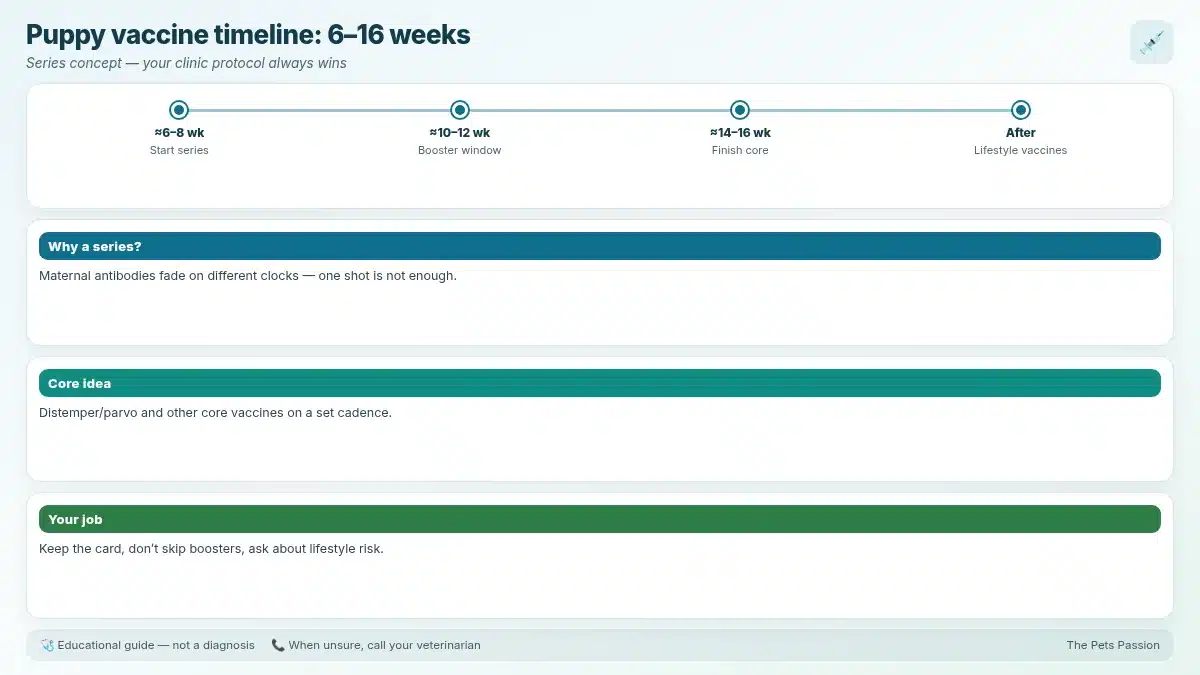
Use this table as a planning scaffold for your puppy vaccination schedule, then let your veterinarian finalize products and dates.
This is a planning template aligned with AAHA/AVMA/Cornell patterns — not a prescription. Product labels and your vet’s protocol win.
| Age window | Common vaccines / visits | Notes |
|---|---|---|
| 6–8 weeks | First DA2PP/DHPP | Exam, fecal plan, nutrition and socialization |
| 10–12 weeks | Second combo dose | Continue parasite prevention; discuss lifestyle vaccines |
| 12–16 weeks | Third combo; often rabies; start lepto | Many clinics pair lepto with late visits |
| 14–16+ weeks | Finish combo; complete lepto second dose | High-risk areas may continue to 18–20 weeks |
| Within 1 year | Combo booster; lepto annual; rabies per law | Many viral vaccines then every 3 years |
| Adult | Lifestyle vaccines as indicated | Never skip legally required rabies |
Shelter/high-risk note: Shelter guidance often uses tighter intervals and may continue DA2PP into 18–20 weeks.
If diarrhea or vomiting shows up between visits in an incompletely vaccinated puppy, treat it as urgent — see puppy diarrhea when to worry and how dogs get parvo.
What changed in the AAHA vaccine schedule for dogs (lepto)?
Many older pet articles still call lepto “optional.” The 2024 update to the AAHA Canine Vaccination Guidelines elevated leptospirosis to core status for dogs in North America in most practical settings (AAHA update).
AAHA highlights that lepto is endemic, potentially life-threatening, and zoonotic. Vaccination is recommended for dogs ≥12 weeks who go outdoors, including suburban yards and daycares.
Practical lepto schedule:
- Dose 1 at ≥12 weeks
- Dose 2 24 weeks later
- Booster within 1 year, then annually
Smaller or younger dogs can be more reaction-prone. Ask your vet how they stage small-breed puppies; don’t split a vial at home.
When can a puppy go outside after vaccines?
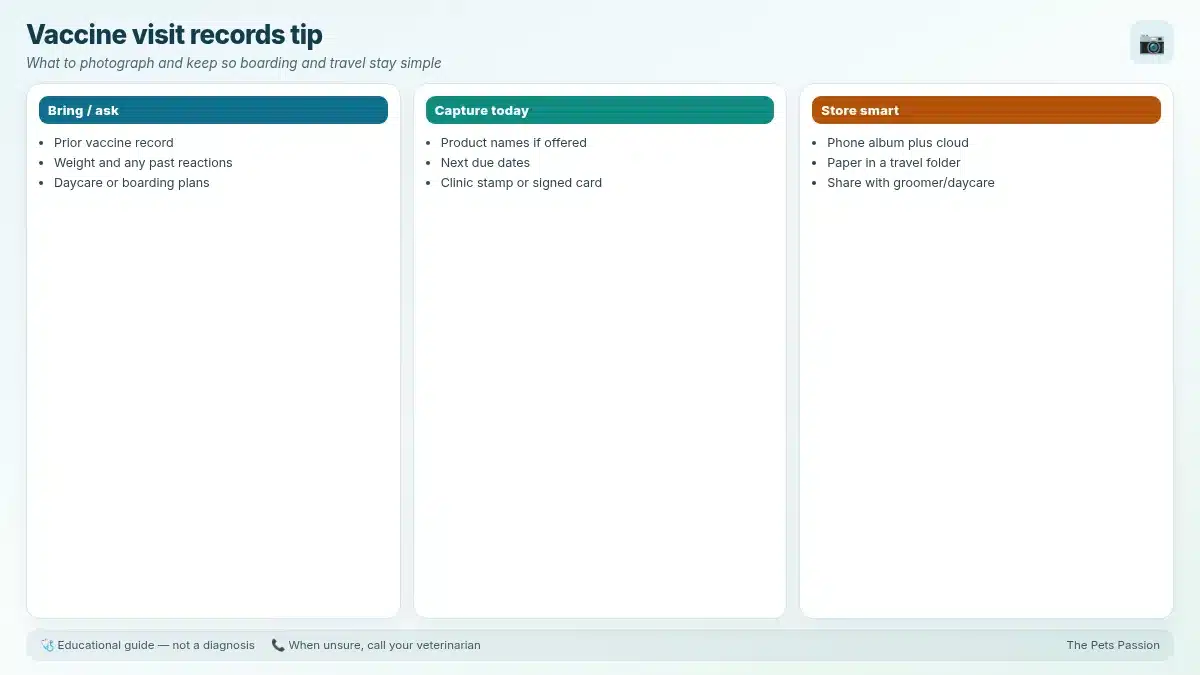
Outdoor timing is the lifestyle half of a puppy vaccination schedule — shots alone don’t set a single safe day.
This is the question behind most “puppy shot schedule searches — the answer is a risk trade-off, not a single calendar day.
What evidence-framed groups emphasize
- AVMA socialization guidance supports early socialization while avoiding unvaccinated dogs and high-risk surfaces until coverage is more complete. Indoor classes can start near 8 weeks if well run.
- Cornell advises caution at high-risk sites such as dog parks until the series is complete.
- Many clinicians treat public ground contact as safer about 1–2 weeks after the final core vaccine, often near 18–22 weeks.
Safer outdoor / socialization options before “fully vaccinated”
| Lower-risk ideas | Higher-risk to delay |
|---|---|
| Carry the puppy in public; sit outside cafés without ground contact | Dog parks |
| Backyard if no sick dogs; discuss lepto risk | Pet store floor play areas |
| Known healthy, vaccinated adult dogs | High-traffic grassy parks |
| Indoor puppy classes | Boarding/daycare before series |
Socialization still matters. Fear periods don’t pause for pathogens. The goal is smart exposure, not isolation.
Use the vaccine schedule tool to mark “last core dose + 14 days” as a discussion point with your veterinarian.
What do core diseases look like if vaccines are missed?
Parvovirus
Cornell describes lethargy, reduced appetite, vomiting, then often foul, sometimes bloody diarrhea. Unvaccinated puppies 6 weeks–6 months are classic patients. Any incompletely vaccinated puppy with vomiting plus diarrhea should be tested promptly.
Distemper
Cornell’s distemper overview notes variable severity; vaccination is highly effective and remains core.
Leptospirosis and rabies
Leptospirosis is a zoonotic bacterial infection linked to urine-contaminated water or soil. Rabies is fatal and governed by local law. Follow your clinic’s protocol.
What side effects should I watch for?
Most puppies have mild, short-lived effects: sleepiness, mild soreness, brief soft stool, or a small lump at the injection site.
Call your veterinarian or ER promptly for: facial swelling, hives, repeated vomiting, collapse, difficulty breathing, or severe lethargy. AVMA advises waiting 30–60 minutes at the clinic after new vaccines when reaction risk is a concern.
Bring a written list of every vaccine product your puppy has received. Brand names matter for future titers and booster decisions.
What if doses were missed or paperwork is incomplete?
AAHA’s practical rule of thumb for overdue or unknown history: when in doubt, vaccinate with manufacturer and legal guidance for rabies. Adult dogs starting late typically need two combo doses 2–4 weeks apart, plus lepto and rabies per protocol.
If you adopted a puppy with incomplete paperwork, bring every record to the first exam and rebuild the calendar inside the The Pets Passion vaccine planner.
How should boarding, daycare, and travel change the puppy shot schedule?
Lifestyle vaccines aren’t vanity add-ons when a boarding date is on the calendar. Bordetella and canine influenza schedules vary by product. Ask the facility for written vaccine requirements, then compare them with your veterinarian’s plan.
Lyme vaccination belongs in the tick conversation if you hike in endemic regions. Travel can add rabies certificate rules, hotel policies, and airline crate stress. Use the vaccine planner to drop boarding and travel dates onto the same calendar.
FAQ: puppy vaccination schedule
What is the standard puppy vaccination schedule?
Most puppies start DA2PP/DHPP at 6–8 weeks, repeat every 2–4 weeks until at least 16 weeks, receive rabies per law, and complete a two-dose lepto series from ≥12 weeks.
What is the AAHA vaccine schedule for dogs?
AAHA separates core vaccines from risk-based lifestyle vaccines. See the AAHA recommendations.
When can my puppy go outside after vaccines?
Begin low-risk socialization early; delay dog parks and public high-traffic grass until roughly 1–2 weeks after the final core vaccine, commonly near 18–22 weeks. Confirm with your veterinarian.
How many puppy shots are there?
Count visits, not a fixed national number. Expect multiple combo doses, rabies, often two lepto doses, plus optional lifestyle vaccines.
Can I socialize before the series is finished?
Yes, with risk management. Support carefully chosen exposures and indoor classes while avoiding unknown dogs and contaminated public surfaces.
Is leptospirosis required for indoor dogs?
“Indoor” dogs still visit clinics and walk outside. AAHA frames lepto as core for most North American dogs; discuss exceptions with your veterinarian.
Do adult dogs follow the same dog vaccine schedule by age?
No. After the puppy series and first-year boosters, many viral core vaccines are boosted about every 3 years; lepto is commonly annual; rabies follows law.
Where can I track dates?
Use The Pets Passion Pet Vaccination & Preventative Care Schedule and keep clinic invoices.
Sources
- AAHA. Recommendations for core and noncore canine vaccines. https://www.aaha.org/resources/2022-aaha-canine-vaccination-guidelines/recommendations-for-core-and-noncore-canine-vaccines/
- AAHA. Leptospirosis vaccination recommended to be core. https://www.aaha.org/newstat/publications/leptospirosis-vaccination-recommended-to-be-core-for-most-dogs/
- AVMA. Vaccinating your pet. https://www.avma.org/resources-tools/pet-owners/petcare/vaccinations
- AVMA. Socialization of puppies and kittens. https://www.avma.org/sites/default/files/2024-09/avma-lit-review-socialization-puppies-kittens-0924.pdf
- Cornell. Parvovirus. https://www.vet.cornell.edu/departments-centers-and-institutes/riney-canine-health-center/canine-health-topics/parvovirus-transmission-treatment
- Cornell. Canine distemper virus. https://www.vet.cornell.edu/departments-centers-and-institutes/riney-canine-health-center/canine-health-topics/canine-distemper-virus
- Merck Veterinary Manual. Canine Parvovirus Infection. https://www.merckvetmanual.com/digestive-system/infectious-diseases-of-the-gastrointestinal-tract-in-small-animals/canine-parvovirus-infection-parvoviral-enteritis-in-dogs
About The Pets Passion: Evidence-framed dog and cat health guides and free tools to help you prepare better questions for your veterinarian — not replace one.
Veterinary Review & Editorial Standard
This clinical guide was prepared using peer-reviewed veterinary literature and guidelines from leading veterinary associations. If your pet exhibits acute symptoms or distress, please seek immediate in-person veterinary emergency care.

💬 2 Community Responses