How Long Does Parvo Live Outside? Yard Survival & Cleanup
 The Pets Passion Medical Team
Medical disclaimer: Educational guide from The Pets Passion. Parvovirus cases need veterinary care. Disinfection tips summarize published veterinary sources; always follow product labels and your clinic’s discharge instructions. This is not a guarantee your yard is “parvo-free.”
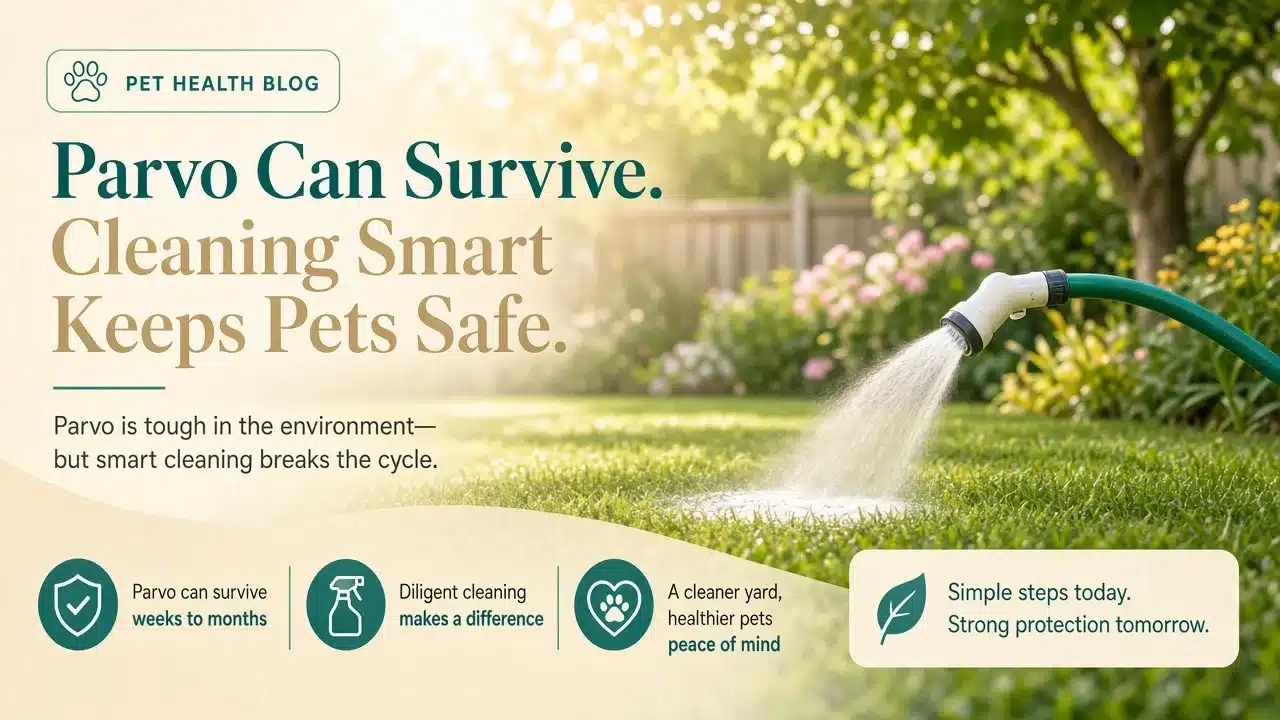
How long does parvo live outside depends on shade, moisture, and sunlight. In cool, moist, protected conditions, canine parvovirus can persist for months and possibly years; sun, heat, and drying help shorten survival. Waiting two weeks before a new puppy is not a cleanup plan—pair disinfection with your vet’s vaccine timing.
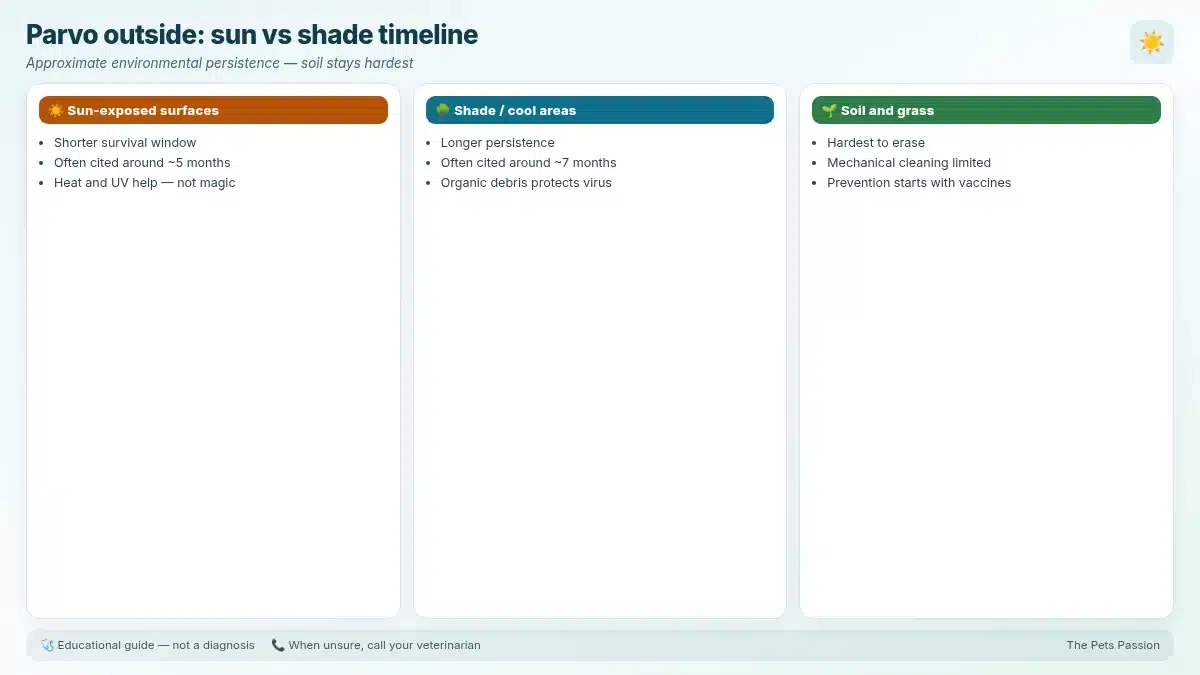
Direct answer: Canine parvovirus can survive outdoors for months—often cited as about five months in sun and up to about seven in shaded moist soil. Hard surfaces need cleaning then dilute bleach after feces removal; soil and grass cannot be fully sterilized. Unvaccinated puppies are highest risk—seek veterinary care for suspected parvo.
How long does parvo live outside? Longer than most owners hope. Canine parvovirus (CPV) is a tough, non-enveloped virus. Merck Veterinary Manual states infectious CPV can persist indoors at room temperature for at least 2 months; outdoors, if protected from sunlight and drying, it can persist for many months and possibly years. Cornell’s Wildlife Health Lab notes parvoviruses survive for months in cool, moist, shaded conditions and remain viable when frozen.
Sun, heat, and drying help. Shade, soil, feces, and freeze–thaw cycles protect the virus. That is why “we waited two weeks and got a new puppy” goes wrong so often.
Quick answer
– Shaded, moist outdoor areas: months; Merck allows possibly years when protected from sun/desiccation.
– Indoor room temperature: at least ~2 months of viability per Merck.
– Frozen ground: virus can remain dormant and infective; Mar Vista notes roughly 5 months or more concerns with frozen contaminated yards (Mar Vista disinfection).
– Does bleach kill parvo? Yes, when used correctly: clean organic matter first, then dilute household bleach (Merck cites 1:32; Mar Vista describes ~½ cup bleach per gallon ≈ 1:30) with ≥10 minutes wet contact on compatible hard surfaces. Quaternary ammonium cleaners are not reliable for CPV (Merck).
– Parvo in yard dirt/grass: you cannot fully sterilize soil. Remove feces + surrounding soil where practical, dilute with water, maximize sun, and only introduce fully vaccinated dogs later.Prevention beats scrubbing: finish core vaccines on time with our Pet Vaccine Schedule tool and puppy vaccination schedule.
Why does parvovirus last so long in the environment?
CPV lacks the fragile outer envelope that soap easily shreds on some other viruses. Merck groups it with pathogens resistant to many common detergents and to temperature/pH swings.
Shedding math makes contamination worse. Mar Vista cites that an infected dog can shed on the order of tens of millions of viral particles per ounce of stool, while a typical infectious dose for a susceptible dog may be around 1,000 particles. One diarrhea accident seeds a hallway, or a shaded run, densely.
Infected dogs shed in feces within about 4–5 days after exposure, during illness, and for roughly 10 days after clinical recovery (Merck). Indoor shoes, bowls, and crates move virus like tiny Uber rides.
Background disease facts: How Do Dogs Get Parvo?.
How long does parvo live outside vs indoors?
| Setting | Survival (per veterinary sources) | Practical takeaway |
|---|---|---|
| Indoors, room temp | ≥ ~2 months (Merck) | Bleach-compatible surfaces can be disinfected; porous stuff is harder |
| Outdoors, sun + dry | Shorter; UV and drying help (Mar Vista) | Hose, remove feces, favor sunny pens |
| Outdoors, shade + moist soil | Many months, possibly years (Merck) | Assume risk for unvaccinated puppies |
| Frozen yard | Remains viable; ~5+ months concerns (Mar Vista) | Treat winter yards as contaminated until spring cleanup |
| Organic matter (feces, soil, carpet) | Protects virus | Remove first or disinfection fails |
Cornell emphasizes cool, moist, sun-protected niches, and survival when frozen. If your “cleanup” is a quick hose on a north-facing dirt run in February, you mostly rearranged mud.
Parvo in yard: what actually helps
You will not autoclave a lawn. Aim to cut viral load and buy time until immunity.
Dirt, grass, gravel
- Bag and discard all visible feces (double-bag if your clinic suggests).
- Where soil is contaminated, shovel feces plus surrounding soil into trash (Mar Vista).
- Hose to dilute remaining material.
- Maximize sun exposure; trim tall shade weeds if practical.
- Keep unvaccinated puppies off that zone.
Concrete, stone, sealed wood, plastic kennels
These can take real parvo disinfection:
- Scrub off organic matter completely.
- Apply an effective disinfectant (bleach dilution or veterinary-grade options below).
- Keep surface wet for ≥10 minutes.
- Rinse if needed for plant/pet safety; ventilate.
- Let dry.
Things to throw away without guilt
Cheap toys soaked in diarrhea, heavily soiled area rugs, crumbling beds, porous chewed bones. Replacement is cheaper than a second ICU stay.
Does bleach kill parvo? Dilutions and contact time
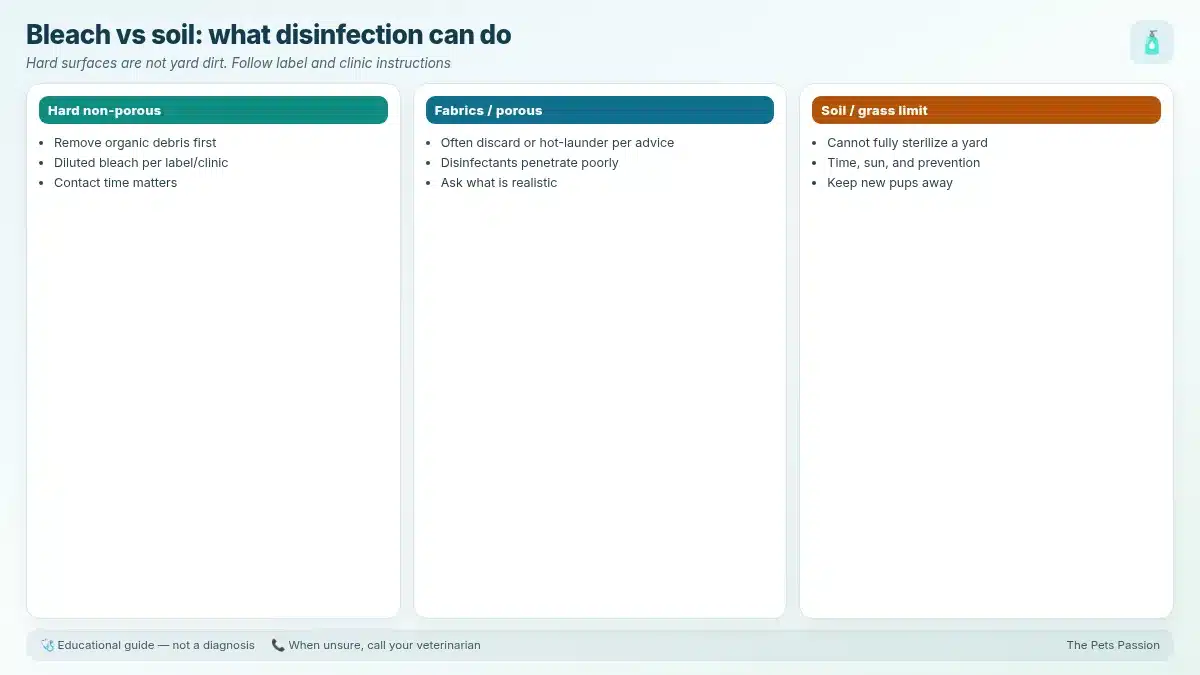
Yes, sodium hypochlorite bleach is a classic effective option when organic matter is gone and contact time is real.
| Source | Dilution guidance | Contact |
|---|---|---|
| Merck Veterinary Manual | Dilute bleach 1:32; also lists potassium peroxymonosulfate and accelerated hydrogen peroxide as virucidal options | Follow label; clean first |
| Mar Vista AMC | ~½ cup bleach per gallon of water (~1:30) | 10 minutes wet contact |
| Cornell Wildlife Health Lab | Notes resistance to some common disinfectants; chlorine-containing agents among those that work (with formaldehyde/glutaraldehyde in lab contexts) | Clinic protocols vary |
Bleach rules that decide success or failure
- Remove feces first. Organic load inactivates bleach.
- Mix fresh. Bleach solutions lose punch; don’t use last month’s bucket.
- Ten minutes wet. Wiping on and instantly drying is theater.
- Compatible surfaces only. Bleach fades fabric, corrodes some metals, burns plants and lungs, ventilate, wear gloves, keep pets off until rinsed/dry.
- Not for soil sterilization. Bleach on grass usually kills grass more reliably than every viral particle in dirt.
What does not reliably kill CPV?
Merck states quaternary ammonium disinfectants are not reliable for parvovirus. Many “pet odor” sprays are in that camp. Alcohol wipes and casual soap routines that work on enveloped viruses are not enough by themselves for CPV environmental kill claims.
Accelerated hydrogen peroxide products (not the same as weak bathroom peroxide) and potassium peroxymonosulfate disinfectants are additional options clinics use, follow the veterinary product label.
Indoor parvo disinfection checklist
Work room by room after a hospitalized puppy comes home, or after a foster fails a SNAP test.
- Isolate recovered or infected dogs from susceptibles; follow your vet on how long to quarantine.
- Bath the recovered dog to reduce virus stuck in fur/fecal crust (Mar Vista).
- Trash what you can replace.
- Laundry with bleach when fabric allows; hot cycles help but aren’t magic alone.
- Hard floors: detergent scrub → bleach 1:30–1:32 → 10-minute wet time → rinse.
- Bowls/toys: soak bleach-compatible items 10 minutes; rinse thoroughly.
- Carpet/upholstery: hardest problem. Steam might help if truly hot enough; Mar Vista is frank that many consumer “steam” jobs don’t hit kill temperatures and that bleach ruins color. Prefer an older, fully vaccinated next dog if carpet was soaked.
- Shoes and hands: footbaths with effective disinfectant; wash hands; don’t visit puppy classes in the same sneakers you wore in the isolation room.
Merck prevention section pushes strict isolation procedures in hospitals, gowning, gloving, cleaning, footbaths, and the same concepts scale down to a laundry-room isolation ward at home.
When can I bring a new puppy home after parvo?
There is no universal “21 days and you’re fine” stamp for a contaminated property.
Merck’s practical control point: only introduce fully vaccinated puppies (series including doses around 6, 8, and 12 weeks in their example schedule language) or fully vaccinated adults into a home that recently had parvoviral enteritis. Mar Vista argues for an immune puppy, often ≥16 weeks with a completed early series including a dose near 16 weeks, because maternal antibody interference and stress blunt protection in younger pups.
Translate that to real life:
- If your yard is shaded dirt you cannot disinfect, wait for a fully vaccinated dog, not a 8-week impulse adopt.
- Keep using vaccine schedule planning.
- Ask your vet about titer testing in edge cases; don’t invent your own protocol off a forum.
Disease primer + transmission: how dogs get parvo. Puppy GI triage if diarrhea returns: puppy diarrhea when to worry.
Parvo disinfection products: label-reading cheat sheet
| Agent | Role | Watch-outs |
|---|---|---|
| Sodium hypochlorite (bleach) | Household workhorse at ~1:30–1:32 | Corrosion, fumes, fabric damage; clean first |
| Potassium peroxymonosulfate (e.g. many vet kennel disinfectants) | Common shelter/hospital choice | Follow concentration & contact time on label |
| Accelerated hydrogen peroxide | Effective category per Merck/Mar Vista | Not identical to drugstore H₂O₂ |
| Quats / many grocery "pet cleaners" | Convenience | Not reliable for CPV per Merck |
| Sunlight + drying | Free outdoor ally | Unreliable as sole method in shade |
Always follow the label-first rule for EPA-registered products. “Someone on a group chat said 1:10 forever” can damage surfaces and still miss contact time.
Q&A
How long does parvo live outside in summer sun?
Less time than in a damp shaded corner, but “less” is not “gone tomorrow.” Merck still frames outdoor persistence in months-to-years language when protected from sun and desiccation. Use sun as a helper, not a certificate.
Does bleach kill parvo on shoes?
On bleach-safe rubber/vinyl after cleaning, a proper dilution with 10-minute contact helps. Porous mud-caked soles are a different story, scrub first. Dedicated “parvo shoes” for isolation duty reduce tracking.
Can my vaccinated adult dog catch parvo from the yard?
Well-vaccinated adults have strong protection and often show inapparent or mild infection if exposed, but no vaccine is a daredevil license for a sick immunosuppressed dog. The bigger risk is the next under-vaccinated puppy.
Is the recovered dog immune?
Dogs that recover typically develop long-term, possibly lifelong immunity (Merck). They can still mechanically carry virus on fur early after illness, hence the bath.
What about freezing, does winter kill parvo in the yard?
Opposite problem. Freezing can preserve infectivity. Mar Vista advises treating frozen contaminated yards as unsafe until spring cleaning is possible.
Prevention still beats the bleach bucket
Environmental survival is why vaccination timing is not optional fluff.
- Start and finish puppy core vaccines on a veterinary schedule (AAHA-aligned planning via our schedule article).
- Limit high-traffic dog areas until the series is complete.
- After any GI scare in a young dog, use the symptom checker and get tested rather than “hoping it’s chicken and rice weather.”
- Boarding and shelter intakes need documented vaccines, don’t argue with the front desk on this one.
If you’re cleaning after a known case, ask the attending vet for a written home-care sheet. Bring Merck/Mar Vista-style questions: which disinfectant they prefer, how long to isolate, and when a new dog is reasonable.
Related reads from The Pets Passion
- How Do Dogs Get Parvo?
- Puppy Vaccination Schedule
- Pet Vaccine Schedule tool
- Puppy Diarrhea When to Worry
- Dog Diarrhea: Top Causes…
- Pet Symptom Urgency Checklist
How long does parvo live outside? Long enough that sunlight, shovel work, bleach-on-hard-surfaces, and a completed vaccine series have to work as a team. Skip any one leg and the virus tends to get the last vote.
Room-by-room home cleanup after a parvo discharge
Entryway: Shoes off; bleach-safe boot tray; laundry hamper for isolation clothes.
Bathroom isolation ward: Hard floors win. Remove rugs. Keep dedicated towels. Ventilate when bleaching.
Kitchen: Wash hands before food prep for humans. Don’t “quick rinse” dog bowls in the human sink without a disinfection plan, use a dedicated tub.
Living room: Assume couch throws and remote controls got contaminated if a puppy had diarrhea accidents during movie night. Wipe hard remotes; launder throws with bleach if fabric allows; quarantine soft items you can’t treat.
Car: Plastic seat covers help for rechecks. Clean hard mats with detergent then bleach dilution; soft upholstery is the same carpet problem as indoors.
Write a checklist on tape on the isolation door so every family member follows the same steps at 11 p.m.
Shelter, daycare, and dog-park angles
High-traffic dog businesses live or die by disinfection SOPs. Merck-style principles, remove organic matter, use bleach 1:32 or peroxymonosulfate / accelerated hydrogen peroxide products, avoid relying on quats, apply to boarding runs too.
As an owner:
- Ask what disinfectant they use and contact time.
- Confirm vaccine requirements are enforced (not winked at).
- Keep young puppies out of communal grass until vaccines are complete (puppy vaccination schedule).
Dog parks with chronic mud wallows are viral soup in outbreak seasons. Fully vaccinated adults still track virus home to the susceptible foster puppy in your laundry room.
After cleanup: verifying readiness without false confidence
There is no affordable consumer “parvo Environmental Swiffer test” that clears a yard with certainty. Readiness is a risk estimate:
- Hard surfaces bleached with correct contact time
- Organic waste removed outdoors
- Time + sun + drying stacked in your favor
- Next dog fully vaccinated per your veterinarian
If you cannot meet those, delay adoption or choose an older vaccinated dog. Guilt is cheaper than a second parvo hospitalization.
Talking to your vet about reinfection risk
Ask:
- How long should we isolate from other dogs?
- Which disinfectant do you want us using on tile?
- When is it reasonable to meet vaccinated dog friends on neutral ground?
- Should housemate dogs get booster timing reviewed?
- Any monoclonal antibody or other therapies relevant if we face another exposure? (hospital decision)
Bring your yard description: dirt run vs concrete pad changes advice.
Myths that keep yards dangerous
Myth: “Snow sterilizes the yard.”
Reality: Freezing preserves virus; snow can hide feces.
Myth: “If my recovered dog lives there, the yard is safe for any puppy.”
Reality: Recovered dogs are immune; new susceptible puppies are not.
Myth: “Essential oil sprays kill parvo.”
Reality: Not a Merck-listed strategy. Skip the Pinterest chemistry.
Myth: “One bleach splash is enough.”
Reality: Contact time and precleaning decide outcomes.
FAQ
How long can parvovirus live in a yard?
CPV is a hardy non-enveloped virus. Sources commonly cite roughly five months in sun-exposed outdoor areas and about seven months in shaded, moist soil; organic matter and freezing can extend viability. Timelines are estimates, not guarantees.
Does sunlight kill parvovirus outside?
Sunlight and drying help inactivate the virus; shade and moisture protect it. Opening canopy, removing debris, and keeping areas dry may reduce risk over time but do not certify a yard “parvo-free.”
Can bleach disinfect a parvo-contaminated yard?
Dilute household bleach (often cited about 1:30–1:32, e.g., ½ cup per gallon of water) can kill CPV on clean, non-porous hard surfaces with adequate contact time (often ~10 minutes) after feces are removed. Bleach works poorly in soil/grass organic load—yards cannot be fully sterilized with bleach alone.
What should I clean first after a parvo case?
Mechanically remove all visible feces and contaminated topsoil where practical, then clean hard surfaces before disinfecting. Products with activity in organic matter (used as labeled) may help outdoors; keep pets off wet disinfectant.
When is it safer to bring a new puppy home?
Unvaccinated or incompletely vaccinated puppies are at highest risk. Many clinicians wait until outdoor contamination risk has declined and the puppy’s vaccine series is appropriately advanced—timing is individual. Discuss isolation and vaccination with your veterinarian.
How does parvo spread from the environment?
Infected dogs shed huge amounts of virus in stool; shoes, paws, and objects can carry it. Even after feces disappear, soil can remain infectious.
What are emergency signs of parvovirus?
Sudden lethargy, vomiting, foul diarrhea (sometimes bloody), fever or low temperature, and refusal to eat in a young or unvaccinated dog need immediate veterinary care.
Veterinary Review & Editorial Standard
This clinical guide was prepared using peer-reviewed veterinary literature and guidelines from leading veterinary associations. If your pet exhibits acute symptoms or distress, please seek immediate in-person veterinary emergency care.