
Do Dogs Need Probiotics? An Evidence-First Answer
 The Pets Passion Medical Team

YMYL / medical disclaimer: This guide from The Pets Passion is educational. It draws on ENOVAT/WSAVA antimicrobial guidelines for canine acute diarrhea, systematic reviews, and veterinary teaching sources. Probiotics are supplements with strain-specific effects. This page is not a product endorsement, dose chart, or substitute for veterinary diagnostics. Sick dogs need exams—not only sachets.
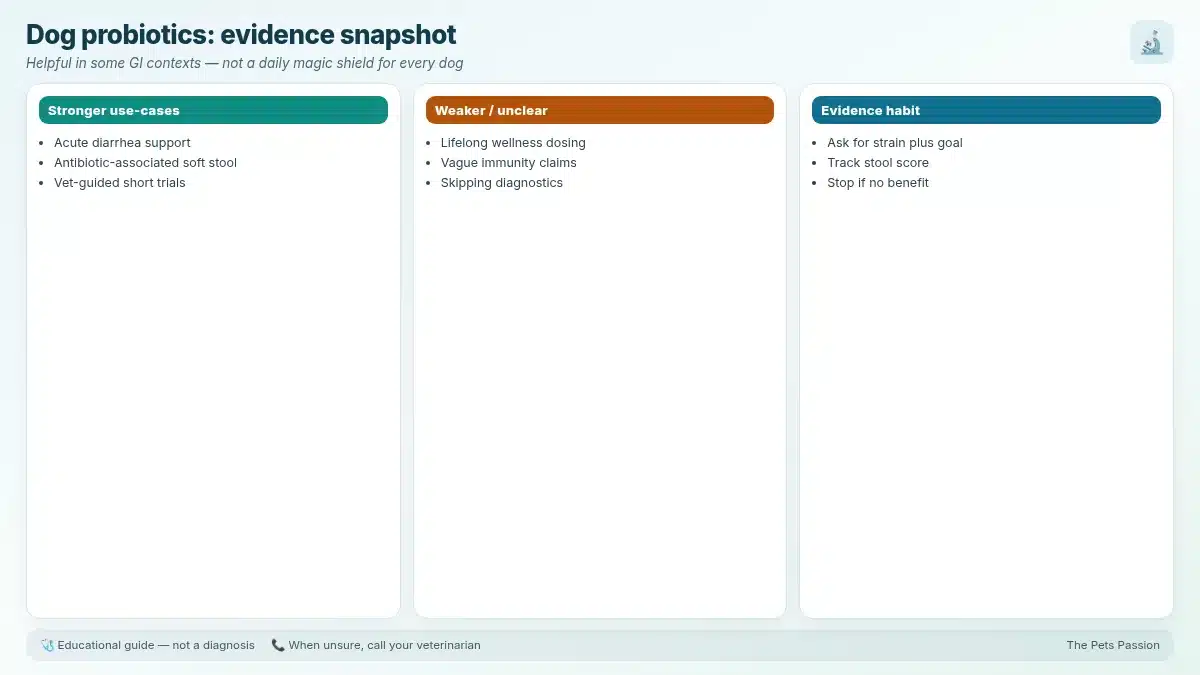
Do dogs need probiotics? Short version: healthy dogs do not have a proven daily requirement for a probiotic supplement the way they require complete nutrition, parasite control, and vaccines. For acute diarrhea, ENOVAT’s Recommendation 8 is explicit: the panel does not recommend for or against probiotics (moderate-certainty evidence; trade-offs closely balanced). That is the opposite of Instagram certainty. Probiotics may be reasonable adjuncts in selected situations your veterinarian chooses. They are a poor replacement for fecal testing, diet trials, fluid therapy, or workups when red flags appear.
This article is intentionally not another soft-stool triage walkthrough. For urgency, color, and bland-diet logistics, use our diarrhea and fecal-score guides linked below. Here we stay on the evidence question: need vs nice-to-have vs noise.
Quick answer. Do dogs need probiotics?
| Situation | Evidence-leaning stance |
|---|---|
| Healthy adult dog, normal stools | No demonstrated nutritional *need*; optional at best |
| Mild acute diarrhea, dog otherwise well | ENOVAT: neither for nor against; clinician/owner preference after costs/stress weighed |
| Chronic GI signs | Diet and diagnosis dominate; probiotic add-on often secondary |
| After antibiotics | Common clinic habit; strain evidence still product-specific |
| Bloody diarrhea, puppy collapse, repeated vomiting | Diagnostics/fluids first—not the supplement aisle |
What probiotics are (and are not)
Probiotics are live microorganisms given in hopes of a health benefit. Prebiotics are fibers that feed preferred microbes. Synbiotics combine both. Effects are strain- and dose-dependent. A Lactobacillus on a yogurt cup is not interchangeable with a veterinary Enterococcus faecium SF68 product, and neither is magic dust for every colon.
Color shifts can matter as much as texture—see why is my dog’s poop yellow when mustard stools show up with soft scores.
They are not:
- A cure for giardia, parvo, or toxin ingestion
- Proof your dog has “leaky gut” because a blog said so
- Automatically safer than drugs (quality control varies wildly in over-the-counter jars)
- Required for every dog after every soft stool
VCA’s diarrhea overview notes veterinarians may use probiotics while warning that OTC quality varies—ask before buying the cartoon-canine tub.
What the better evidence actually says
Acute diarrhea (ENOVAT)
ENOVAT’s systematic work feeding the canine acute diarrhea guideline found limited, product-diverse trials. Across analyzed studies, probiotics were associated with a small average shortening of diarrhea duration that the panel did not treat as clearly clinically decisive for a blanket recommendation. Microbiota shifts appeared in some trials; clinical meaning of those shifts remains debated. Preference surveys showed many clinicians and owners like probiotics, but cost and pill stress still count.
Hence Recommendation 8: neither for nor against in acute diarrhea.
Broader GI prevention/treatment reviews
A 2019 systematic review in Journal of Veterinary Internal Medicine circles (Jensen & Bjørnvad; PMC6766488) concluded evidence pointed toward a limited and possibly clinically unimportant effect for preventing or treating acute GI disease, and that for chronic GI disease dietary intervention remains the major key, with probiotics not clearly adding significant improvement across the reviewed studies. Many trials were small or methodologically messy. That does not ban probiotics; it bans overselling them.
Microbiome honesty
We know canine gut communities exist and shift with diet, antibiotics, and disease. We do not have a universal “ideal microbiome score” you can buy back with a random 20-strain capsule. Be suspicious of consumer tests that upsell matching supplements without clinical context.
When probiotics may help (reasonable clinic conversations)
Talk to your veterinarian about a time-limited trial when:
- Soft stool follows boarding, travel, or a diet change and the dog is otherwise bright
- The clinic wants a supportive adjunct while awaiting fecal results on a stable dog
- A specific veterinary product has been helpful for this dog before
- Antibiotic courses are prescribed for a documented reason and the vet wants synbiotic support afterward
- A dermatology or GI specialist includes a researched strain in a multimodal plan
“May help” still means: pick one product, keep the diet stable, and score stool for 5–7 days (dog fecal score chart). If nothing changes, stop wasting money.
Brand comparisons (e.g. FortiFlora vs Proviable) belong in product-choice articles—see FortiFlora vs Proviable for strain/CFU logistics. This page answers the prior question: whether you needed anything from that aisle.
When diagnostics beat probiotics
Skip the supplement-first reflex when you see:
- Puppy diarrhea with lethargy or appetite loss (puppy diarrhea when to worry)
- Black tarry stool, large amounts of blood, or repeated vomiting
- Signs of dehydration, abdominal pain, or collapse
- Weight loss, greasy yellow stools, or chronic signs >2 weeks
- Household outbreak patterns suggesting contagious disease
- Dogs on immunosuppressive drugs with new GI signs
Those dogs need exams, fecals, parvovirus testing when indicated, imaging, or bloodwork. A probiotic sprinkle on top of undiagnosed disease delays care.
ENOVAT’s antibiotic recommendations are separate: many mild acute diarrhea cases should not get antimicrobials. Do not confuse “no metronidazole” with “must buy probiotics.” Supportive care can be diet, fluids, and time.
Daily probiotics for “wellness”—what is missing
Marketing pushes lifelong daily scoops for immune health, shiny coats, and mood. For a dog with normal stools, good body condition, and no clinical problem, there is no strong guideline mandate that a probiotic is required. Money often returns more health when spent on:
- A complete diet appropriate for life stage
- Year-round parasite prevention
- Dental care
- Weight control (dog calorie calculator)
- Actual veterinary exams
If your dog is fine and you still want a probiotic, that is a preference purchase—own it as preference, not as fulfilling a biologic need.
How to choose if your vet says yes
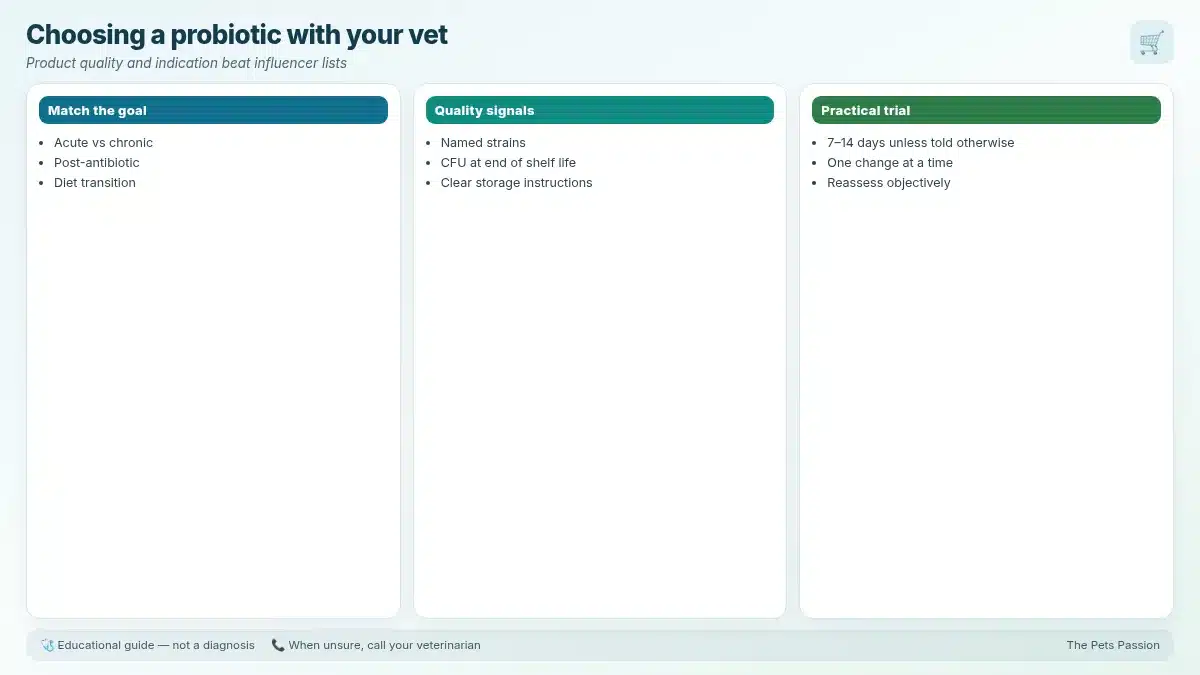
- Prefer veterinary-channel products with named strains and CFU guarantees through end of shelf life when listed.
- Match species labeling (canine vs feline).
- Check storage (heat kills live products left in cars).
- Avoid stacking five Amazon bottles.
- Disclose all products during elimination diet trials—flavor bases can break a trial.
- Immunocompromised or critically ill pets need explicit approval first.
Human megadose capsules and grocery yogurt are not automatically appropriate. Lactose and non-canine strains complicate DIY plans.
Q&A
Do dogs need probiotics every day?
Not as a universal nutritional requirement. Daily use is a clinical or preference decision, not a law of dog biology.
Can probiotics replace a bland diet or GI prescription food?
No. Diet remains central for many acute and chronic enteropathies (bland diet guide).
Are probiotics safe?
Generally well tolerated in stable pets, but “natural” is not a safety certificate for every septic or severely immunocompromised patient. Quality varies.
Why did my vet recommend FortiFlora if ENOVAT is neutral?
Neutrality means optional, not forbidden. Clinics may choose a product for compliance (palatability) or prior response. Ask what success looks like in 5 days.
Do probiotics help itchy dogs?
Skin plans sometimes include gut support, but itch workups still need fleas, food, infection, and allergy therapy. Do not expect a sachet to replace Apoquel/Cytopoint-level decisions.
What about soil-based or raw-fed “probiotic” claims?
Extraordinary claims need evidence. Raw diets bring separate pathogen risks; adding a probiotic does not sanitize a risky feeding plan.
Related guides and tools
- FortiFlora vs Proviable
- Dog Fecal Score Chart
- Dog Diarrhea: Top Causes…
- Bland Diet for Dogs with Diarrhea
- Metronidazole for Dogs Diarrhea
- Pet Symptom Urgency Checklist
- Dog Calorie Calculator
A simple decision table for the exam room
| If this is true | Do this first | Probiotic role |
|---|---|---|
| Dog bright, one soft day after trash raiding | Withhold indiscretion, monitor | Optional adjunct |
| Soft stool 3 days, still playful | Fecal float/antigen as vet advises | Optional while awaiting results |
| Chronic soft stool 6 weeks | Diet trial + workup | Secondary, specialist-guided |
| Bloody liquid stool + dull mentation | Urgent clinic | Not the priority |
| On antibiotics for pneumonia | Give antibiotics correctly | Vet may add probiotic; space timing if advised |
How to run an honest 7-day trial
Only with veterinary okay:
- One product, labeled dose.
- No new treats, bones, or broth experiments.
- Daily fecal score.
- Log gas, appetite, vomiting, itch.
- Stop for worsening or red flags.
- Decide continue/stop with the clinic based on notes, not hope.
Owner patterns (anonymized)
- Dog fine for years on no probiotic; owner starts one after social media scare; stools unchanged; money redirected to dental cleaning—better outcome.
- Boarding colitis dog improves on diet alone while unopened probiotic sits on the counter—also valid.
- Yeast-sensitive dog flares on a savory probiotic base; switching products or stopping helps the itch diary.
- Owner stacks kefir, sauerkraut water, and three capsules; diarrhea worsens from dietary chaos.
Checklist before you buy
- Vet agreed a probiotic fits this problem
- Red flags ruled out or scheduled for diagnostics
- Single named product chosen
- Storage plan away from heat
- Stool score sheet ready
- Stop date or reassess date written
- Budget compared to diet/prevention upgrades
Do dogs need probiotics? Not as a blanket daily requirement. Evidence for acute diarrhea is mixed enough that major guidelines stay neutral. Use them as optional, strain-aware tools after—or alongside—real diagnostics, not instead of them.
Strain specificity without the marketing fog
If a trial studied Enterococcus faecium SF68 at a defined CFU, that result does not automatically transfer to a mystery multi-strain powder sold beside the checkout aisle. ENOVAT authors flagged product diversity as one reason they refused a blanket for/against call. Reviews of canine microbiota modifiers likewise note that in vitro promise often fails to translate cleanly in vivo.
Questions worth asking the clinic or label:
- Which genus, species, and strain IDs are listed?
- Is CFU guaranteed through end of shelf life or only “at manufacture”?
- Was this product in any peer-reviewed clinical study relevant to my problem?
- Does the base contain yeast, animal digest, or fibers that conflict with an elimination diet?
If the seller answers with “proprietary blend for total gut harmony,” walk.
Antibiotics, stewardship, and the probiotic reflex
ENOVAT recommends against antimicrobials for many mild hemorrhagic and non-hemorrhagic acute diarrhea cases without systemic illness. Owners sometimes hear “no Flagyl” and assume the consolation prize must be a probiotic. Supportive care can be monitoring, diet adjustment, and fluids—full stop.
When antibiotics are indicated for another infection (pneumonia, wound, confirmed pathogen), some clinicians add a veterinary probiotic during or after the course. Evidence remains product-specific. Spacing the probiotic several hours from the antibiotic dose is a common practical tip; follow your vet’s timing sheet.
For deeper stewardship context, see metronidazole for dogs diarrhea.
Kennel stress, shelter dogs, and “prevention” studies
A few trials in kennelled dogs reported better fecal consistency with certain synbiotic or probiotic products. Methods and products differ, and some positive studies bundle prebiotics so you cannot credit the live microbes alone. Boarding soft stool in an otherwise bright dog remains one of the more reasonable “try a vetted product for a week” scenarios—after you rule out dietary indiscretion and parasites when the history warrants.
Puppies in high-density environments still need vaccines, deworming, and parvo caution far more than a subscription sachet (puppy diarrhea when to worry; how long does parvo live outside).
Chronic enteropathy: diet first, supplements second
For dogs with months of soft stool, weight loss, or inflammatory bowel disease–type signs, veterinary internists typically prioritize diet trials (hydrolyzed or novel protein), parasite control, cobalamin/folate assessment, imaging, and sometimes biopsy. Systematic review conclusions that probiotics add little on average to chronic GI therapy should humble anyone selling a cure-in-a-jar. Individual dogs may still improve on a specific product inside a specialist plan—that is n-of-one medicine under supervision, not proof every Labrador needs lifelong CFU.
Track with a fecal score chart so “better” is visible.
Money test: what else buys more health?
Before a $40/month wellness probiotic:
- Fecal exam if soft stools recur
- Calorie trim if overweight (dog calorie calculator)
- Dental cleaning when tartar and hush-puppy breath dominate
- Actual tick/flea/heartworm prevention refill
Preference purchases are fine. Calling them mandatory is not.
Veterinary Review & Editorial Standard
This clinical guide was prepared using peer-reviewed veterinary literature and guidelines from leading veterinary associations. If your pet exhibits acute symptoms or distress, please seek immediate in-person veterinary emergency care.