
How Many Calories Does My Dog Need? A WSAVA-Style Starting Point
 The Pets Passion Medical Team

YMYL / medical disclaimer: This guide from The Pets Passion is educational. It summarizes WSAVA Global Nutrition Committee framing for resting and maintenance energy, body condition scoring, and treat limits. Individual dogs can land well outside textbook ranges. This page is not a prescription for weight-loss kits, homemade recipes, or disease diets. Puppies, pregnant/lactating dogs, senior dogs with disease, and pets on veterinary therapeutic foods need a veterinarian’s plan.
How many calories does my dog need? Start with Resting Energy Requirement (RER), multiply by a life-stage or activity factor to estimate Maintenance Energy Requirement (MER), then adjust using body condition score (BCS) and the scale—not the cup alone. Treats, table scraps, and “pill pockets” belong inside the daily total and should stay at ≤10% of calories. For a fast, structured estimate you can bring to your vet, use our live Dog Calorie Calculator (WSAVA-style allometric RER: \(70 \times \mathrm{BW_{kg}}^{0.75}\)).
Quick answer. How many calories does my dog need?
| Step | What to do |
|---|---|
| 1. Weigh accurately | Use clinic or home scale; convert lb → kg (÷ 2.2) |
| 2. Calculate RER | \(70 \times (\mathrm{kg})^{0.75}\) kcal/day |
| 3. Estimate MER | RER × life-stage/activity factor (examples below) |
| 4. Cross-check WSAVA adult bands | Inactive ≈ \(95 \times \mathrm{kg}^{0.75}\); active ≈ \(130 \times \mathrm{kg}^{0.75}\) |
| 5. Score BCS | Aim roughly 4–5/9; ribs palpable, waist visible |
| 6. Cap extras | Treats/table food/medication foods ≤10% of daily calories |
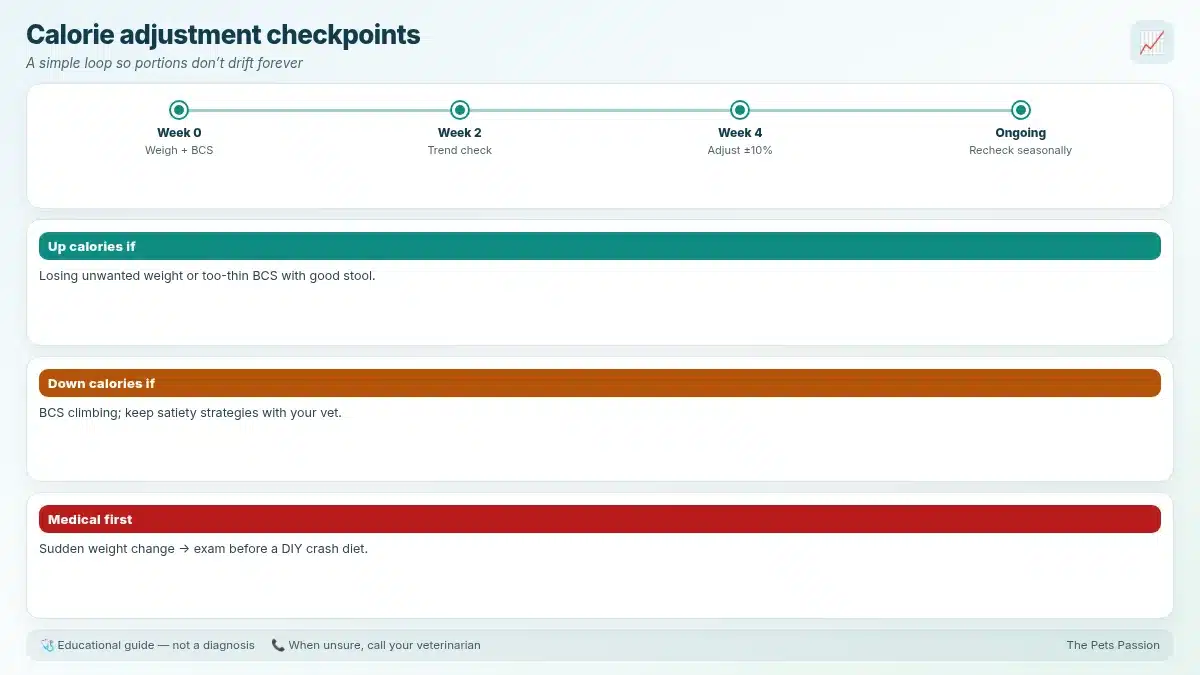
| 7. Reweigh | Adjust every 2–4 weeks based on trend, not one lucky day |
What is RER vs MER (plain English)?
RER is an estimate of calories needed at rest in a thermoneutral environment—think “keep the lights on,” not “run the agility course.” The allometric formula used widely in small-animal nutrition teaching (and referenced on our calculator) is:
Food is only one line item—stress-test the budget with cost of owning a dog once portions look realistic.
Growing puppies are not tiny adults: estimate size with how big will my puppy get before you lock a long-term calorie target.
Calories and water rise together with heat and work—pair this math with how much water should a dog drink so you catch polydipsia, not just a big appetite.
RER (kcal/day) = 70 × (body weight in kg)^0.75
MER (sometimes called DER, daily energy requirement) is RER multiplied by a factor that reflects neuter status, growth, work, gestation, or lactation. MER is a starting guess. WSAVA’s nutritional assessment guidance notes that energy needs for dogs can vary by roughly ±30% around maintenance estimates, which is why the scale and BCS beat “the bag said two cups.”
For healthy adults in ideal condition, WSAVA also publishes ready-made calorie ranges derived from 2006 NRC maintenance math: inactive adults ≈ \(95 \times \mathrm{BW_{kg}}^{0.75}\) and active adults ≈ \(130 \times \mathrm{BW_{kg}}^{0.75}\) (WSAVA calorie chart PDF, updated July 2020). Those ranges are guidance, not a promise your Labrador will land on the midpoint.
How do I use the dog calorie calculator on this site?
Open the Dog Calorie Calculator. Enter current weight and the life-stage/activity context the tool asks for. Read RER and MER as planning numbers. Then:
- Find kcal per cup (or per can/gram) on the food’s guaranteed analysis / calorie statement—or ask the manufacturer.
- Divide MER by kcal per measuring unit to get a starting portion.
- Subtract treat calories first if you want extras (≤10% rule).
- Recheck weight and BCS on a calendar, not by “he looks fine in winter fur.”
The tool cites the WSAVA Global Nutrition Committee allometric approach. It cannot see hypothyroidism, steroid therapy, or the half bagel your kid shares at breakfast. You still own the honesty layer.
Common MER multipliers (examples, not laws)
Teaching charts often list factors like these (your clinic may use a slightly different set):
| Typical situation | Rough MER factor × RER |
|---|---|
| Weight loss (under veterinary plan) | Often ~1.0 × RER of ideal weight (clinic-directed) |
| Inactive / obese-prone adult | ~1.2–1.4 |
| Neutered adult, average home life | ~1.6 |
| Intact adult | ~1.8 |
| Light work / very active pet | ~2.0 |
| Puppy 4–12 months (varies by size) | Often ~2.0 |
| Young puppy (<4 months) | Often ~3.0 |
| Late gestation / heavy lactation | Much higher; clinic-guided |
These are orientation, not a DIY ICU protocol. Working sled dogs, nursing bitches with large litters, and recovering inpatients live outside hobby-owner charts.
Why body condition score beats the measuring cup
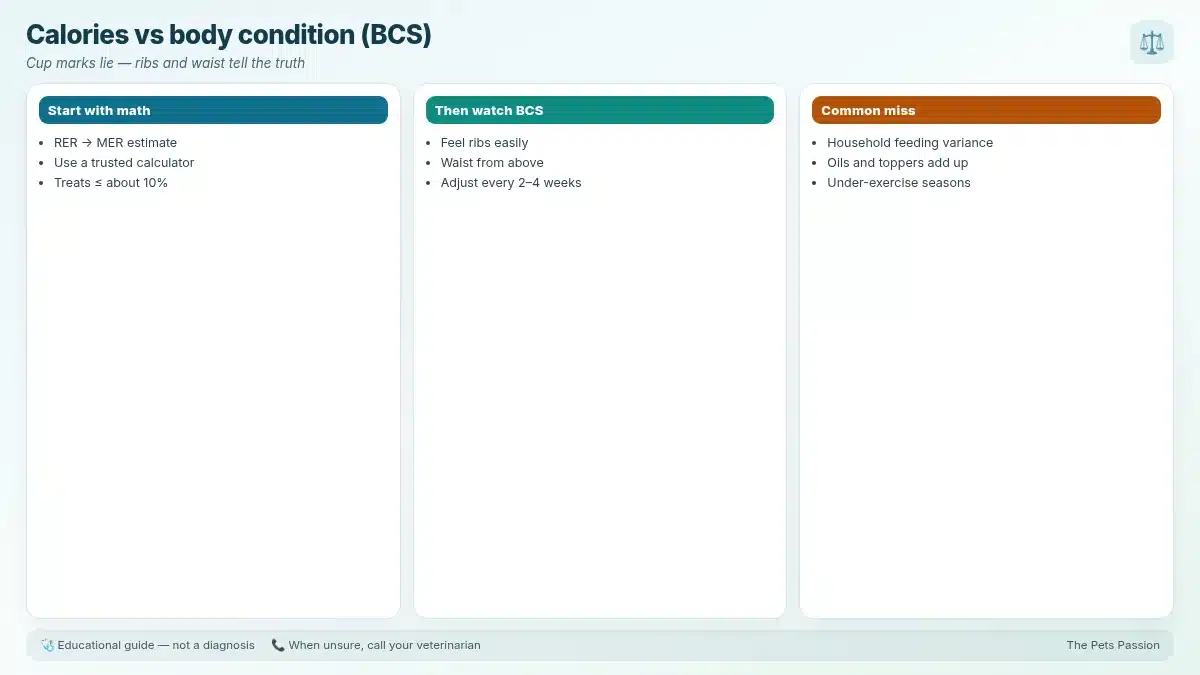
WSAVA nutritional screening treats BCS outside 4–5/9 (or equivalent on another validated scale) as a risk flag. Ideal dogs show:
- Ribs easy to feel under a thin fat cover
- A waist when viewed from above
- An abdominal tuck from the side
Too thin (ribs/hips obvious at a distance) and too heavy (waist gone, fat over the loin and tail base) both need a plan. Muscle condition score (MCS) matters too—especially in seniors who can be “skinny-fat” or lose muscle while the scale barely moves.
A dog at BCS 7/9 eating “the bag amount” is not proof the bag is wrong; it is proof this dog needs less energy or more honest accounting of extras. Conversely, a highly active border collie may need the high end of the WSAVA active band—or beyond—if work is real.
Treats ≤10%: the rule people quietly break
WSAVA nutritional assessment lists snacks, treats, and table food >10% of total calories as a screening risk factor. That 10% is not a bonus pile on top of MER. It comes out of the daily allotment.
Practical translation for a dog whose MER estimate is 1,000 kcal/day:
- Food ≈ 900 kcal
- Treats/training rewards/pill vehicles ≤ 100 kcal
Dental chews, peanut butter on pills, cheese “just a little,” and frozen Kong stuffing all count. If training needs high treat volume, switch to tiny pieces or kibble from the daily ration.
Pair calorie math with the Pet Budget tool if premium food and training treats are blowing the household plan—money and calories are both budget items.
Worked examples (illustrative math only)
Example A — 10 kg (22 lb) quiet adult, neutered
- RER ≈ \(70 \times 10^{0.75}\) ≈ \(70 \times 5.62\) ≈ 393 kcal
- MER at 1.6 × RER ≈ 629 kcal
- WSAVA inactive–active adult band for 10 kg on the published chart: roughly 470–590 kcal/day
- Notice the factor method and the chart band can disagree slightly—that is normal. Start near a band, watch BCS.
Example B — 25 kg (55 lb) active adult
- RER ≈ \(70 \times 25^{0.75}\) ≈ \(70 \times 11.18\) ≈ 783 kcal
- MER at 2.0 × RER ≈ 1,566 kcal
- WSAVA chart band for 25 kg: roughly 940–1,174 kcal/day for average healthy adults in ideal condition
If your “active” dog is mostly sofa + one leash walk, do not romanticize the 2.0 factor. Activity adjectives inflate cups.
Run your own numbers in the Dog Calorie Calculator rather than trusting blog arithmetic forever.
Puppy, senior, and medical caveats
Puppies need growth diets and higher energy density, but giant-breed puppies are not helped by free-choice overfeeding that rushes skeletal growth. Use puppy food labeled for the size category your vet recommends, and weigh every 1–2 weeks early on. Our Puppy Weight Predictor helps set size expectations; it does not replace growth-curve visits.
Seniors may need fewer calories if activity drops—or more protein-aware support if muscle is wasting. Disease (CKD, heart disease, cancer) can invert naive “feed less” instincts. QoL conversations belong with your clinic and, when relevant, the Canine Quality of Life Scale.
Weight-loss programs should target gradual fat loss while protecting muscle. Crash diets and unmonitored fasting are not clever. Ask for a target weight, rate of loss, and recheck schedule.
Therapeutic diets (renal, GI, urinary, allergy) already encode calorie density choices. Do not “top up” with random toppers that wreck the nutrient profile.
How do cup markings and “feed 2–3 cups” go wrong?
Bags print ranges because dogs are not clones. Cup markings on plastic scoops drift. “One cup” of a dense kibble is not one cup of a light kibble. Weigh the daily portion on a kitchen scale in grams for two weeks; many households discover they were 15–25% off without meaning to.
Also count:
- Shared household feeding (one dog finishes the other’s bowl)
- Food-stuffed toys left out all day
- Neighbors who “spoil” the dog at the fence
- High-calorie dental products sold as if they were zero
Q&A
How many calories does my dog need per day by weight?
There is no single universal kcal/kg for all adult dogs. Use RER/MER or the WSAVA adult calorie ranges as a start, then adjust to BCS. A 5 kg inactive-to-active adult on that chart falls near 280–351 kcal/day; a 30 kg adult near 1,080–1,346 kcal/day—still guidance only.
Is RER the same as what I should feed?
Usually no. RER is the resting baseline. Most house pets eat an MER estimate above RER unless they are on a clinic weight-loss plan anchored near RER of ideal weight.
Do neutered dogs need fewer calories?
Many maintenance charts use a lower factor for neutered adults than intact adults because average energy needs often fall after neutering—especially if activity drops. Individual response still rules.
Can I trust online calorie calculators?
Trust the method (allometric RER + transparent factors) and distrust any tool that pretends one number is destiny. Ours is built for education and planning: Dog Calorie Calculator.
What if my dog is hungry on the calculated amount?
First verify true calories (treats, cup accuracy, food kcal/cup). Then discuss satiety strategies with your vet: higher-fiber weight-management diets, puzzle feeders, more low-calorie vegetables only if appropriate, medical rule-outs for polyphagia.
Are grain-free or raw diets lower calorie by default?
Not automatically. Calorie density depends on the formula. Evaluate the calorie statement and the dog’s BCS, not the marketing adjective.
Related guides and tools
- Primary tool: Dog Calorie Calculator
- Pet Hydration Calculator
- Puppy Weight Predictor
- Pet Budget planner
- Canine Quality of Life Scale
- Cat Calorie Calculator (multi-pet homes)
Checklist: set calories without guessing forever
- Current weight recorded in kg and lb
- BCS scored on a 9-point chart (photo from above + side)
- RER calculated or pulled from the calorie calculator
- MER factor chosen honestly (sofa ≠ “athlete”)
- Food kcal per cup/can confirmed from label or manufacturer
- Treat budget ≤10% written down in kcal
- Kitchen scale used for 14 days
- Recheck weight/BCS date on the calendar
- Vet looped in for puppies, weight-loss plans, or disease diets
Reading the food label like a nutrition geek (without becoming one)
Look for a calorie statement such as “kcal/kg” and “kcal/cup.” If only kcal/kg appears, weigh a filled cup once. Prefer foods that meet AAFCO (or your region’s equivalent) complete-and-balanced statements for the right life stage. “All life stages” foods can be too rich for couch adults if portions are lazy.
When switching foods, transition over several days and recalculate portions—calorie density changes even when the cup count stays pretty.
Weight-loss reality check (clinic conversation starters)
Bring to your appointment:
- Brand, product name, and exact kcal/cup
- Photo of the measuring cup you actually use
- Treat list with package kcal
- Two weeks of morning weights if you have a scale
- Activity diary (real walks, not aspirational ones)
Ask: target weight, weekly loss rate, whether to feed to ideal-weight RER, and when labs are needed. Do not borrow a neighbor’s thyroid meds or human diet pills.
Hydration still matters during weight loss—use the Pet Hydration Calculator if intake seems off, and never withhold water to “cut bloat.”
Multi-dog households and calorie theft
Feed separately. Pick up bowls after 15–20 minutes if your vet agrees that pattern fits. Microchip-gated feeders help when one dog is on a diet and another is a vacuum. Shared free-choice feeders make every calculator lie.
When “he’s just big-boned” is denial
Breed standards list adult ranges; BCS still applies inside the breed. A show-ring Labrador and a pet Labrador both deserve palpable ribs. Obesity raises risk conversations around osteoarthritis, anesthesia, and metabolic disease—your veterinarian owns those clinical calls; your job is not to wait until the dog needs a hoist to enter the car.
If mobility and comfort are already sliding, pair nutrition talk with the HHHHHMM quality-of-life tool so pain is not mistaken for “normal old age.”
Homemade and raw feeding calorie traps
Home-prepared diets frequently drift in calories and micronutrients unless formulated by a board-certified veterinary nutritionist. Raw diets are not exempt from math: fat percentage swings kcal density hard. If you insist on home prep, get a proper recipe and still track BCS. Our calculator estimates energy need; it does not balance calcium/phosphorus.
Travel, boarding, and holiday calorie creep
Boarding kennels and pet sitters may follow the bag’s upper range “to be safe.” Write portions in grams, not cups, on the care sheet. Holidays add gravy, dropped hors d’oeuvres, and guilt treats. Pre-portion a treat allowance for guests so love does not equal pancreatitis risk.
Building a 30-day feeding experiment
Week 1: Weigh food, log treats, no other changes.
Week 2: Apply calculator MER ± adjust for BCS.
Week 3: Hold steady; note hunger behaviors vs true polyphagia.
Week 4: Weigh and rescore BCS; change only one variable at a time.
If weight climbs despite honest logs, book the vet—medical drivers exist.
Internal links worth your next click
Keep the primary CTA warm: every serious feeding change should start with a fresh pass through the Dog Calorie Calculator, a BCS photo, and a willingness to believe the tape measure over the puppy eyes.
How many calories does my dog need? Enough to hold a lean, muscled body at a life stage they can enjoy—not enough to match the neighbor’s Instagram portions. Math first, then mercy for the ±30% biological scatter, then professional help when the trend disagrees with the plan.
Veterinary Review & Editorial Standard
This clinical guide was prepared using peer-reviewed veterinary literature and guidelines from leading veterinary associations. If your pet exhibits acute symptoms or distress, please seek immediate in-person veterinary emergency care.