
Cat Ate String and Seems Normal? What to Do Now
 The Pets Passion Medical Team
If your cat ate string — thread, yarn, ribbon, dental floss, or tinsel — here is what to do: call a veterinarian or emergency clinic right away, even if the cat is acting normal. Linear foreign bodies can anchor under the tongue or in the stomach while the intestines bunch and pull against the material, and a cat may look This guide explains cat ate string what to do first, the red flags to watch for, and what happens at the vet.fine for hours before vomiting, pain, loss of appetite, dehydration, or a tear develops. Never pull visible string from the mouth or rectum.
Why is string different from a small swallowed object?
A linear foreign body can anchor at one end while the intestines bunch and pleat around it — the bowel can saw against the taut string and perforate. One end may catch under the tongue or in the stomach while the rest travels onward, causing the intestines to pleat or bunch. A needle attached to thread adds puncture risk. VCA and PetMD describe perforation and peritonitis as life-threatening complications. “It is only thread” is never a safe reason to watch at home.

What should I do immediately after my cat eats string?
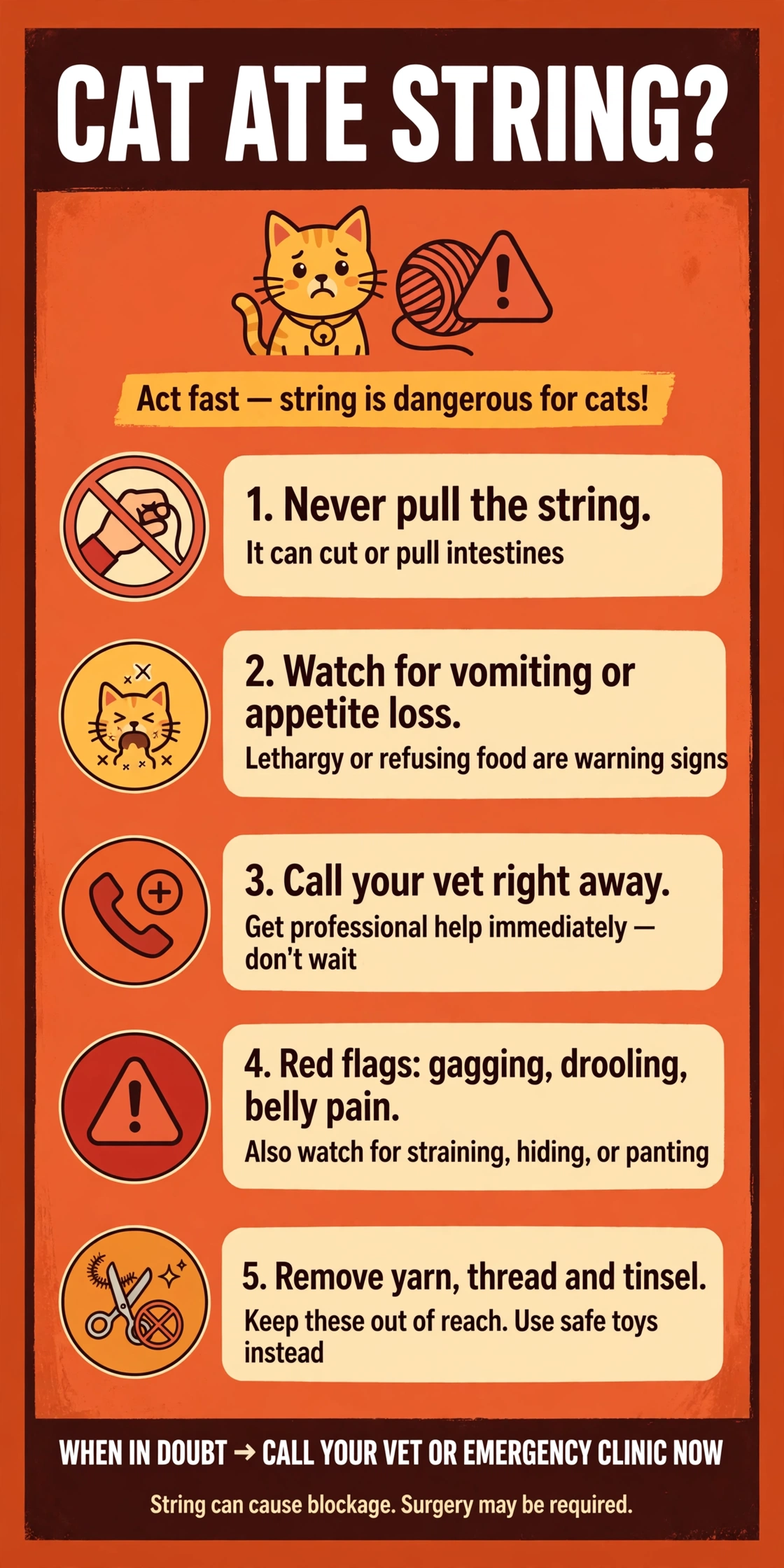
- Remove access to the remaining string, yarn, or ribbon.
- Keep the cat calm — a carrier in a quiet room works well.
- Call the clinic now. Tell them the material, the approximate length, whether a needle was attached, when it happened, and whether any string is visible.
- Do not pull it — not from the mouth, not from the rectum.
- Do not cut it flush against the skin or mouth on your own.
- Do not give oil or food to push it through, and do not induce vomiting.
- Follow the clinic’s instructions about transport, food, and timing.
What if my cat is acting normal?
Normal behavior does not prove that the string passed or is harmless. Some foreign bodies cause signs hours or even a day later, and cats are experts at masking discomfort. Call now rather than waiting for the first vomit. If the clinic tells you to monitor at home, ask exactly which signs should trigger a return visit — and within what time window.

What does “watchful waiting” actually involve?
When a vet approves monitoring — usually only for short, smooth material with no needle and a cat that is eating and comfortable — watchful waiting is active, not passive. Check on the cat every few hours: is it eating, drinking, and using the litter box normally? Look at every stool for the passed material. Watch for the warning signs below. Any change ends the waiting — call the clinic. And set a clear deadline with your vet: if the material has not passed within the agreed window, the cat goes back in.
What are the warning signs of a possible linear obstruction?
- Vomiting — especially repeated vomiting
- Refusal to eat
- Drooling, pawing at the mouth, or repeated swallowing
- Abdominal pain — a cat that bites or cries when picked up around the belly may be painful
- Hiding or lethargy
- Dehydration
- Diarrhea, constipation, or straining to defecate
Go urgently for collapse, severe pain, repeated vomiting, or breathing trouble. Do not wait for every sign to appear — one or two are enough. For the broader picture of digestive red flags, see our guides on cat vomiting and cat not eating.
How will the veterinarian evaluate my cat?
The veterinarian may inspect under the tongue (a common anchor point), examine the abdomen, assess hydration, and run blood and urine tests. X-rays may show abnormal bowel patterns even when the string itself is not visible; ultrasound can add information. Treatment may be careful monitoring in selected cases, endoscopy, or surgery if an obstruction or perforation is suspected. The choice depends on the object and the cat’s condition. If you are unsure how urgent your situation is, our guide on when to take a cat to the emergency vet can help you decide.
What does surgery involve, in plain terms?
If surgery is needed, the vet opens the abdomen, locates where the string has anchored and bunched the intestines, and carefully removes the material — sometimes through one or more small openings in the bowel, which are then closed with stitches. Damaged sections of intestine may need to be removed. It is major surgery, but it is also a well-established procedure, and most cats recover well when the problem is caught before perforation. This is the main reason early calls matter: surgery on intact bowel has a far better outlook than surgery after a tear.
What happens after treatment?
If the string passed on its own under vet supervision, your vet may recommend a bland, easy diet for a few days and a recheck to confirm the gut has settled. After endoscopy or surgery, expect restricted activity, medications on a strict schedule, and an incision to monitor for redness, swelling, or discharge. Appetite usually returns gradually — offer small, frequent meals of whatever your vet recommends. Call the clinic if vomiting returns, the cat stops eating again, or the incision looks worse instead of better. Most cats bounce back well once the material is out, which is why the follow-up plan matters as much as the emergency visit.
Which string-like dangers should I watch for at home?
- Hair ties and rubber bands: among the most commonly swallowed items — small, stretchy, and fun to chew.
- Tinsel and ribbon at holidays: tinsel season sends cats to emergency clinics every year. Skip tinsel if you have a cat, or keep the tree in a closed room.
- Dental floss: flavored and stringy — put used floss directly into a closed bin.
- Sewing thread and embroidery floss: often with a needle attached, which adds puncture risk.
- Wand toys and toys with strings: great for supervised play, dangerous left unattended. Store them out of reach between play sessions.
- Elastic bands, gift wrap ribbon, and balloon strings.
If your cat chews non-food items regularly, mention it to your vet — and read our toxic lilies guide while you are proofing the house, since plant dangers often live in the same rooms.
How do I string-proof my home, room by room?
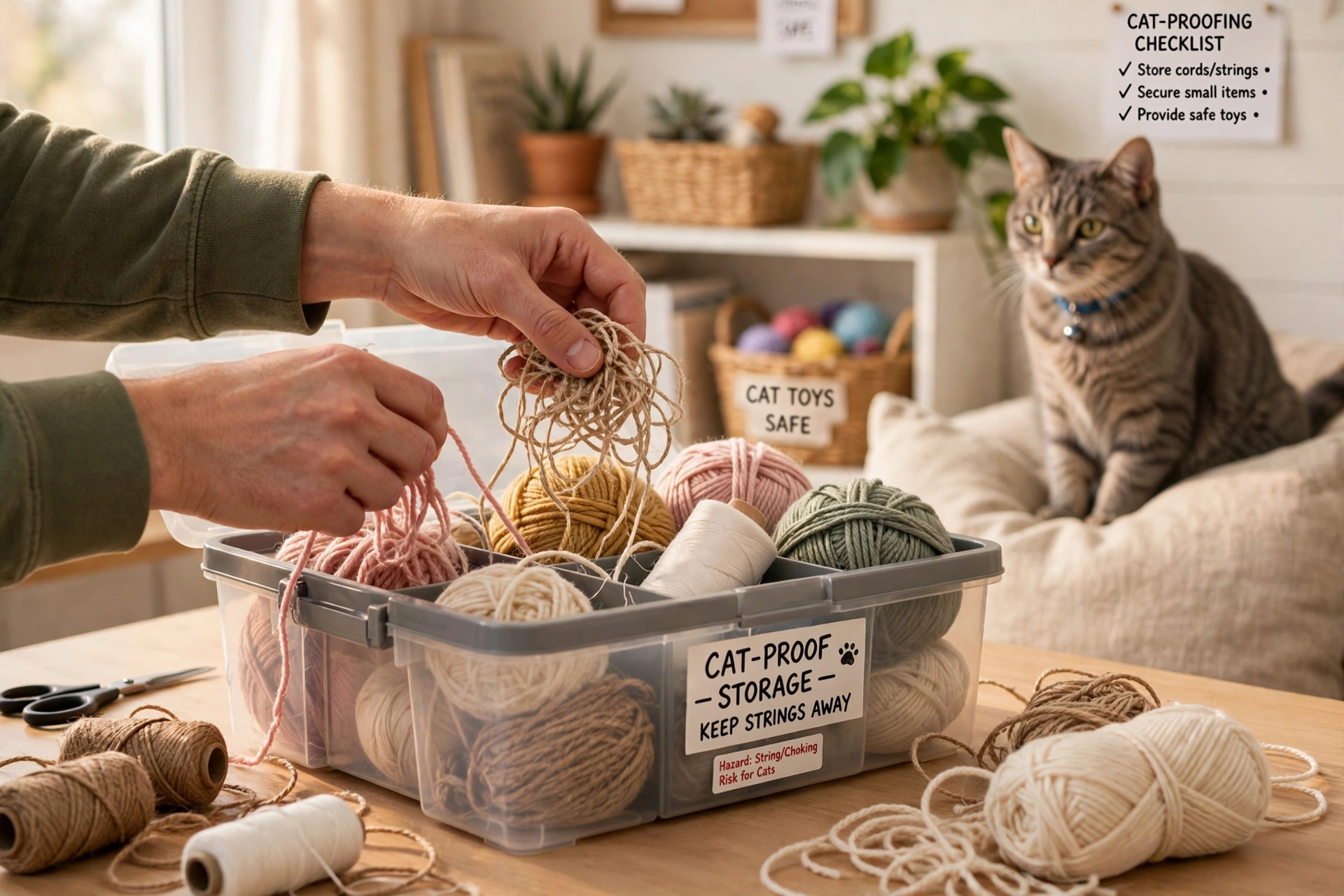
- Sewing/craft area: store thread, needles, and ribbon in closed containers; sweep up cut ends immediately.
- Bathroom: closed bin for dental floss; keep hair ties in a drawer, not on counters.
- Living room: inspect toys for loose strands; store wand toys out of reach; check under furniture and behind appliances where loose thread collects.
- Holidays: avoid tinsel; secure ribbon on gifts or keep gifts behind closed doors.
- Multi-cat homes: one cat’s toy is another cat’s emergency — proof shared spaces for the most determined chewer.
Prevention is far easier than proving a swallowed object has passed.
Frequently asked questions
Can I pull string from my cat’s mouth?
No. Pulling can saw the string through bunched intestine or damage the mouth and throat. Leave any visible string exactly as it is and call your vet.
Can string pass through a cat on its own?
Sometimes short, smooth pieces do pass — but you cannot know in advance which cases those are. Always call your vet first; monitoring is only safe when the clinic agrees to it.
Should I give my cat a laxative or oil to help it pass?
No. Laxatives, oils, and “push it through” home remedies can worsen a linear foreign body situation. Do not give anything unless your veterinarian specifically directs it.
How long does it take for string to pass?
There is no safe standard timeline — it depends on the material, length, and where it anchored. Your vet will set the monitoring window; if it passes that window without the material appearing, the cat goes back in.
My cat chews string but I don’t think she swallowed any — what now?
Watch her closely for a day or two for any of the warning signs above, string-proof the area, and call your vet for advice. When in doubt, a call costs nothing.
Sources consulted
- VCA Hospitals: Linear Foreign Body in Cats
- VCA Hospitals: Ingestion of Foreign Bodies in Cats
- PetMD: Gastrointestinal Obstruction in Cats
Related guides
- Cat Not Eating: When To Worry
- Cat Diarrhea: When To Worry
- Cat Constipation: When To Worry
- Cat Coughing Vs Hairball
Veterinary Review & Editorial Standard
This clinical guide was prepared using peer-reviewed veterinary literature and guidelines from leading veterinary associations. If your pet exhibits acute symptoms or distress, please seek immediate in-person veterinary emergency care.


💬 1 Community Response
Comments are closed for this article.