Are Lilies Toxic to Cats? What to Do in the First Hours
 The Pets Passion Medical Team
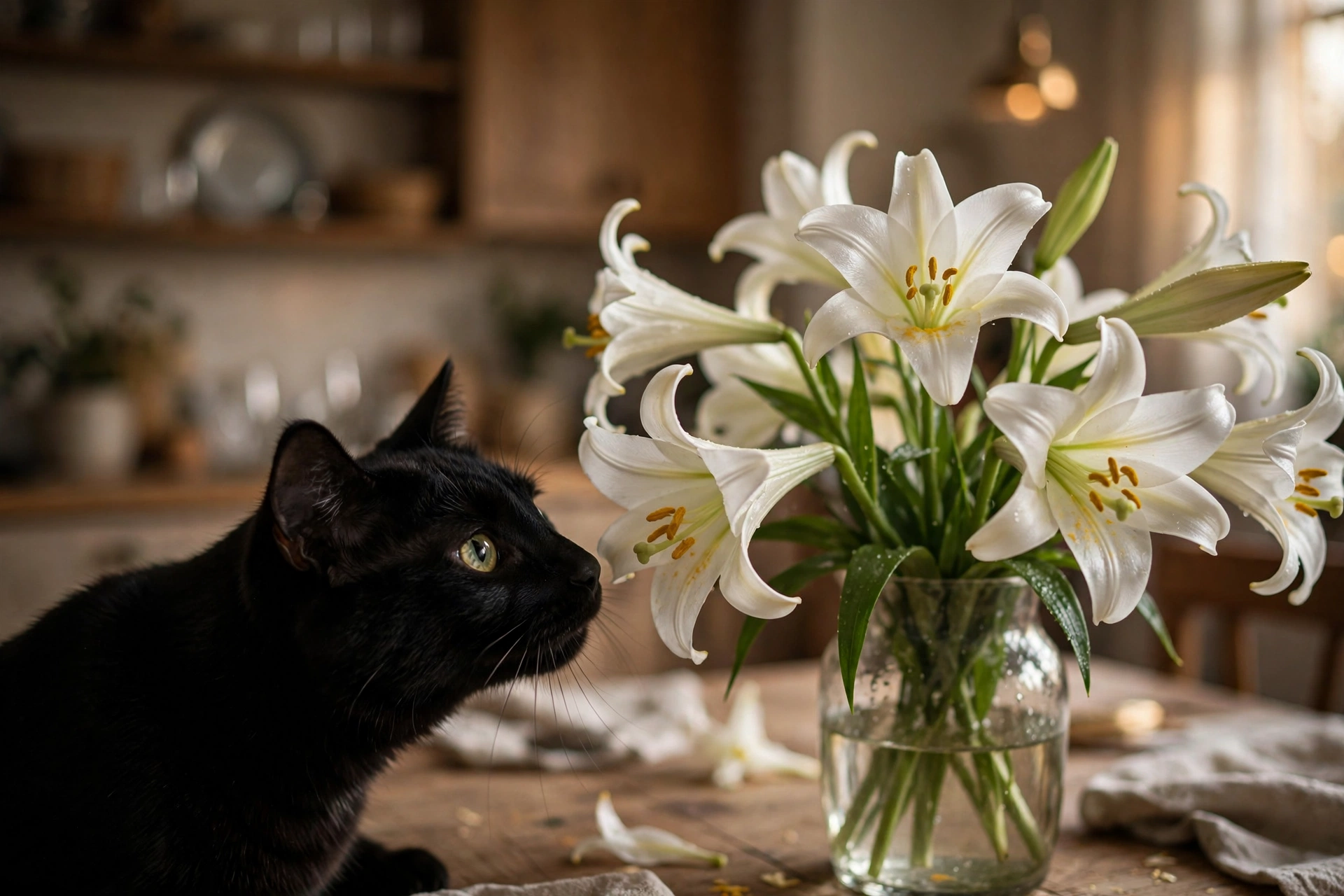
Yes — true lilies (Lilium) and daylilies (Hemerocallis) are highly toxic to cats. Even a nibble of leaf or petal, a few pollen grains licked off fur, or a sip of vase water can lead to acute kidney failure, often within 24–72 hours if untreated. This is a same-hour veterinary emergency, not a wait-and-see situation. For the wider red-flag checklist, see our when to take a cat to the emergency vet guide.
Educational disclaimer: This guide from The Pets Passion summarizes public guidance from the U.S. FDA, ASPCA, Merck Veterinary Manual, and UC Davis School of Veterinary Medicine. It is not a diagnosis or treatment plan. If exposure is possible, call your veterinarian or an emergency clinic now, and consider a pet poison hotline:
- ASPCA Animal Poison Control Center (APCC): (888) 426-4435 — 24/7; a consultation fee may apply
- Pet Poison Helpline: (855) 764-7661 — 24/7; a consultation fee may apply
Are all plants called “lilies” equally dangerous to cats?
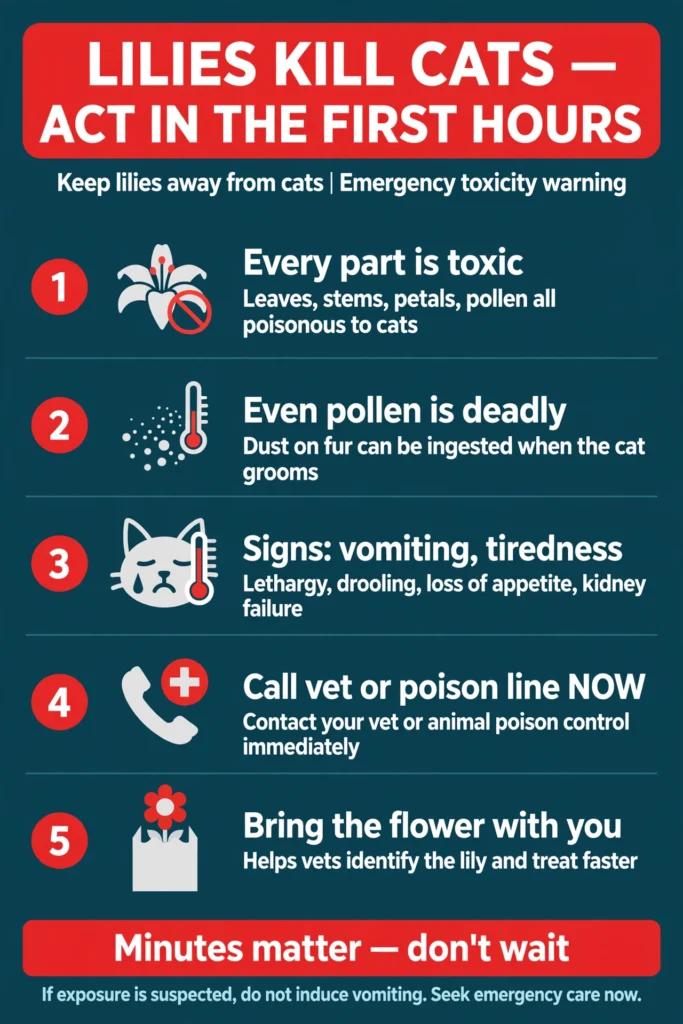
No. The life-threatening kidney toxin problem is tied to true lilies (genus Lilium) and daylilies (genus Hemerocallis). The FDA stresses that the entire plant is toxic to cats — stem, leaves, flowers, pollen, and vase water — and that the feline-specific toxin is still unidentified. Dogs that chew these plants may get mild stomach upset; they do not develop the same kidney failure pattern cats do.
Other plants with “lily” in the common name are not the same toxin class:
| Plant (common name) | Typical concern in cats | Kidney failure like true lilies? |
|---|---|---|
| Easter, Stargazer, Asiatic, Oriental, Tiger lily (Lilium) | Acute kidney injury / failure | Yes — emergency |
| Daylily (Hemerocallis) | Acute kidney injury / failure | Yes — emergency |
| Peace lily (Spathiphyllum) | Mouth/throat irritation from insoluble calcium oxalate crystals | No (still call if severe swelling or distress) |
| Calla lily | Same oxalate irritation pattern | No |
| Peruvian lily (Alstroemeria) | Mild GI upset in larger amounts | No |
| Lily of the valley (Convallaria) | Cardiac glycosides — abnormal heart rhythm risk | No (different, still serious) |
| Gloriosa / flame lily | Multi-system organ injury risk (tubers especially) | No (different, still serious) |
If you are unsure which plant it is, treat it as a true lily until a vet or poison hotline says otherwise. Bring the plant, a clear photo, or the florist tag.
Cross-check other household hazards in our pet toxic foods checker (foods, sweeteners, common pantry risks) while you arrange transport — it does not replace lily plant ID, but it helps if the bouquet included chocolate, xylitol gum, or other co-ingestants.
Which true lilies and daylilies are toxic to cats?
The FDA lists highly toxic examples that commonly show up in bouquets and gardens, including:
- Asiatic lily (and hybrids)
- Daylily (Hemerocallis species)
- Easter lily (Lilium longiflorum)
- Japanese show lily (Lilium speciosum)
- Oriental lily
- Rubrum lily
- Stargazer lily (hybrid)
- Tiger lily (Lilium tigrinum / lancifolium)
- Wood lily
UC Davis notes Easter, Stargazer, and Asiatic types are among the most hazardous Lilium exposures seen clinically, and daylilies share the kidney-failure risk. ASPCA lists Lilium species as toxic to cats with clinical signs centered on kidney failure.
How little is too much? Credible sources agree: a small amount of leaf or petal, pollen groomed off the coat, or vase water can be enough. There is no “safe decorative dose” for indoor cats.
What should I do in the first hours if my cat ate a lily?
Act on suspicion, not on waiting for kidney signs.
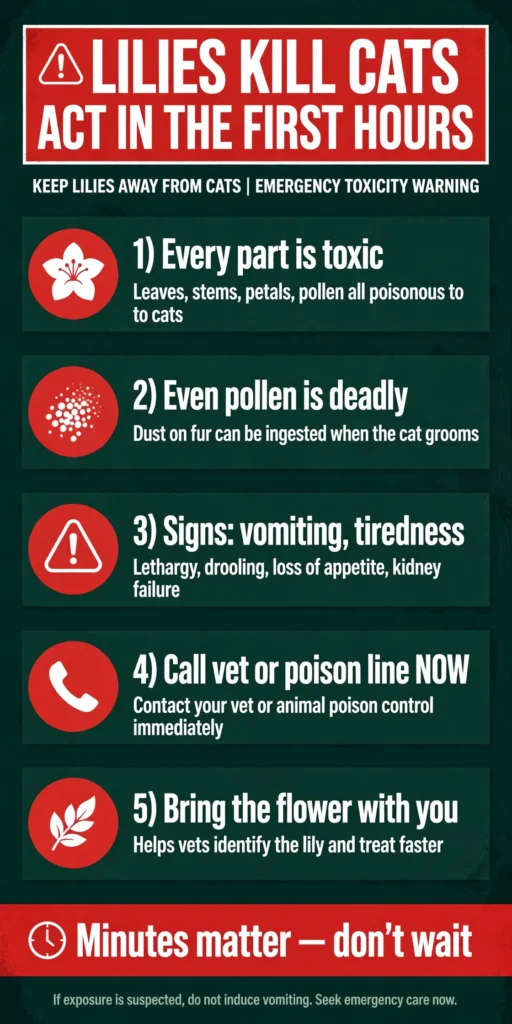
- Separate the cat from the plant and any fallen pollen or petals. If you see pollen on your cat’s fur, keep the cat calm and call your veterinarian or a poison helpline before trying to remove it — wiping is a step your clinic may advise while you arrange care, not a substitute for it.
- Photograph the plant (whole plant + label). Save the bouquet card.
- Call your veterinarian or nearest emergency clinic immediately. Say “possible Lilium/daylily exposure” and the estimated time.
- Call a poison hotline while you drive or wait for callbacks if advised: ASPCA APCC (888) 426-4435 or Pet Poison Helpline (855) 764-7661.
- Do not induce vomiting unless a veterinarian or poison specialist specifically instructs you for this cat and this timing. Human remedies and internet “home detox” protocols are unsafe.
- Note what you saw: chewed leaf vs pollen on whiskers vs drinking from the vase; time of exposure; any vomiting already.
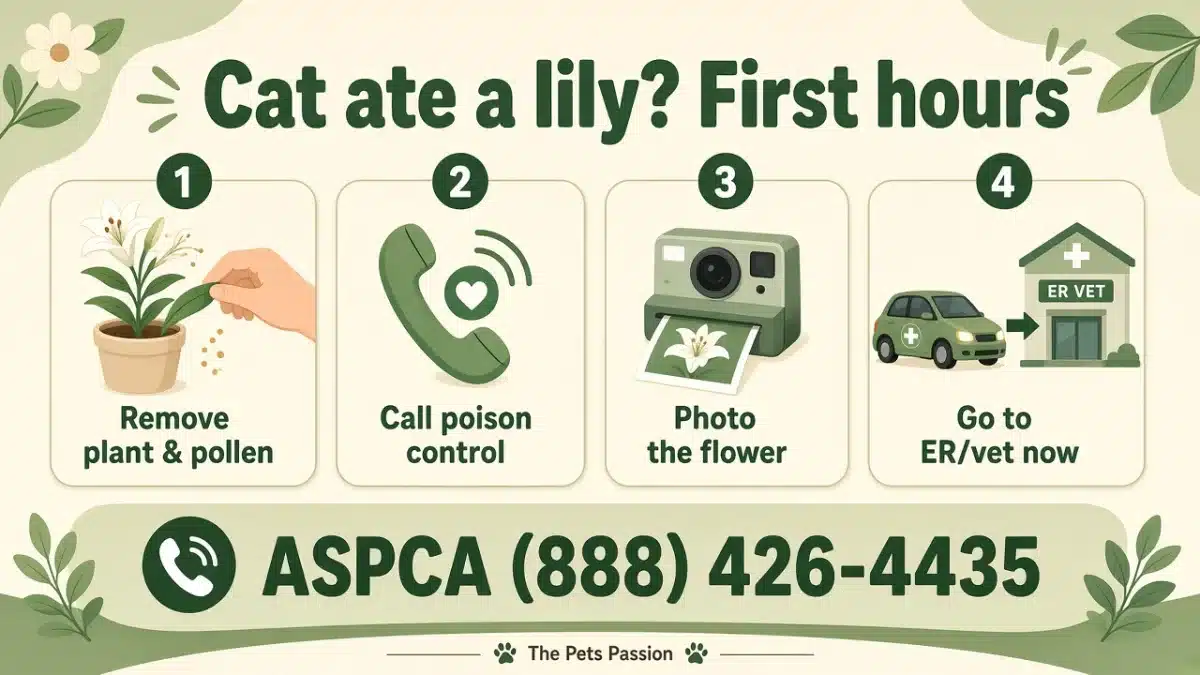
FDA and UC Davis both emphasize that early treatment greatly improves prognosis, and that delays approaching or past roughly 18 hours after ingestion are associated with a much higher risk of irreversible kidney failure.
If your cat already looks painful, hunched, or unusually quiet after exposure, a quick facial-pain check with the Cat Grimace Scale guide can help you describe findings to the ER — it does not replace emergency care for lily ingestion.
What does lily poisoning look like over the first 72 hours?
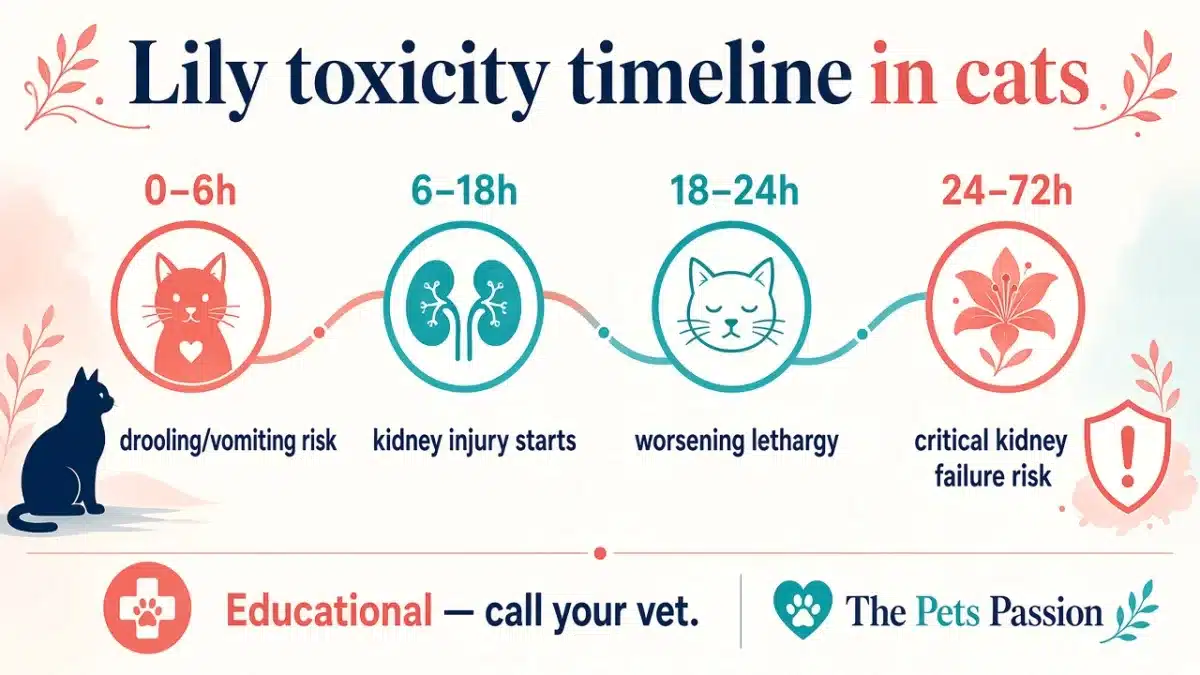
Timelines below follow FDA and UC Davis public summaries (Merck describes a similar early GI phase within hours, then progressive kidney signs). Individual cats vary; absence of signs is not clearance.
| Window | What owners often notice | Why it matters |
|---|---|---|
| 0–6 hours | Drooling, vomiting, quieter than usual, appetite drop may start | Best window for prompt decontamination and starting protective care |
| 6–18 hours | Ongoing GI signs, lethargy; still may not look “kidney sick” yet | Critical decision window — FDA/UC Davis flag delays past ~18 h as high risk for irreversible damage |
| 12–24 hours | Increased urination and dehydration as kidney injury develops | Kidney damage phase; needs clinic monitoring, not home watching |
| 18–72 hours | Worsening lethargy; urine output may fall (oliguria/anuria); kidney failure risk | Life-threatening stage without aggressive veterinary support |
Merck notes clinical signs can begin within 1–3 hours (salivation, anorexia, lethargy, vomiting), with polyuria/dehydration over the next 12–30 hours, and severe outcomes within days if untreated. Seizures are uncommon but can occur with severe uremia.
How do veterinarians treat lily toxicity in cats?
Only a veterinarian should decide the plan. Public specialty sources describe a typical emergency pathway that may include:
- Stabilization and history (plant ID, timing, concurrent toxins)
- Decontamination when appropriate (induced emesis only if safe and recent; activated charcoal, only if your veterinarian directs it)
- Baseline bloodwork and urinalysis, then repeat kidney bloodwork on a schedule your veterinarian sets (monitoring commonly continues for about 48–72 hours)
- IV fluid therapy in the hospital, often for around 48 hours as directed by the treating veterinarian
- Anti-nausea / gastroprotectant support if gastritis or uremia develops
- Advanced care (including dialysis referral) if urine output collapses
Prognosis is much better when care starts early and only mild effects develop. Once oliguria or anuria is established, prognosis becomes guarded to poor.
True lily vs lookalikes: how severe is each?
Use this severity table when a florist card is vague. When in doubt, escalate.
| Plant group | Severity for cats | Main problem | Owner action |
|---|---|---|---|
| Lilium (true lilies) | Critical | Nephrotoxin → AKI / failure | ER / poison control now |
| Hemerocallis (daylilies) | Critical | Same kidney-failure risk | ER / poison control now |
| Lily of the valley | Critical (cardiac) | Heart rhythm disruption | ER / poison control now |
| Gloriosa / flame lily | Critical (multi-organ) | Serious systemic toxin risk | ER / poison control now |
| Peace / calla lily | Moderate (local) | Oxalate oral pain, drooling, vomiting; rare airway swelling | Call vet; ER if breathing trouble |
| Peruvian lily | Mild–moderate GI | Stomach upset with larger ingestions | Call vet for dose/context |
Sources for this comparison: FDA “Lovely Lilies…” lookalike sections; ASPCA plant and news guidance; Pet Poison Helpline peace/calla entries; UC Davis lily page.
How can I keep cats safe around flowers and gardens?

- Do not keep Lilium or daylilies in homes or yards shared with cats (FDA’s plain advice for cat households).
- Tell florists and gift-givers: “No true lilies or daylilies — cat household.” Ask for cat-safer alternatives (Pet Poison Helpline publishes safer-bouquet lists; FDA points readers there).
- Put delivered bouquets in a closed room until you verify every stem.
- After guests leave Easter or Mother’s Day arrangements, check floors for fallen anthers and pollen.
- Outdoor cats: daylilies in borders are a hidden seasonal risk — same toxin class.
- Keep the toxic foods checker bookmarked for food co-hazards that often arrive with holidays (chocolate, raisins, sugar-free gum).
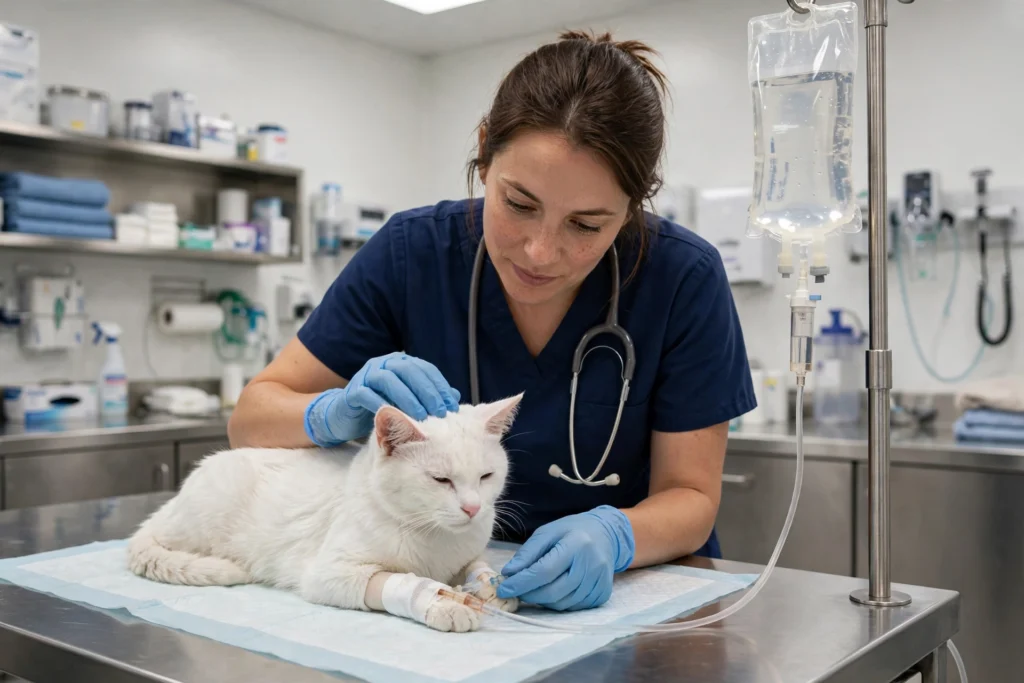
Remember: lily exposure is an emergency — don’t wait for kidney signs. Vomiting is an early sign of lily poisoning and warrants immediate care. For other things cats swallow that need a vet, see our foreign-body guide.
Veterinary sources:
Are lilies toxic to cats even if they only lick pollen?
Yes. FDA and clinical toxicology sources document that pollen grooming alone has caused kidney injury. Treat pollen on the coat as exposure.
Are daylilies toxic to cats the same way as Easter lilies?
Yes for the kidney-failure risk. Daylilies are Hemerocallis, not Lilium, but they are grouped with true lilies as highly dangerous to cats.
Are peace lilies toxic to cats?
Peace lilies are irritating (calcium oxalate crystals) and can cause drooling, oral pain, and vomiting. They are not the classic true-lily nephrotoxin. Still call a vet if signs are severe or breathing seems affected.
Can vase water from lilies poison a cat?
Yes. FDA explicitly includes vase water as a route to fatal kidney failure in cats.
How long after eating a lily do symptoms start?
GI-type signs often appear within hours (FDA: early signs 0–12 hours; Merck: often 1–3 hours). Kidney-damage signs commonly emerge around 12–24 hours, with failure risk through 24–72 hours without treatment.
Is lily toxicity in cats always fatal?
No — early veterinary care markedly improves odds. Delays near or beyond ~18 hours are linked to much worse kidney outcomes in public FDA/UC Davis guidance. Do not use internet survival stories as a plan.
Are lilies toxic to dogs too?
True lilies usually cause mild GI upset in dogs, not the feline kidney-failure syndrome. Lily of the valley and gloriosa remain dangerous across species. When mixed bouquets are involved, get species-specific advice from a vet or hotline.
Should I make my cat vomit at home?
Only if a veterinarian or poison specialist tells you to for that exact case. Wrong timing or method can worsen injury.
Bottom line
Are lilies toxic to cats? True lilies and daylilies are among the most dangerous common plants for cats — tiny exposures can destroy kidneys on a short clock. Identify the plant, call a vet/ER and a poison hotline, and move within the first hours. Lookalikes still need respect, but they are not interchangeable with Lilium/Hemerocallis.
Related cat guides: When a possible lily exposure is also causing collapse, breathing trouble, or severe weakness, use the emergency-vet guide; for pain language, see the Cat Grimace Scale. More cat guides.
Primary references: FDA — Lovely Lilies and Curious Cats · ASPCA — Lily · ASPCA Poison Control · Merck — Houseplants and Ornamentals · UC Davis — Lily Toxicity in Cats · Pet Poison Helpline (855) 764-7661
Veterinary Review & Editorial Standard
This clinical guide was prepared using peer-reviewed veterinary literature and guidelines from leading veterinary associations. If your pet exhibits acute symptoms or distress, please seek immediate in-person veterinary emergency care.