
Dog Quality of Life Scale: Using HHHHHMM Without Guilt
 The Pets Passion Medical Team

YMYL / medical disclaimer: This guide from The Pets Passion is educational and emotionally sensitive. It explains Dr. Alice Villalobos’s HHHHHMM Quality of Life Scale as used in palliative and hospice (“Pawspice”) conversations. It is not a standalone euthanasia order, a substitute for veterinary examination, or permission to stop prescribed pain control. If your dog is in severe distress, struggle-breathes, or cannot be kept comfortable, contact a veterinarian or emergency service now.
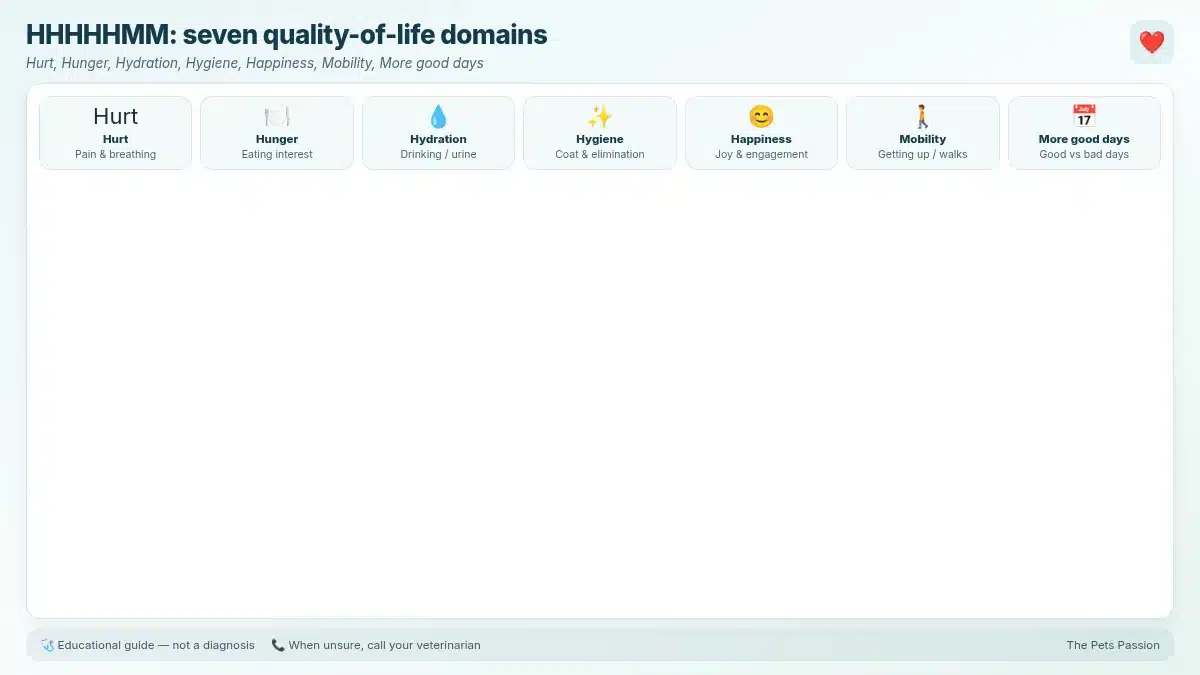
Dog quality of life scale searches almost always mean the HHHHHMM instrument: Hurt, Hunger, Hydration, Hygiene, Happiness, Mobility, and More good days than bad. Veterinary oncologist Dr. Alice Villalobos designed it so families and veterinary teams share a vocabulary when life-limiting disease enters the room. Score each domain, look at the pattern over days—not one tearful afternoon—and bring the numbers to your clinic. Our live primary CTA is the Canine Quality of Life Scale tool.
Quick answer. Dog quality of life scale (HHHHHMM)
| Letter | Domain | Core question |
|---|---|---|
| H | Hurt | Is pain controlled? Is breathing comfortable? |
| H | Hunger | Is the dog eating enough with reasonable help? |
| H | Hydration | Are gums moist? Is drinking (or clinic fluids) keeping up? |
| H | Hygiene | Can you keep the coat/skin clean without constant suffering? |
| H | Happiness | Does joy, greeting, or engagement still show up? |
| M | Mobility | Can the dog rise, posture to eliminate, move with acceptable help? |
| M | More good days than bad | Over 1–2 weeks, do good days still win? |
Direct answer: The Villalobos HHHHHMM quality-of-life scale scores seven domains—Hurt, Hunger, Hydration, Hygiene, Happiness, Mobility, and More good days than bad—from 0 to 10 each. A total over 35 is often cited as acceptable for hospice continuation, but trends matter more than one number. Pair our canine QoL tool with veterinary judgment—not as a substitute.
Why use a dog quality of life scale instead of vibes?
Grief, hope, and credit-card math all shout at once. A structured scale slows the spiral. It does not remove love from the decision; it keeps love from drowning clinical facts. VCA’s owner education on end-of-life quality of life describes Villalobos’s seven categories and the familiar “above 5 per category / overall greater than 35” framing for continuing support—always beside a veterinarian, not instead of one.
Hospice-level care has real costs; map them with cost of owning a dog so love and logistics stay in the same notebook.
If mobility pain is the main drag and injection OA therapy is on the table, read Librela side effects with your clinician—not as DIY dosing.
Hunger and hydration scores sit next to pain for a reason—revisit how many calories does my dog need and how much water should a dog drink when those rows stay low.
HHHHHMM is also a care audit. Low Hunger plus low Hydration may mean a feeding-tube or fluid conversation. Low Mobility with preserved Happiness may mean rugs, slings, and pain reassessment—not an automatic goodbye.
How do I score the HHHHHMM domains honestly?
Open the Canine Quality of Life Scale and move slowly.
Hurt
Pain control and easy breathing sit at the top on purpose. Trouble breathing outweighs almost everything. Score the dog you see on meds they actually receive—not the dog you imagine if someone “maybe” starts gabapentin next month. Untreated pain is not loyalty.
Hunger
Hand-feeding fancy rotisserie chicken once does not equal a 10. Ask whether caloric needs are roughly met across the day. Nausea control belongs in the vet plan. Pair with the Dog Calorie Calculator only as context—hospice appetites are medical.
Hydration
Tacky gums, thick saliva, and skin tenting matter. Some hospice patients receive subcutaneous fluids; score the result, not the effort theater. Everyday targets still live in the Pet Hydration Calculator.
Hygiene
Can the dog avoid urine scald, feces matting, and pressure sores with a care plan your household can sustain? A score should reflect dignity maintained—not martyrdom that destroys the caregiver’s health.
Happiness
Tail, eyes, interest in family, response to a special word. A quiet senior can still be content. A withdrawn dog that no longer greets anyone is telling you something.
Mobility
Independent marathon walks are not required. Ability to rise, shift, and eliminate with acceptable assistance is the bar. Orthopedic pain flares deserve analgesia trials directed by a vet—not scolding the dog for “giving up.”
More good days than bad
Track two weeks. Three awful days after anesthesia do not equal a life sentence. Fourteen bad days in a row with no plausible upside often do.
What does an HHHHHMM total above 35 mean?
Teaching materials commonly treat totals above ~35/70 (when using 0–10 × seven domains) as a zone where palliative care may still be “working.” A slide below that line—or any single domain stuck near the floor despite best treatment—should trigger a candid visit. Some families print weekly scores so trends beat memory.
Overrides: severe dyspnea, unmanageable pain, status epilepticus, or caregiver safety crises can make euthanasia the kindest option even if a partial score looks “mid.” Numbers serve compassion; they do not veto it.
Is using HHHHHMM the same as giving up?
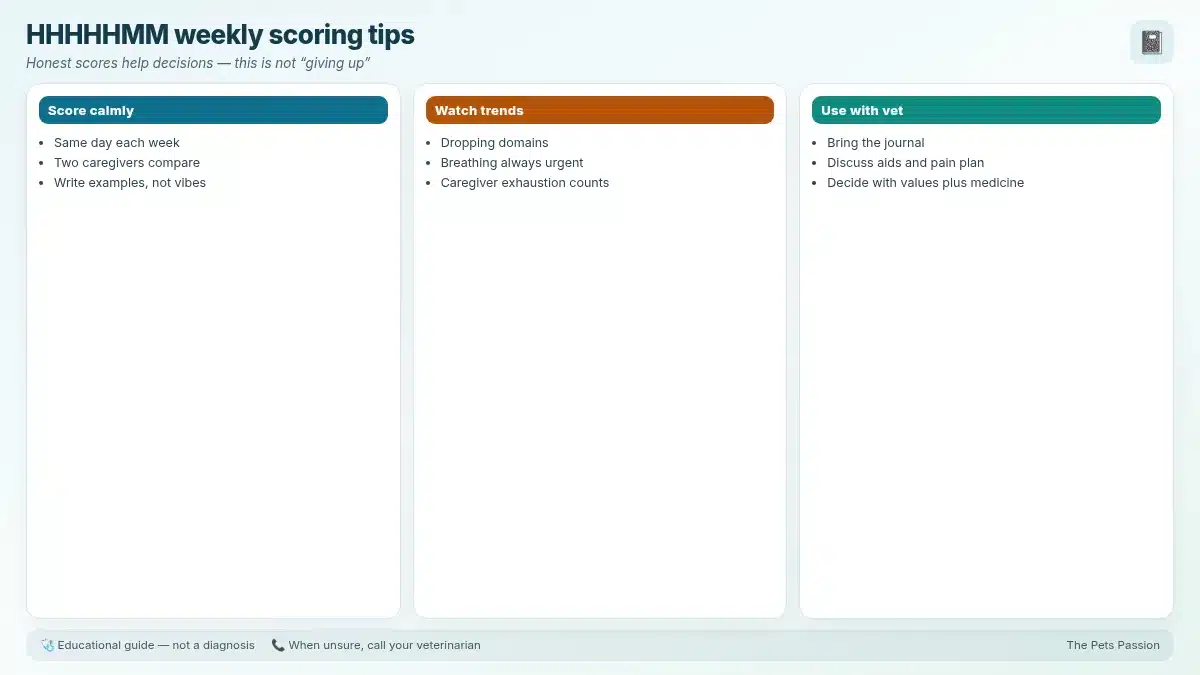
Villalobos’s Pawspice framing starts at diagnosis of life-limiting disease: gentler standard care, symptom control, and a planned transition into hospice when appropriate. Completing HHHHHHMM is not surrender. It is quality control on the love you are already giving.
Ask your clinic about:
- Pain scoring and multimodal analgesia
- Nausea control
- Mobility aids and home modifications
- In-home euthanasia options before a 3 a.m. crisis
- Aftercare (cremation/burial) so logistics are not decided in shock
Q&A
What is the dog quality of life scale cut-off?
Many handouts cite >35 overall (and/or >5 per category) as suggesting acceptable QoL under care. Your veterinarian may use slightly different teaching versions (0–10 vs 1–10). Trends matter more than one heroic number.
Can the HHHHHHMM scale tell me exactly when to euthanize?
It structures the conversation. It does not stamp a date. The dog, the disease, the response to treatment, and veterinary guidance decide together.
Should I score every day?
During unstable weeks, daily or every other day helps. In steadier palliative phases, twice weekly may suffice. Always score after major medication changes.
What if family members get different scores?
Expect it. Sit down with the same video clip of a morning rise and score together. Bring both numbers to the vet.
Is this only for cancer dogs?
No. Heart failure, neurologic disease, advanced osteoarthritis, and frailty all fit. Oncology popularized the scale; hospice minds use it widely.
Related guides and tools
- Primary tool: Canine Quality of Life Scale (HHHHHMM)
- Cat Quality of Life
- Pet Symptom Urgency Checklist
- Pet Hydration Calculator
- Dog Calorie Calculator
- Pet Budget / Pet Insurance Calculator
Caregiver sustainability is part of hygiene and happiness
If keeping Hygiene at 8 requires three hours of overnight laundry you cannot sustain, the plan fails the household—and eventually the dog. Honest scores include caregiver capacity. Ask about pet hospice nurses, veterinary social workers, or respite help early.
Financial strain is real; map expected palliative costs with the Pet Budget tool so money panic does not masquerade as a QoL verdict.
Sample two-week journal
| Day | Rate each HHHHHMM letter 0–10 (Hurt, Hunger, Hydration, Hygiene, Happiness, Mobility, More good days) | Notes prompts |
|---|---|---|
| Mon | Hurt __ Hunger __ Hydration __ Hygiene __ Happiness __ Mobility __ More good __ | Meds given? Appetite change? |
| Tue | Hurt __ Hunger __ Hydration __ Hygiene __ Happiness __ Mobility __ More good __ | Energy / interest in family |
| Wed | Hurt __ Hunger __ Hydration __ Hygiene __ Happiness __ Mobility __ More good __ | Accidents? Restlessness at night? |
| Thu | Hurt __ Hunger __ Hydration __ Hygiene __ Happiness __ Mobility __ More good __ | Walks / mobility limits |
| Fri | Hurt __ Hunger __ Hydration __ Hygiene __ Happiness __ Mobility __ More good __ | Pain signs (panting, guarding) |
| Sat | Hurt __ Hunger __ Hydration __ Hygiene __ Happiness __ Mobility __ More good __ | Good moments to note |
| Sun | Hurt __ Hunger __ Hydration __ Hygiene __ Happiness __ Mobility __ More good __ | Vet call? Pattern vs last week? |
Transfer weekly averages into the online scale before appointments.
Children, other pets, and saying goodbye
Prepare kids with age-honest language. Let them score Happiness with you so they feel included without carrying the final medical call. Plan other household pets’ routines for the day of euthanasia—their schedule still matters.
Memorial plans (paw prints, locks of fur) can be arranged ahead. That is love, not morbidity.
Myths that keep dogs waiting too long
| Myth | Kinder reality |
|---|---|
| "He'll tell us clearly" | Many dogs fade quietly |
| "Eating means no suffering" | Appetite can outlast comfort |
| "Euthanasia is quitting" | It can be the last pain control |
| "One good hour cancels a bad week" | Pattern > highlight reel |
| "Scales are only for vets" | Villalobos designed caregiver partnership |
Breathing: the non-negotiable Hurt clause
Open-mouth breathing at rest in a dog that is not cooling from exercise, blue/gray gums, or orthopnea (must sit/stand to breathe) are emergency flags. Do not wait for a pretty HHHHHMM average. Go.
Mobility aids that can raise a domain score
Nail grips, yoga mats on slick floors, ramps instead of stairs, belly slings, harnesses with handles, raised bowls only if aspiration risk is cleared, and scheduled potty outings after pain meds. Recheck Mobility after five days of consistent aids—sometimes the score climbs enough to buy quality time.
When palliative chemotherapy or surgery is on the table
Ask oncology teams how a proposed treatment is expected to move each HHHHHMM domain in 2–4 weeks. If the best-case scenario still leaves Hurt and Happiness on the floor, that is data. If a short anesthesia might fix a resectable pain source in an otherwise joyful dog, that is different data. The scale keeps those talks concrete.
Spiritual and cultural notes (keep them yours)
Families differ on home vs clinic euthanasia, presence at induction, and aftercare. Write preferences down while the dog still has good days. QoL scoring supports those values; it does not replace them.
After the decision: grief is not a score
When you choose euthanasia with veterinary partnership, HHHHHHMM has done its job. What follows is grief support—human friends, pet-loss hotlines your clinic recommends, and time. Do not re-litigate the spreadsheet forever. You used a dog quality of life scale to center the dog’s experience. That is the opposite of failure.
Keep the Canine Quality of Life Scale bookmarked for future seniors in the home; practicing on a healthy older dog once a year reduces panic when a diagnosis eventually arrives.
Pain meds, sedation, and honest Hurt scores
A dog deeply sedated into stillness is not automatically a Hurt score of 10. Over-sedation that prevents drinking, toileting, or any awareness can tank Hunger, Hydration, Hygiene, and Happiness even if the whimpering stops. Ask your veterinarian for the smallest effective multimodal plan and what “too sedated” looks like at home.
Never add human ibuprofen, naproxen, or acetaminophen. Those mistakes turn a QoL crisis into a toxicology crisis.
Appetite tricks vs medical nausea care
Warming food, offering novel proteins, and sitting with the dog help only if nausea and oral pain are addressed. If Hunger stays ≤3 for days despite coaxing, call—do not invent a DIY feeding tube. Subcutaneous fluids and anti-nausea drugs are veterinary tools; our calculators only help you describe the deficit.
Weight loss in hospice may be accepted as part of decline; starvation with pleading eyes is different. Document what percentage of normal intake you are seeing.
Multicentric scoring: when one disease hits five letters
Pulmonary metastasis can wound Hurt (breathing), Happiness (panic), Mobility (weakness), and More-good-days at once. Congestive heart failure can do the same. Do not average away a single catastrophic domain. Villalobos-style teaching repeatedly elevates breathing comfort for a reason.
Home euthanasia logistics (plan while scores are still mid-range)
Ask:
- Which veterinarian travels to homes?
- What payment and aftercare paperwork is needed in advance?
- Where will other pets and children be?
- How long until the team arrives on a bad day?
Having the number on the fridge is not “inviting death.” It is preventing a terrified ER car ride with a dog who can no longer stand.
Tracking “More good days” without toxic positivity
Define a good day in writing: ate breakfast willingly, walked to the yard with sling help, rested without crying, engaged when you said a cue word. Define a bad day: refused all food, cried despite meds, soiled while distressed, panic breathing. Tally them. The More domain is arithmetic plus mercy—not a TED Talk about cherishing moments.
Second opinions without shame
If your gut says pain is undertreated, seek another veterinary voice. Bring your HHHHHHMM log and the tool export/screenshot. Good clinicians welcome structured caregiver data. You are not “doctor shopping” when you are advocating.
Final stretch reminder
Revisit the primary CTA whenever the week feels foggy: the Canine Quality of Life Scale exists so dog quality of life scale conversations stay grounded in Hurt through More—seven letters, one dog, your veterinary team beside you.
Putting it together tonight
- Film a 60-second clip of your dog rising and greeting.
- Score all seven domains in the HHHHHMM tool.
- Circle the lowest two domains and email your vet with meds list + scores.
- Schedule a quality-of-life appointment before the next crisis weekend.
- Revisit in three to seven days.
Dog quality of life scale literacy will not make the last week easy. It will make the decisions clearer, the care more targeted, and the love easier to recognize in the data—not only in the tears.
FAQ
What is the Villalobos HHHHHMM scale?
Dr. Alice Villalobos developed this quality-of-life scale to help families and veterinary teams discuss hospice (“Pawspice”) and end-of-life decisions. Each of seven domains is scored 0–10 (10 = ideal). It structures observation; it does not diagnose disease or legally authorize euthanasia.
What do the seven HHHHHMM domains mean?
Hurt: pain control and breathing. Hunger: adequate eating. Hydration: fluid intake / dehydration risk. Hygiene: cleanliness, bedding, skin. Happiness: interest, joy, social engagement. Mobility: rising, walking, needing help. More good days than bad: whether good days still outnumber bad ones.
How is the total score interpreted?
Scores are summed; a total over 35 is often cited as acceptable quality of life to continue hospice care. Falling totals, a single very low domain (especially Hurt/breathing), or weeks of decline can matter more than one snapshot.
Can I use HHHHHMM instead of seeing a vet?
No. The scale complements veterinary and hospice judgment. Use our canine quality-of-life scale tool to organize thoughts, then review results with your veterinary team.
Which domain should never be ignored?
Hurt—especially difficulty breathing—is prioritized as top concern on the Villalobos scale. Poor pain control or respiratory distress warrants urgent veterinary care regardless of a “decent” total score from other categories.
How often should I rescore my dog?
Many families score weekly during stable hospice care and more often during rapid change. Track each domain, not only the sum. Bring notes to veterinary or hospice appointments.
Does a score under 35 mean I must euthanize today?
Not automatically. It is a discussion signal that quality of life may be compromised and that goals of care need review. Cultural values, treatable flares, and veterinary assessment all factor in—avoid unilateral decisions based on a single number alone.
Veterinary Review & Editorial Standard
This clinical guide was prepared using peer-reviewed veterinary literature and guidelines from leading veterinary associations. If your pet exhibits acute symptoms or distress, please seek immediate in-person veterinary emergency care.
💬 2 Community Responses
Comments are closed for this article.