How Much Water Should a Dog Drink? Normal Bands vs Polydipsia
 The Pets Passion Medical Team
YMYL / medical disclaimer: This guide from The Pets Passion is educational. Typical maintenance bands and polydipsia cut-offs come from veterinary teaching sources (including WSAVA congress materials and clinical review articles). Water needs swing with diet moisture, heat, exercise, and lactation. Never restrict water to “test” thirst unless a veterinarian is directing a diagnostic protocol in real time. This page cannot diagnose kidney disease, diabetes, Cushing’s, pyometra, or diabetes insipidus.
How much water should a dog drink? For many healthy dogs, a practical planning band sits around ~50–60 ml per kg body weight per day from all sources, with commonly cited “about 40–60 ml/kg/day” ranges in owner-facing and clinical explainers. Veterinary definitions of polydipsia often use >100 ml/kg/day. A sudden jump from your dog’s baseline can matter even below that line. Measure a real 24-hour total, then sanity-check with our Pet Hydration Calculator.
Quick answer. How much water should a dog drink?
| Band | Rough meaning |
|---|---|
| ~40–60 ml/kg/day | Commonly cited comfortable daily intake range for many healthy dogs (diet/climate matter) |
| ~50–60 ml/kg/day | Maintenance-style planning figure used on many clinical hydration explainers / our tool framing |
| Persistent >100 ml/kg/day | Classic teaching cut-off for polydipsia—call your veterinarian |
| Marked rise from baseline | Worth a call even if still Pet Hydration Calculator, then measure actual bowl intake for 2–3 days. |
Why doesn’t one water number work for every dog?
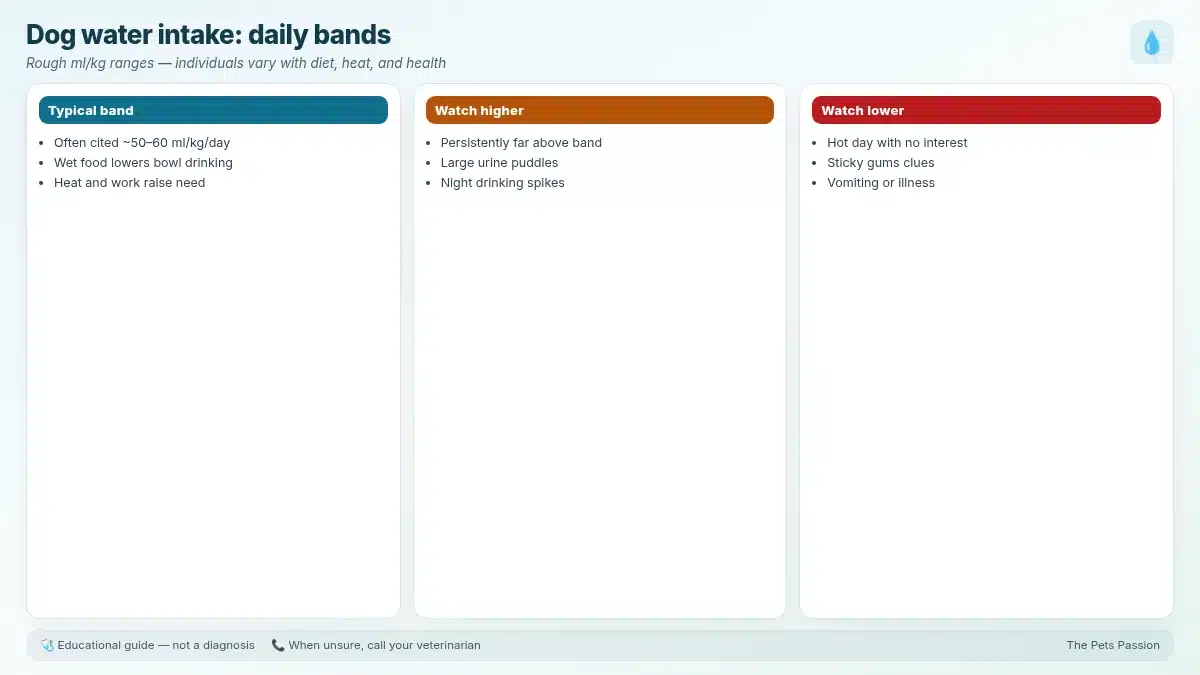
A dog eating canned food swallows a lot of water inside the meal. A dog on dry kibble in July after a hike will drain the bowl. Nursing bitches, feverish dogs, and pets on diuretics live on different planets from the average adult.
Chronic disease that drives drinking also drives spend—sketch the year with cost of owning a dog before surprises hit.
Sudden polydipsia plus fading energy belongs on a dog quality of life scale and a same-week vet call.
Thirst spikes after salty treats or bigger meals—cross-check intake with how many calories does my dog need so you are not chasing a diet problem with a water bowl.
Bands exist so you can spot outliers, not so you can punish a thirsty athlete. Polyuria (large urine volume, often taught as >50 ml/kg/day) usually travels with polydipsia—what goes in tends to come out. Owners often notice the backyard first: more marking posts, night asks to go out, larger puddles.
How do I measure how much water my dog drinks in 24 hours?
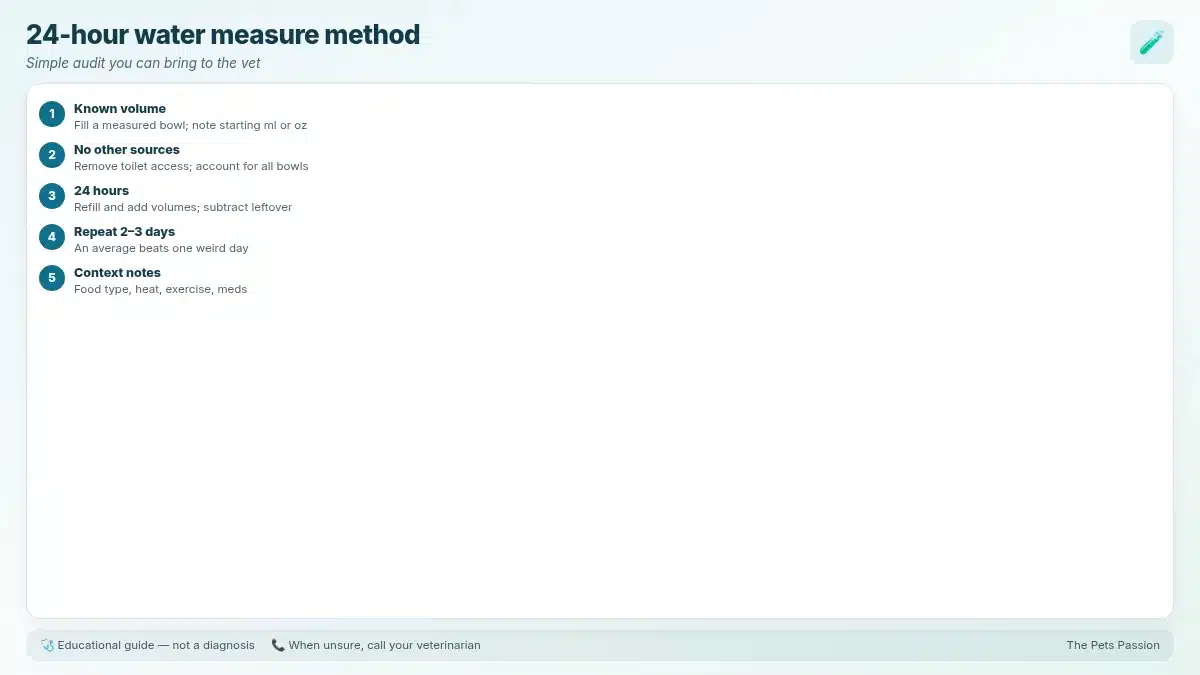
- Use a marked bowl or measuring jug.
- Morning: fill with a known volume.
- Add only measured top-ups during the day.
- Next morning: subtract what’s left.
- Repeat 2–3 days; average the results.
- Note canned-food moisture roughly if relevant (ask your vet how they want it counted).
- If multiple pets share a bowl, separate them for the test or rely more on urine specific gravity at the clinic.
Write the total as ml/kg/day: total ml ÷ body weight in kg. A 20 kg dog drinking 1,200 ml ingested about 60 ml/kg. The same dog at 2,200 ml is at 110 ml/kg—polydipsia territory on classic cut-offs.
Plug weight into the Pet Hydration Calculator to see a bowl target in everyday units, then compare to your measured total.
What can polydipsia in dogs mean?
When drinking cross the teaching threshold—or clearly explodes from baseline—veterinary differentials often include:
- Diabetes mellitus
- Chronic kidney disease
- Hyperadrenocorticism (Cushing’s)
- Pyometra in intact females (emergency spectrum)
- Liver disease
- Electrolyte disorders
- Drugs (e.g., glucocorticoids, diuretics, some anticonvulsants)
- Post-obstructive diuresis or other renal concentrating problems
- Central or nephrogenic diabetes insipidus (less common)
- Psychogenic/primary polydipsia (diagnosis of thoughtful exclusion)
You cannot sort that list with a Pinterest chart. You can arrive with a measured ml/kg number, a medication list, and a urine sample if the clinic asks.
When is my dog drinking too much—call now or watch?
Seek urgent/emergency care if drinking changes come with:
- Repeated vomiting, collapse, or extreme lethargy
- Distended or painful abdomen
- Unproductive retching (bloat concern in deep-chested dogs)
- Straining to urinate with little urine
- Known toxin exposure
- Intact female who is lethargic, vomiting, or polyuric—ask about pyometra risk
- Seizures or disorientation
Call the regular clinic promptly (same day / next available) if:
- Intake stays >100 ml/kg/day
- Nighttime urination is new and heavy
- Appetite or weight is changing with thirst
- Urinary accidents appear in a previously house-trained dog
- You needed a new gallon jug “just for the dog bowl” this month
Short watchful waiting (with a hard stop date) may fit a single hot-weekend spike after intense exercise—if the dog is bright, eating, and back to baseline quickly. When unsure, call. For structured urgency sorting alongside other symptoms, pair with the Pet Symptom Urgency Checklist.
Dry food, wet food, and “but he barely drinks”
Dogs on high-moisture diets may visit the bowl less and still be fine. That is not permission to ignore true polydipsia on dry food, and it is not proof a canned-fed dog with 120 ml/kg bowl intake is “normal because food is wet”—you would still investigate.
Cats are different thirst animals; if you also care for felines, use the same hydration tool’s species context and do not copy dog expectations onto cats.
Hot weather, hiking, and working dogs
Increase access, not shame. Offer water frequently on trails; watch for thick saliva, wobbly gait, brick-red or very pale gums, and heatstroke signs—those are emergencies, not “hydrate later.” Cooling and veterinary care beat social-media ice-bath myths.
After blood donation, anesthesia, or GI fluid loss, follow the clinic’s rehydration plan. Our calculator is for everyday planning, not drip-rate orders.
Q&A
How much water should a dog drink per day?
Many healthy dogs land near 40–60 ml/kg/day, with ~50–60 ml/kg often used as a maintenance-style planning band. Individual scatter is real—measure your dog.
How much water should a 50 lb dog drink?
Fifty pounds is about 22.7 kg. At 50 ml/kg that’s roughly 1.1 liters (about 37–40 fl oz) as a planning midpoint; at 60 ml/kg closer to 1.4 liters. Heat and diet move the target. Confirm with the hydration calculator.
What counts as drinking too much?
Persistent intake above ~100 ml/kg/day is the usual veterinary definition of polydipsia. A sharp rise from baseline still deserves a call.
Can I limit water at night for housetraining?
Be careful. Restricting water to manage disease thirst is dangerous. Housetraining tweaks belong in a behavior plan that still protects free access for healthy dogs—ask your vet/behaviorist before any nighttime lockout of water.
Does chicken broth hydration count?
Broth can add fluid but also sodium and calories. It is not a fix for polydipsia and can wreck a calorie plan (dog calorie calculator).
Should I run a water deprivation test at home?
No. Water deprivation testing is a supervised veterinary procedure with real risk.
Related guides and tools
- Primary tool: Pet Hydration Calculator
- Dog Calorie Calculator
- Pet Symptom Urgency Checklist
- Canine Quality of Life Scale
- Pet Budget (labs and chronic disease costs)
Checklist: 72-hour hydration audit
- Weigh the dog
- Separate bowls if multi-pet
- Measure fills and leftovers for 3 days
- Note canned vs dry diet
- Log heat waves, hikes, diarrhea episodes
- Compute ml/kg/day
- Compare to Pet Hydration Calculator target
- Call clinic if ≥100 ml/kg or other red flags
- Bring medication list + measured numbers to the visit
Puppies and seniors: special thirst stories
Puppies play hard and dump water bowls for sport; still, a puppy that drinks obsessively and pees oceans needs a vet visit—diabetes and congenital kidney issues do not wait for adulthood. Seniors deserve baseline ml/kg notes at annual labs so “he’s always been a drinker” can be checked against reality.
Cognitive dysfunction can change drinking routines (forgotten bowl, or obsessive visits). Pair behavior notes with medical workups rather than assuming “just senility.”
Urine color is not a complete lab
Pale urine can accompany high water turnover; dark urine can mean concentration—or bilirubin, blood, or dehydration contexts that need diagnostics. Urine specific gravity (USG) at the clinic beats phone photos. Mentions of USG in PU/PD algorithms exist to remind you: low USG in a dehydrated dog is a different problem than low USG after a water buffet.
Bowls, fountains, and practical access
Wide stainless bowls beat plastic slime factories for many households. Some dogs prefer moving water; fountains help if cleaned on a schedule that does not grow a science fair. Outdoor dogs need shade and water that is not a mosquito pond. Frozen metal bowls in winter can discourage drinking—check and refresh.
Travel days: pack more water than you think, especially airplanes-with-crates and road trips where panting spikes losses.
Medications and “new thirst” timelines
If steroids, phenobarbital, or diuretics started last week and thirst exploded, call the prescribing clinic—they may expect some polyuria/polydipsia and still want a line between expected and excessive. Do not stop seizure meds on your own.
Dehydration signs owners actually catch
- Tacky gums
- Skin tent that stays up (less reliable in seniors/puppies)
- Sunken eyes
- Lethargy
- Dry, sticky nose is not a gold-standard test by itself
Dehydrated dogs can still have full bowls if they feel too sick to drink. Pushing water into a nauseated dog risks aspiration—veterinary fluids may be needed.
Linking thirst to food math and budget
Polydipsia workups mean urinalysis, blood chemistries, sometimes imaging or endocrine tests. Price that reality with the Pet Budget and Pet Insurance Calculator before a crisis, not during one. Calorie concentration also shifts if disease appetite changes—keep the calorie calculator nearby when diets change.
Myth vs clinic reality
| Myth | Reality |
|---|---|
| "Dogs will drink the perfect amount automatically" | Disease breaks the thermostat |
| "Withhold water overnight to confirm diabetes" | Dangerous amateur diagnostics |
| "If urine is clear, kidneys are fine" | Not how staging works |
| "Canned food means bowl intake should be near zero" | Bowl intake varies; trends still matter |
| "100 ml/kg is only a cat rule" | Dogs use the same classic polydipsia cut-off in many texts |
Sample owner script for the receptionist
“I’ve measured water for three days. My dog is 18 kg and averaged 2,100 ml/day—about 117 ml/kg. He’s waking us twice nightly to urinate, eating normally otherwise, on no new meds. I’d like a nurse triage note and the soonest diagnostics slot.”
That script beats “he drinks a lot, I guess?”
After the diagnosis: hydration still has a job
Chronic kidney disease plans may include wet food, fountain encouragement, or subcutaneous fluids—clinic directed. Diabetes plans hinge on insulin and diet timing, not bowl shaming. Cushing’s management tracks thirst as a clinical sign among others. Keep measuring occasionally so “better” is a number, not a vibe.
If comfort and dignity are the bigger question in a hospice context, step into the Canine Quality of Life Scale with your veterinary team.
Shared bowls, kids, and dishonest data
If a child refills the bowl “whenever,” your ml/kg math collapses. Assign one adult to the measuring jug for the audit weekend. Outside dogs that drink from ponds cannot be measured by bowl subtraction alone—rely on clinic USG and bloodwork sooner.
Hotels and relatives’ homes also break baselines. Note travel days in the log so a single weird Tuesday does not trigger panic—or hide a real trend.
Lactation, pregnancy, and performance
Pregnant and nursing dogs can drink far more than the idle adult band. That does not exempt them from veterinary checks if thirst looks frantic or the bitch stops eating. Performance dogs may need scheduled water stops; gulping huge volumes right before intense work can be uncomfortable—ask a sports-medicine-inclined vet for timing tips rather than copying human marathon forums.
When soft stool and thirst show up together
GI loss (vomiting/diarrhea) raises fluid needs while bowl intake may lag because nausea. This is a fluids-and-diagnostics problem, not a fountain upgrade problem. Review our diarrhea education on-site if relevant, and use the symptom checker for urgency. Soft stool plus polydipsia plus weight loss is not a “wait for Monday if someone is available” hobby.
Building a household hydration habit (healthy dogs)
- Refresh water at least twice daily
- Wash bowls with hot soapy water (biofilm is real)
- Offer water after every walk before critiquing “picky drinking”
- Keep a collapsible bowl on the leash hook
- Recalculate targets after major weight change using the Pet Hydration Calculator
Healthy hydration habits will not prevent every endocrine disease. They will make abnormal patterns obvious sooner—which is the entire point of knowing how much water should a dog drink for your dog, not for a mythical average mascot.
Bottom line
How much water should a dog drink? Enough to land near typical ml/kg maintenance bands for that diet and climate—and not so much that you quietly pass 100 ml/kg/day without a professional workup. Measure, calculate, and use the Pet Hydration Calculator as your primary planning CTA. Thirst is information. Treat it that way.
Veterinary Review & Editorial Standard
This clinical guide was prepared using peer-reviewed veterinary literature and guidelines from leading veterinary associations. If your pet exhibits acute symptoms or distress, please seek immediate in-person veterinary emergency care.