
Dog Seizure What to Do: Calm First Aid Steps & ER Guide
 The Pets Passion Medical Team

Dog Seizure What to Do: Calm First-Aid Steps You Can Use Tonight
Medical disclaimer: Educational only — not a substitute for veterinary exam or emergency care. If your dog is seizing, not recovering normally, or you suspect toxin or trauma, call your vet or the nearest ER now.
Dog seizure what to do, in short: Stay calm, clear breakable objects and stairs, keep hands and objects out of the mouth, time the episode (film it if you can), and get emergency care if it lasts more than five minutes, repeats without full recovery, or comes in clusters. After it ends, quiet the room, check for injuries, log what you saw, and call your clinic — especially after a first seizure.
- 1. What does a dog seizure look like?
- 2. What is dog seizure first aid during the episode?
- 3. What should you never do during a dog seizure?
- 4. When should you go to the ER for a dog seizure?
- 5. What are cluster seizures in dogs?
- 6. What should you do right after a seizure?
- 7. Could a toxin be causing the seizure?
- 8. How do you build a simple home seizure plan?
- 9. FAQ: dog seizure what to do
What does a dog seizure look like?
A seizure is a short storm of abnormal brain activity. Some look dramatic. Others look subtle enough that you second-guess whether it “counted.”
If the seizure followed a cocoa binge, treat it as a toxin emergency and run the numbers with our chocolate toxicity in dogs guide while you call the ER.
VCA Animal Hospitals describes three phases that help you talk clearly with a vet:
- 1. Pre-ictal (aura): Clinginess, pacing, hiding, whining, or a “something’s off” vibe for seconds to hours.
- 2. Ictal (the seizure): Often seconds to a couple of minutes. Generalized events can include collapse, stiff limbs, paddling, foaming, and loss of bladder or bowel control. Focal events may look like fly-biting, lip twitching, or chewing-gum motions.
- 3. Post-ictal (recovery): Confusion, pacing, temporary blindness, or restlessness for minutes to hours.
Cornell’s Riney Canine Health Center notes that a focal seizure can escalate into a generalized one, so keep watching until your dog is clearly oriented again. Seizures aren’t usually described as painful, but the recovery phase can feel scary for both of you.
Breeds with higher epilepsy rates in Cornell’s overview include Schnauzers, Collies, Basset Hounds, Cocker Spaniels, Labs, and Goldens. That doesnt mean other dogs are “safe” — it just means your vet may listen extra carefully if your Border Collie or German Shepherd starts having hard episodes.
What is dog seizure first aid during the episode?
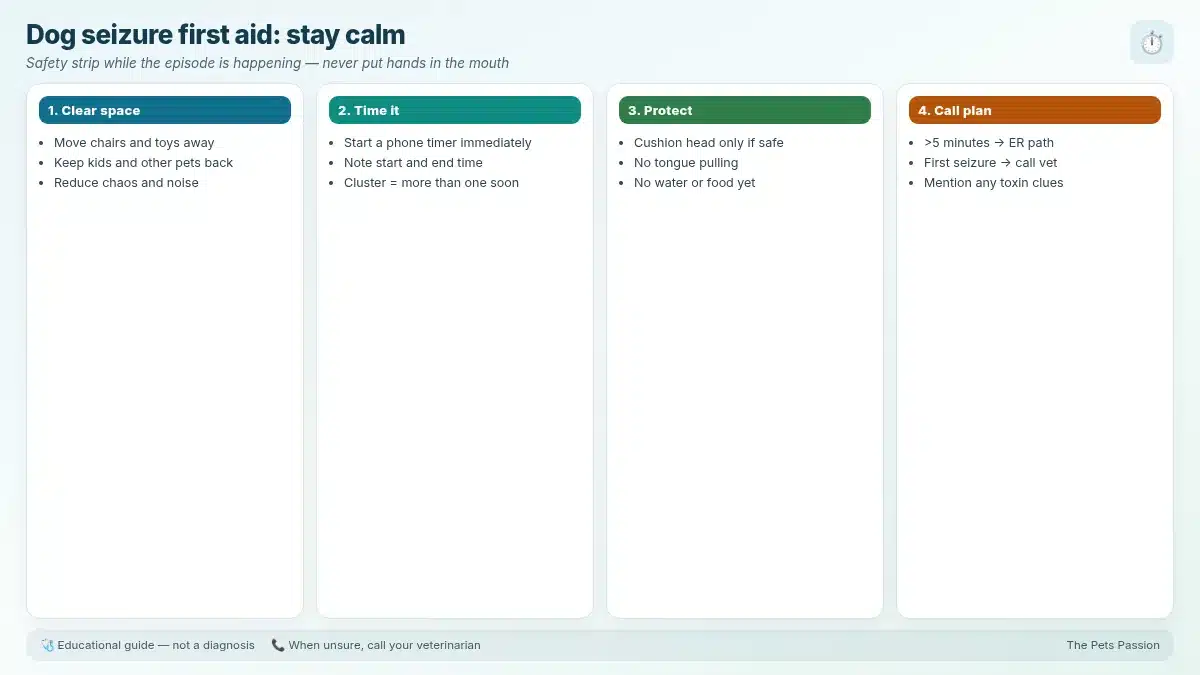
This is the core of dog seizure what to do in real time: protect, time, record — don’t force the seizure to stop.
Your job isn’t to “stop” the seizure with force. Your job is safety plus information.
Dog seizure first aid — numbered steps
- 1. Breathe and stay put. Panic wastes the seconds you need for timing and hazard control.
- 2. Protect your hands. Keep fingers away from the mouth. Dogs can bite without meaning to (Cornell; VCA).
- 3. Clear the zone. Move chairs, lamps, toys, and anything that can fall or cut.
- 4. Guard stairs and drop-offs. Near stairs, Cornell suggests staying below the dog if you can do that safely so they don’t tumble farther.
- 5. Cushion, don’t pin. Slide a folded blanket under the head if it’s safe. Don’t pin thrashing limbs.
- 6. Start a timer immediately. Duration drives the ER call.
- 7. Film a short clip if you can. Video helps vets separate seizures from fainting or vestibular episodes (Cornell).
- 8. Quiet the room. Dim lights. Mute the TV. Park other pets elsewhere.
- 9. Keep kids back until your dog is fully oriented. Post-ictal dogs can snap when startled.
- 10. Use rescue meds only if prescribed for your dog. Rectal diazepam or intranasal midazolam only with exact training from your veterinarian (Cornell; Merck Veterinary Manual).
If you recognize an aura early, Cornell mentions a vagal maneuver some neurologists discuss: gentle pressure on closed eyelids for 10–60 seconds, repeatable every five minutes only if you can do it safely and your vet has okayed the idea. Don’t invent techniques mid-crisis.
What should you never do during a dog seizure?
These myths create bite wounds and delays:
- Don’t put fingers, spoons, sticks, or cloth in the mouth. Dogs don’t swallow their tongues. Objects raise bite and trauma risk (VCA).
- Don’t wrestle them still. Soft padding and hazard control beat forceful restraint.
- Don’t offer food, water, or oral pills until theyre fully awake and swallowing normally.
- Dont ice-pack aggressively or dunk them in water during the convulsion. Temperature problems belong in veterinary hands if hyperthermia is a concern.
- Don’t wait and hope past the five-minute mark. Status epilepticus is a true emergency.
When should you go to the ER for a dog seizure?
Part of dog seizure what to do is knowing when home first aid is no longer enough.
A single short seizure that ends in a minute or two still deserves a same-day or next-available clinic visit — especially the first one. Some situations can’t wait overnight.
ER red-flag table
| Red flag | Why it matters |
|---|---|
| Seizure lasts > 5 minutes | Status epilepticus can cause dangerous overheating, brain injury, or death without IV meds (VCA; Cornell) |
| Seizures repeat without full recovery | Treated as status / emergency |
| Cluster seizures (≥2 in ~24 hours) | High escalation risk (Merck) |
| Suspected toxin, trauma, or poison | Reactive seizures can worsen fast |
| Trouble breathing, blue/pale gums, collapse, or prolonged unresponsiveness | Systemic emergency |
| Puppy, senior, or dog with known liver/kidney/brain disease | Higher odds of metabolic or structural causes |
| First seizure after about age 6 | Cornell flags older first-time seizures for metabolic disease or structural brain lesions |
Cornell’s practical note: if a long seizure finally stops while you’re driving, the “crash” phase may be over — but your dog still needs assessment. Don’t cancel care just because the thrashing stopped.
Not sure how urgent the phone call should sound? Organize what you’re seeing with our Pet Symptom Urgency Checklist — it doesn’t diagnose, and it never replaces a vet.
For the “why is this happening” question after the crisis, read What Causes Seizures in Dogs?.
What are cluster seizures in dogs?
Cluster seizures usually means more than one seizure in a short window — commonly within 24 hours. Veterinary emergency pharmacology groups clusters with status epilepticus as high-priority events (Merck Veterinary Manual). The ACVIM consensus on status epilepticus and cluster seizures underscores how quickly these patterns can become drug-resistant if delayed.
Why clusters scare clinicians:
- Body temperature climbs with repeated muscle work.
- Each seizure can make the next more likely.
- Dogs with a cluster history often need a home rescue plan (rectal diazepam, intranasal midazolam, or “pulse” levetiracetam after a seizure — only as prescribed).
Ask your vet in advance:
- When to give rescue medication
- How many doses are allowed in 24 hours
- When to leave for the ER even if a dose was given
- Whether pulse therapy fits your dog (Cornell)
Never start, stop, or stack anticonvulsants without direction. Sudden withdrawal can trigger worse seizures (VCA).
What should you do right after a seizure?
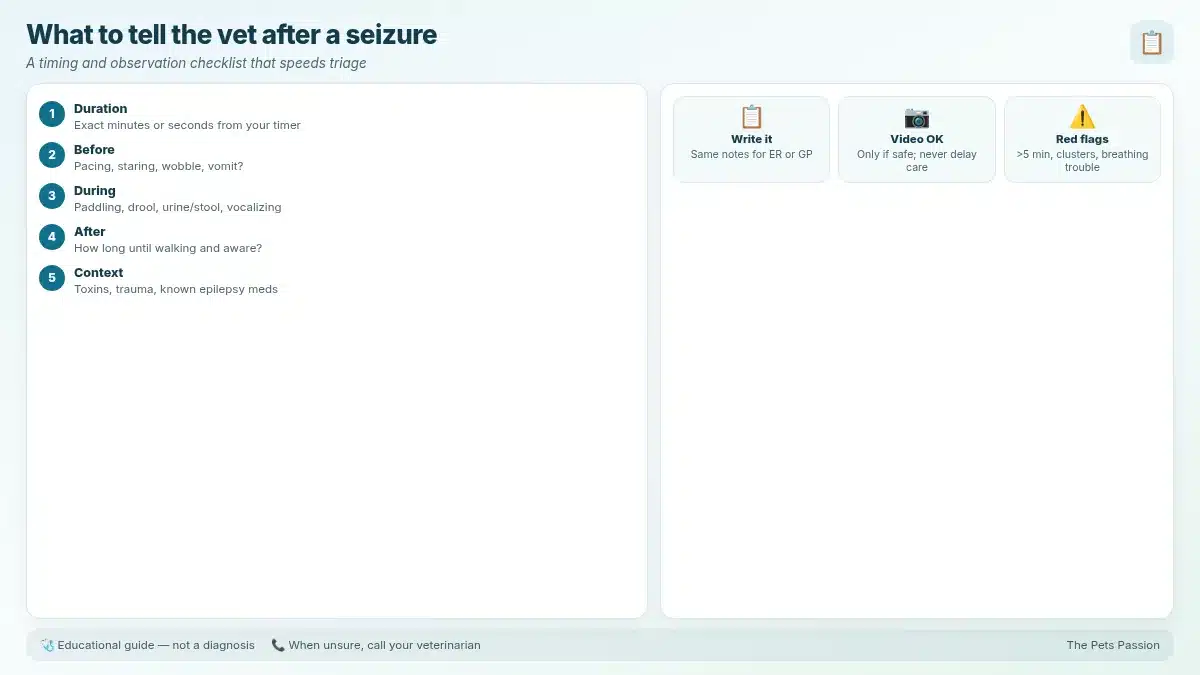
Dog seizure what to do doesn’t end when the paddling stops — aftercare and logging still matter.
Once paddling stops, you’re in the post-ictal phase. Relief hits — and careful watching still matters.
Right after
- Keep the room quiet and dim.
- Offer water only when your dog is fully awake and coordinated enough to drink without choking.
- Check for injuries: tongue bites, scratched eyes, bumps from furniture.
- Write down start time, end time, what the body did, and how long recovery took.
- Save the video and log date, possible triggers, food, meds, and stressors.
In the next few hours
- Limit stairs, slick floors, and off-leash outdoor time until coordination returns.
- Temporary blindness, pacing, or clinginess can show up; report lasting or severe post-ictal signs (VCA).
- Don’t force food right away. Offer a small meal later if they seem settled.
- Call your clinic after any first seizure, or sooner if recovery looks wrong.
Bring a history covering age at onset, frequency and length, sleep or excitement links, other illness signs, recent flea products or meds, diet, and toxin access. That story helps separate idiopathic epilepsy from metabolic, toxic, or structural causes — details we unpack in What Causes Seizures in Dogs?.
Could a toxin be causing the seizure?
Yes. Cornell lists dark chocolate, caffeine, xylitol, antifreeze, rat poison, and alcohol among seizure-linked risks, alongside metabolic problems like low blood sugar or low calcium.
If you suspect ingestion:
- 1. Remove remaining product.
- 2. Call your veterinarian/ER or a pet poison hotline before home remedies.
- 3. Bring packaging if you go in.
Non-diagnostic helpers while you arrange care: the Canine Chocolate Toxicity Risk Assessor and the Pet Toxic Foods & Household Hazard Checker. They organize numbers. They can’t diagnose poisoning.
How do you build a simple home seizure plan?
Many dogs with well-managed epilepsy live full lives. Cornell notes long-term anticonvulsants are often considered when seizures happen more than about once a month — or sooner for clusters, status, violent seizures, or high-risk breeds. VCA similarly describes starting treatment after two or more seizures in six months, clusters, status, or worsening patterns. Timing is individualized.
Between visits, track:
- Seizure dates, durations, and videos
- Medication refill dates (never run out)
- Sleep, stress, heat, and diet patterns
- Day-to-day comfort
For seniors or chronically ill dogs, the Canine Quality of Life (HHHHHMM) Scale can organize observations for vet talks — it doesn’t diagnose. More tools live at Pet Health Tools.
Home kit checklist
- ER and regular clinic phone numbers
- Phone timer and video plan
- Soft pad or folded blanket
- Prescribed rescue medication only if dispensed for your dog
- Seizure log notebook or phone note
- Safe carrier or harness plan for transport after recovery
Practice once while everyone is calm. Muscle memory beats improvisation at 2 a.m.
How do you tell a seizure from fainting or a vestibular episode?
Not every collapse is a seizure. Cornell notes that vestibular events commonly include loss of balance, incoordination, head tilt, and abnormal eye movements (nystagmus). Cardiac collapse often looks “softer,” closer to fainting, with a quicker bounce-back.
That distinction is why a 20-second phone video matters. Your vet needs motion, eye position, limb tone, and recovery behavior — not a polished Instagram clip. Film from the side if you can. Keep yourself safe first.If you’re unsure in the moment, treat it like a seizure for safety: clear hazards, don’t put anything in the mouth, time it, and call. Sorting the label can wait until the dog is stable.
German Shepherds, Border Collies, Irish Setters, Goldens, Siberian Huskies, Keeshonds, and Saint Bernards show up on Cornell’s list of breeds that can experience especially difficult seizures. If your dog is on that list and has a first hard episode, ask early about a rescue medication plan rather than waiting for a third event.
Keep a one-page seizure card” on the fridge: weight, medication names and doses, ER address, and the last three episode dates. Hand it to whoever is watching your dog when you travel.
FAQ: dog seizure what to do
What should I do if my dog has a seizure?
Stay calm, clear hazards, keep hands away from the mouth, time the episode, and film it if safe. After recovery, call your veterinarian. Go to an ER if it lasts more than five minutes, repeats without recovery, or occurs in clusters.
How long is too long for a dog seizure?
More than five minutes is status epilepticus and needs immediate veterinary care (VCA; Cornell). Many typical seizures last one to two minutes.
Can dogs swallow their tongue during a seizure?
No. Objects or fingers in the mouth don’t help and often cause bite injuries (VCA).
What are cluster seizures in dogs?
Usually two or more seizures within about 24 hours. Clusters are an emergency category and often need vet care plus a home rescue plan (Merck).
When should I go to the ER for a dog seizure?
Go now for seizures over five minutes, incomplete recovery between events, clusters, toxin/trauma suspicion, breathing trouble, or prolonged unresponsiveness. First-time seizures still need prompt veterinary evaluation even if short.
Is dog seizure first aid different for puppies or seniors?
Safety steps are the same, but urgency is often higher. Young dogs may have congenital, infectious, or toxic causes; later-life first seizures more often need screening for metabolic or structural disease (Cornell).
Should I give my dog medication during a seizure?
Only if your veterinarian prescribed a rescue product and trained you on use. Don’t give oral meds during convulsions, and never use another pet’s or a person’s leftovers.
#### Veterinary review & sources
This first-aid guide synthesizes publicly available recommendations from university and clinical veterinary sources. It does not replace individualized veterinary advice.
- Cornell University — Managing seizures
- VCA Animal Hospitals — Seizures in Dogs
- Merck Veterinary Manual — Anticonvulsants for Emergency Treatment of Seizures
- ACVIM Consensus — status epilepticus & cluster seizures
Veterinary Review & Editorial Standard
This clinical guide was prepared using peer-reviewed veterinary literature and guidelines from leading veterinary associations. If your pet exhibits acute symptoms or distress, please seek immediate in-person veterinary emergency care.