Cat Grimace Scale: How to Tell If Your Cat Is in Pain
 The Pets Passion Medical Team
YMYL / medical disclaimer: This guide from The Pets Passion is educational. It summarizes the validated Feline Grimace Scale (FGS) published in Scientific Reports (Evangelista et al., 2019) and training materials referenced by WSAVA acute pain resources. It is not a license to prescribe pain medication at home. Cats hide pain; urgent signs still need a veterinarian. If your cat cannot walk, struggles to breathe, cannot urinate, or seems agonized, seek emergency care now.
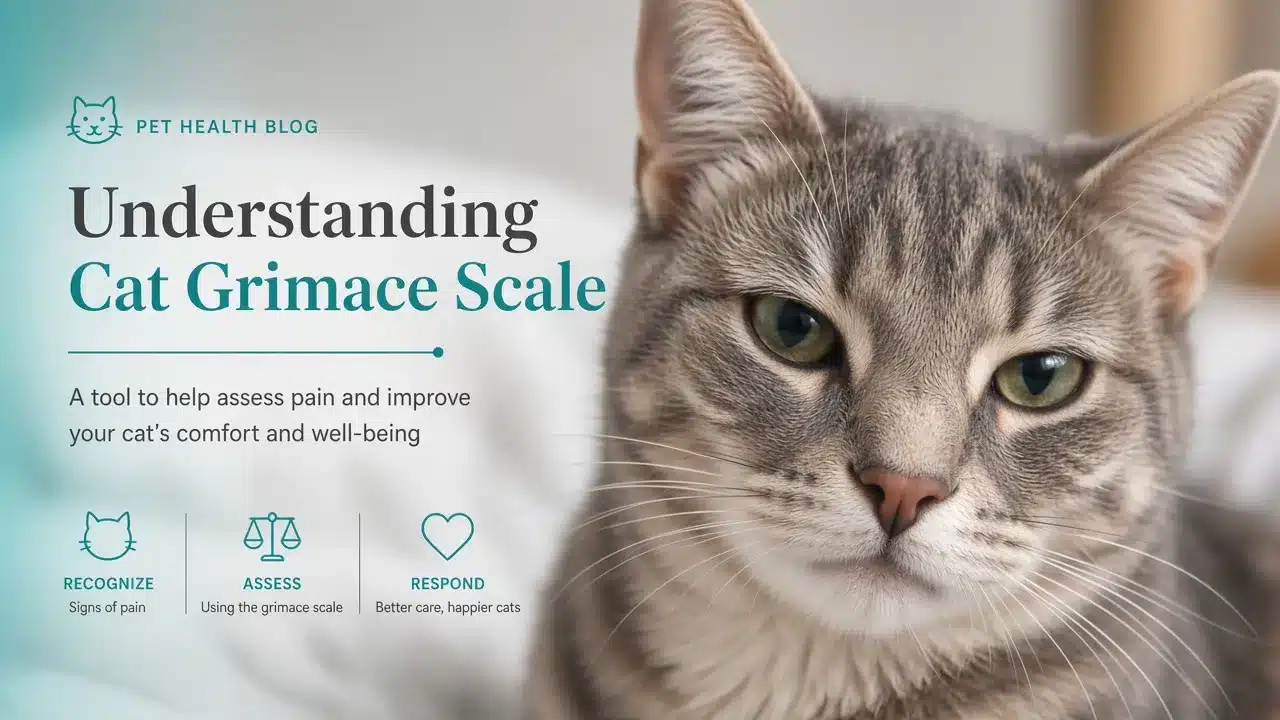
Cat grimace scale searches usually mean the Feline Grimace Scale: a research-backed way to read acute pain on a cat’s face using five action units. Cats do not scream on schedule. They go quiet, hide, and eat less while owners wait for a “clear” limp. The FGS gives you a shared language—ears, eyes, muzzle, whiskers, head carriage—so you can say more than “she seems weird” at 2 a.m.
Quick answer. Cat grimace scale (FGS)
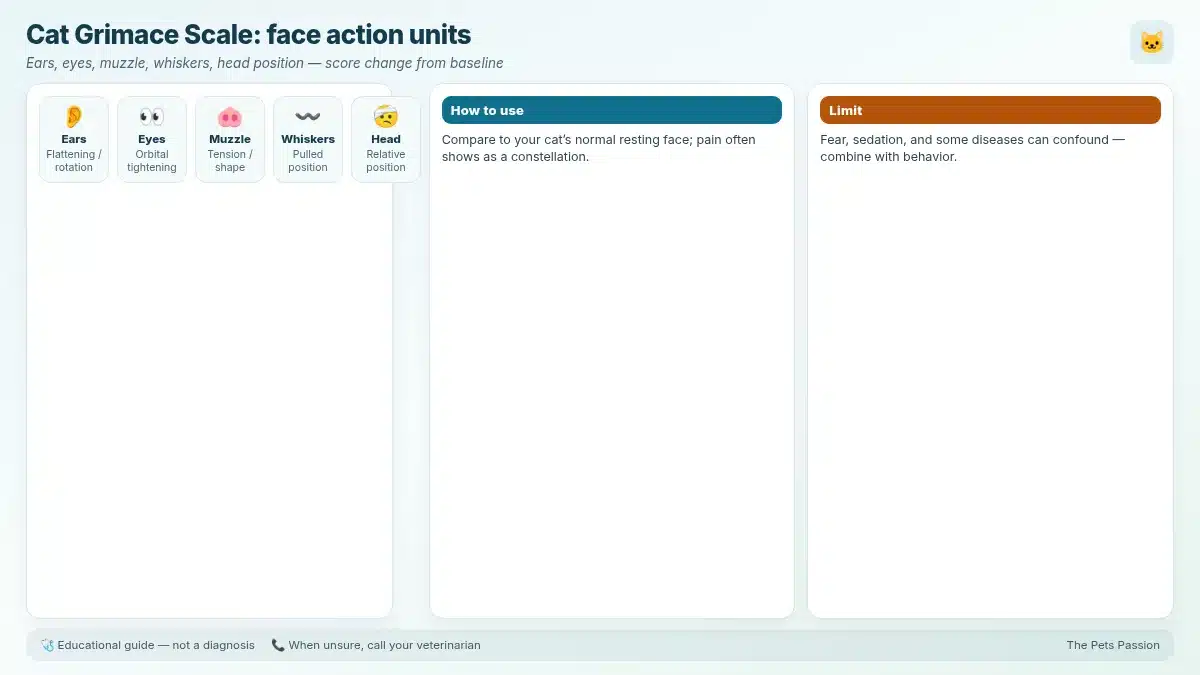
| Action unit | Comfortable (0) | Moderate / unsure (1) | Marked pain face (2) |
|---|---|---|---|
| Ear position | Facing forward | Slightly pulled apart | Flattened / rotated outward |
| Orbital tightening | Eyes open | Partially closed | Squinted / tightly closed |
| Muzzle tension | Round, relaxed | Mild tension | Tense, elliptical / bulged |
| Whiskers | Loose, curved | Slightly straight/curved change | Straight, pushed forward |
| Head position | Above shoulder line | Aligned with shoulders | Below shoulders / chin tucked |
Why facial scoring beats “waiting for a limp”
Dogs often advertise pain with a head bob. Cats flatten into a loaf and cancel social rounds. Studies validating the FGS showed higher scores in painful cats than controls, strong correlation with another feline pain instrument, good inter-rater reliability, and score drops after analgesia. Owners and veterinary teams can learn it—WSAVA materials note reliability across veterinarians, students, technicians, and caregivers when trained.
Dogs get a parallel conversation with the dog quality of life scale; cats need face-based tools like the grimace scale because they hide pain differently.
That does not mean a phone photo replaces a physical exam. It means you arrive with better data.
The 5 features checklist (how to score)
Observe an undisturbed cat when possible. Filming through a crate door or across the room beats looming with a flash. Score what you see, not what you hope.
1) Ear position
- 0: Tips face forward, normal “satellite dishes.”
- 1: Ears start to pull apart / mild rotation; you are unsure.
- 2: Ears flatten and rotate outward—the “airplane ear” pain look, different from happy play swivel.
Fear and pain can overlap. Context matters (carrier trauma vs resting on the sofa).
2) Orbital tightening
- 0: Eyes open normally for the lighting.
- 1: Partially closed.
- 2: Squinted; eyelid aperture clearly narrowed or shut.
Sleepy cats also blink. Score while the cat is awake and not mid-nap.
3) Muzzle tension
- 0: Soft, round muzzle.
- 1: Mild flattening/tension.
- 2: Muzzle looks stretched into an ellipse; may appear bulged.
This is subtle until you compare to a “happy” photo from last month.
4) Whiskers change / position
- 0: Relaxed, gently curved.
- 1: Slightly straighter or uncertain.
- 2: Whiskers stiffen and angle forward, away from the face (“spiked”).
Keep the camera angle straight on; side views distort whisker read.
5) Head position (relative to shoulders)
- 0: Head carried above the shoulder line.
- 1: Head about level with shoulders.
- 2: Head below shoulders or chin tucked toward chest.
A cat staring into a food bowl is not automatically a 2—wait for a neutral sit.
Math: Add the five numbers. If an action unit is invisible (face buried), mark “not possible to score” per training manuals rather than guessing.
How to tell if my cat is in pain (beyond the face)
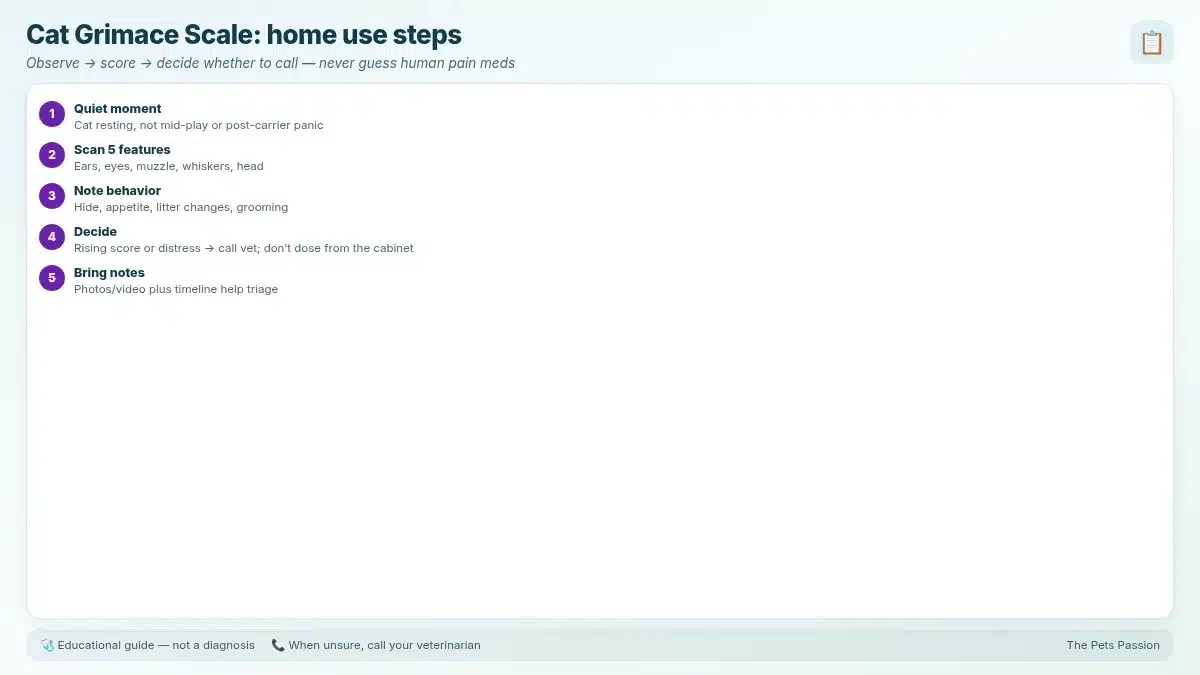
Use FGS with whole-cat clues:
- Hiding more than usual
- Missing the litter box or crying in the box
- Hunched posture, tucked belly
- Reluctance to jump on favored perches
- Sudden aggression when touched at one spot
- Reduced grooming / greasy coat
- Quietness or clinginess that is out of character
- Faster breathing at rest (count breaths)
- Squinting plus pawing at the mouth (dental/ocular differentials)
Male cats straining in the litter box with little urine = emergency (urethral obstruction risk), regardless of FGS score.
Eye injuries, corneal ulcers, and oral pain can produce dramatic orbital and muzzle changes—see also our punctate ulcer education on-site when ocular disease is suspected (punctate ulcers cat).
Using the score without becoming a kitchen pharmacist
A total near or above the commonly taught 4/10 cut-off is a prompt to contact a veterinarian about pain assessment and analgesia, not a green light to human ibuprofen (toxic) or leftover dog NSAIDs (often dangerous in cats).
Bring:
- Short video of the face at rest
- Your 0–10 FGS total and which units scored 2
- Appetite, litter, and jumping notes for 24 hours
- Current medications and chronic diseases (kidney, heart)
Clinics may use FGS alongside UNESP-Botucatu and other scales. Your home score starts the conversation.
After dental work, spay/neuter, or injury, ask what score range they expect and when to call after hours.
Common scoring mistakes
- Scoring a sleeping cat.
- Stressing the cat into a fear face, then calling it pain.
- Using one blurry angle.
- Ignoring body posture that contradicts a “cute” face.
- Waiting a week because “cats are dramatic.”
- Giving OTC pain meds meant for humans.
Fear, sedation, and neuromuscular disease can muddy faces. When unsure, err toward a vet check.
Practice like the researchers intended
The official ecosystem around the FGS includes fact sheets, training manuals, and practice images (multilingual resources linked via felinegrimacescale.com and WSAVA pain-scale PDFs). Spend ten minutes comparing 0 vs 2 examples before your cat’s next senior year. Families with arthritic cats can baseline a “good day” score quarterly.
Combine with the Cat Quality of Life tool for chronic disease decisions and the cat age calculator when framing senior care.
Q&A
What is the cat grimace scale cut-off for pain meds?
Training materials widely teach considering analgesia around ≥4/10, matching the validation paper’s normalized threshold concept. Final drug choices stay with the veterinarian.
Can owners really score accurately?
Studies and WSAVA summaries support caregiver use after training. Practice improves agreement. Still verify with a clinic when scores rise or behavior changes.
Does a low score mean my cat is fine?
Not always. Visceral pain, early obstruction, or intermittent pain can be missed. Trust behavior + litter habits + FGS together.
Is the grimace scale only for surgery patients?
No. It was validated on naturally occurring acute pain and is used across acute contexts (medical and surgical). Chronic maladaptive pain may need additional tools.
My cat always looks grumpy. Help?
Baseline photos help. Some breeds carry flatter faces; compare that individual to itself. Ask your vet to score with you in the room.
Can I use dog grimace advice on cats?
No. Use feline-specific action units.
Related guides and tools
- Pet Symptom Urgency Checklist
- Cat Quality of Life (Cat QoL)
- Cat Age Calculator
- Cat Calorie Calculator
- Punctate Ulcers Cat
Home observation routine (5 minutes)
- Let the cat settle in a quiet room.
- Take a straight-on photo or 15-second video.
- Score five action units without coaching the cat.
- Note litter, food, jumping.
- Recheck in 1–2 hours if mild concern; do not delay emergencies.
- Save the clip for the vet.
Special populations
Kittens: Faces change with play frenzy—score during rest. Trauma and foreign bodies still happen.
Seniors: Osteoarthritis is under-treated. Rising FGS plus reluctance to jump deserves a pain trial directed by a vet, not wishful thinking.
Brachycephalic cats: Orbital and muzzle reads are harder; lean on ears, head carriage, and behavior.
Post-op: Ask for the clinic’s expected FGS trend and which rescue dose they already planned.
Myth vs validated tool
| Myth | Reality |
|---|---|
| "Cats cry when they hurt" | Many do the opposite |
| "If they purr, they are fine" | Purring occurs in stress and pain |
| "Grimace scales are only for labs" | FGS is used in clinics and by caregivers |
| "Any squinted eye is pain" | Sleep, bright light, and ocular disease also matter—context + other units |
Checklist: how to tell if my cat is in pain tonight
- Ears flattened/rotated outward?
- Eyes squinted while awake?
- Muzzle tense/elliptical?
- Whiskers forward and stiff?
- Head below shoulders?
- Total ≥4/10?
- Litter/appetite/jumping off?
- Any urinary strain or breathing effort? (emergency if yes)
- Video saved for the vet
- Symptom checker reviewed for urgency
Cat grimace scale literacy will not turn you into a veterinary anesthesiologist. It will help you catch acute pain earlier, speak precisely with your clinic, and stop waiting for a cat to “admit” something is wrong.
How the Feline Grimace Scale was built (short version)
Evangelista and colleagues developed and validated the FGS using client-owned cats with naturally occurring painful conditions plus controls, scoring still images from undisturbed video. Five action units emerged: ear position, orbital tightening, muzzle tension, whiskers change, and head position. Painful cats scored higher; scores fell after analgesia; correlation with another feline pain scale was very strong; inter- and intra-rater reliability metrics were good to excellent in the paper’s analyses. A cut-off supporting analgesia consideration was derived from the normalized total score distribution (commonly taught as ≥4/10 on the raw sum).
That pedigree matters because many “cat pain face” social posts are anecdotes. FGS is a published instrument you can practice.
WSAVA acute pain resources list the FGS alongside other feline scales and point caregivers to downloadable manuals and the multilingual practice site.
Acute vs chronic pain: what FGS can and cannot do
FGS targets acute pain faces. A cat with slowly progressive osteoarthritis may show subtler day-to-day changes: skipping the top perch, shorter play bursts, irritable grooming of one hip, or a QoL slide on the cat QoL tool. Use FGS during flare days and after procedures; use behavior inventories and veterinary exams for chronic maladaptive pain.
Dental disease deserves special mention. Oral pain can produce squinted eyes and muzzle tension even when the cat still “eats” preferential soft food. Halitosis, drooling, and pawing at the mouth add weight. Do not wait for anorexia before booking dentistry.
Carrier stress vs pain face
Shoving a cat into a carrier five minutes before scoring guarantees a messy face. Tips:
- Leave the carrier out as furniture weeks ahead of vet visits
- Use pheromone sprays only as directed on clean carriers
- Score at home before the car ride when possible
- Cover the carrier in the waiting room to reduce visual stress
- Ask for a cat-only exam room when clinics offer one
Fear ears can mimic pain ears. If the score spikes only during restraint and collapses to 0–1 on the living-room sofa video, tell the veterinarian both numbers.
After surgery or injury: a sample home plan
Ask the clinic to write:
- Expected FGS range on night 1 and day 3
- Which rescue analgesic is already dispensed and when it is allowed
- Red flags (labored breathing, unproductive straining, relentless crying, bleeding)
- Recheck date
Score morning and evening for three days. Send the clinic a face video if the total climbs unexpectedly. Never add human acetaminophen or ibuprofen—both can be catastrophic in cats.
Hydration and calorie tools (pet hydration calculator, cat calorie calculator) support recovery planning but do not replace analgesia.
Teaching kids and housemates the same five checks
Print a one-page FGS fact sheet (from official training materials) on the fridge. Agree that any housemate who sees ears out + squinted eyes + tucked chin calls the designated adult. Cats in multi-cat homes often hide pain in closets—assign a daily “face check” when refreshing water bowls.
If one cat’s score rises while another steals food, separate them and call the clinic; bullying and pain coexist.
Dental, ocular, and abdominal pain: FGS still applies
Corneal ulcers and uveitis produce dramatic orbital tightening; owners sometimes miss the eye disease and only notice the “grumpy face.” Shine a light gently from the side (do not poke) and look for cloudiness, redness, or discharge—then call promptly. Our punctate ulcers guide covers one ocular pattern; any painful eye is time-sensitive.
Abdominal crises (pancreatitis, obstruction, urinary blockage) may show a tucked chin and hunched body with mid-range facial scores. Straining in the litter box with little or no urine overrides every checklist—go to emergency care.
Orthopedic pain after a fall often pairs a grimace with reluctance to jump. Video the failed jump attempt plus the face; surgeons and GPs both use that combo.
Building a household baseline album
Once a quarter, photograph each cat face-on in the same hallway light while they are relaxed. Store the album on your phone labeled “baseline FGS.” When something feels off, shoot a new frame and compare ear width, eyelid aperture, and whisker angle side by side. Baselines help flat-faced breeds and permanently scowly seniors whose “resting face” confuses first-time scorers.
Share the album with pet sitters and boarding staff so temporary caregivers use the same five checks instead of waiting for dramatic crying.
Veterinary Review & Editorial Standard
This clinical guide was prepared using peer-reviewed veterinary literature and guidelines from leading veterinary associations. If your pet exhibits acute symptoms or distress, please seek immediate in-person veterinary emergency care.